Japan · Kurume and Hakata · 36.01° N, 136.71° E
Tonkotsu-Style Ramen
Pork bones boiled white for twelve hours, thin noodles, refills at the counter.
At a glance.
Tonkotsu-Style Ramen comes from Japan · Kurume and Hakata and appears in The Soup Atlas, in the chapter Broths & Noodle Soups. It serves 4, takes about 13 hours, and uses 24 ingredients and 11 steps.
- Yield
- Serves 4
- Method
- Stovetop
- Time
- 13 hours
Ingredients
Tap an ingredient to tick it off.
- For the tonkotsu broth
- For the tare
- For the Hakata chashu
- To assemble
Method
-
Soak the trotters and bones in several changes of cold water for an hour, until the water no longer runs pink. Blood left in the marrow turns the broth gray and gives it a livery edge that no amount of boiling removes later.
-
Cover them with cold water, bring to a hard boil and hold it for 15 minutes. Drain, then scrub each bone under the tap with a brush, digging out the dark matter around the joints and inside the split marrow. Wash the pot until nothing clings to it.
-
Return the clean bones and the back fat to the pot with 6 liters of water and set it over your strongest burner. Bring it to a rolling boil — a genuine one, breaking the surface all over — and keep it there.
-
Now hold that violent boil for 12 hours. This is the reverse of every other stock instruction in this book: where the clear broth at recipe 61 is ruined by turbulence, here turbulence is the technique. The agitation shears collagen, marrow and fat into droplets fine enough to stay suspended, and that suspension turns the pot white and thick.
-
Top up with boiling water every hour or two — never cold, which knocks the pot off the boil and stalls the emulsion — and keep the bones covered throughout. Add the onion, garlic and ginger only in the final 90 minutes; a full day of boiling reduces them to something muddy and bitter.
-
If twelve hours is not available, use a pressure cooker after step 2: fill it two-thirds at most, cook at high pressure for 2 hours, release naturally, then blend a third of the softened bone ends and fat with some liquid — a third full, lid vented, towel over the top — and boil hard for 20 minutes.
-
Braise the chashu in the fifth or sixth hour. Simmer the belly slab in the broth, soy, mirin, sugar and spring onion greens, covered, for 90 minutes, until a skewer slides in without resistance. Cool it in the liquid, then chill it firm and slice it 5 mm thick.
-
Make the tare by warming the soy, sake, salt and water to 60°C with the kombu, holding it there for 20 minutes, then adding the niboshi off the heat for 10 minutes before straining. It is salty enough to make you wince, which is correct — nothing else will season the bowl.
-
Strain the finished broth through a coarse sieve only, and press the softened bone ends through it. Do not reach for muslin: the fine particles you would remove are the emulsion. It should coat a spoon and cling, and you should have around 1.8 liters.
-
Fill the bowls with boiling water and leave them to heat. Boil the noodles in a wide pot of unsalted water for 45–60 seconds — they are thin, low-hydration strands and go from firm to ruined in about fifteen seconds — then drain them hard.
-
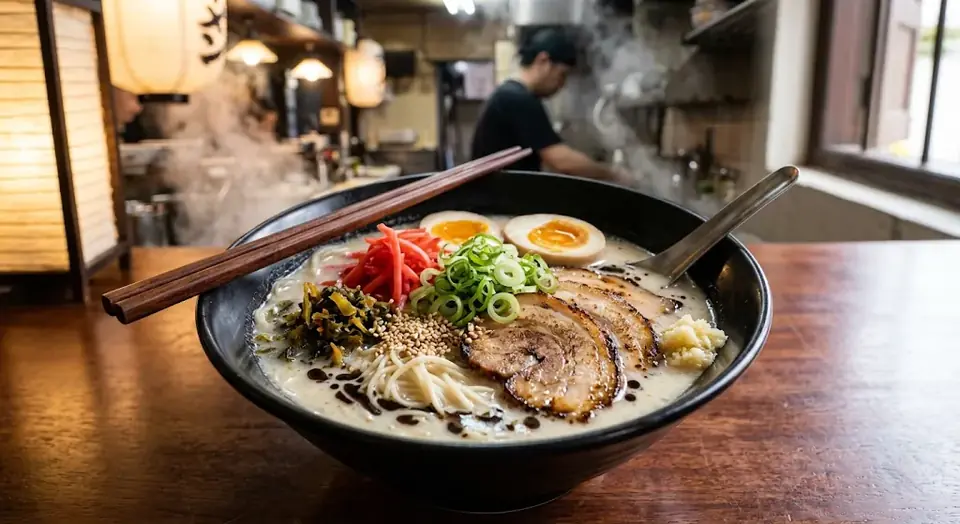
Put 30 ml of tare in each emptied, dried bowl, ladle over 400 ml of near-boiling broth, stir once and lay in the noodles. Top with chashu, beni shōga, spring onion and sesame, and serve with crushed garlic and karashi takana on the table for those who want them.
Cook’s notes
- The technique
- Name what you are making and the contradiction dissolves. A clear broth is an infusion, protected by keeping fat and coagulated protein intact so they can be skimmed or strained away. Tonkotsu is an emulsion, built by destroying them: twelve hours of violence breaks fat into droplets and collagen into gelatin, and the gelatin then acts as the emulsifier holding those droplets suspended. That is why the pot must never drop below a boil, why you top up with boiling water, and why muslin would undo the day's work.
- Make ahead
- The broth keeps five days chilled — it sets to a firm jelly, which is the sign you did it right — and six months frozen. Reheat it hard, whisking, since it separates on standing. Tare keeps two months, chashu four days and slices better cold. Hakata shops run yobimodoshi, adding fresh bones daily; at home, freeze in portions.
- Troubleshooting
- Broth thin and gray rather than white — the pot dropped to a simmer, or there were too few trotters; collagen-rich joints are what emulsify. Bitter and flat — the aromatics went in early, or it scorched at the base; stir the bottom occasionally. Broth split into fat and water on reheating — whisk it hard over heat and it comes back.
- Variations
- Kumamoto's version finishes with mayu, black garlic oil, and a little milk. Kagoshima's is sweeter and often cut with chicken bones. Kurume keeps it the most intense of all. A tori paitan, made the same way with chicken carcasses and wings, needs only 4–5 hours of hard boiling for the same white broth and a lighter finish.
- To serve and keep
- Serve in preheated bowls with the noodles ordered hard, and eat fast — thin strands soften within about three minutes. Ask for kaedama while there is still broth left rather than after. Cold barley tea, a lager, or the shōchū that Fukuoka drinks with it. Made in full within this recipe — Tonkotsu Paitan Broth, Salt and Soy Tare, Hakata Chashu. Also listed in the Component Index at the back.

Where it comes from
Kurume, a river town in Fukuoka prefecture, is where this broth was found rather than invented. A yatai called Nankinsenryō opened there in 1937 selling Chinese-style noodles in a clear pork broth, and the white version is said to have appeared about a decade later when a pot was left at a full boil by accident. Every account repeats that story, and it is tidier than most origins deserve; treat it as tradition rather than record. The style travelled north to Fukuoka city, where the stalls of the Nagahama fish market shaped everything else about the bowl. Market workers wanted to eat in minutes, so the noodles were drawn thin and straight to cook in under a minute, and portions were cut small — which produced kaedama, the extra swirl of noodles ordered mid-bowl and dropped into the broth you have left. Firmness became a vocabulary: futsū, katame, barikata, harigane, each a shorter dip in the water. From the 1980s Hakata chains carried the bowl worldwide, and it is now what most people abroad mean by ramen.
Tonkotsu-Style Ramen: quick answers
How long does Tonkotsu-Style Ramen take?
About 13 hours.
How many does this Tonkotsu-Style Ramen recipe make?
This recipe serves 4.
Where does Tonkotsu-Style Ramen come from?
Kurume, a river town in Fukuoka prefecture, is where this broth was found rather than invented. A yatai called Nankinsenryō opened there in 1937 selling Chinese-style noodles in a clear pork broth, and the white version is said to have appeared about a decade later when a pot was left at a full boil by accident. Every account repeats that story, and it is tidier than most origins deserve; treat it as tradition rather than record. The style travelled north to Fukuoka city, where the stalls of the Nagahama fish market shaped everything else about the bowl. Market workers wanted to eat in minutes, so the noodles were drawn thin and straight to cook in under a minute, and portions were cut small — which produced kaedama, the extra swirl of noodles ordered mid-bowl and dropped into the broth you have left. Firmness became a vocabulary: futsū, katame, barikata, harigane, each a shorter dip in the water. From the 1980s Hakata chains carried the bowl worldwide, and it is now what most people abroad mean by ramen.
More from Japan

More in Broths & Noodle Soups


https://www.atlasserie.com/recipes/soup/tonkotsu-style-ramen/