Japan · Ichijū-sansai · 36.01° N, 136.71° E
Japanese Breakfast
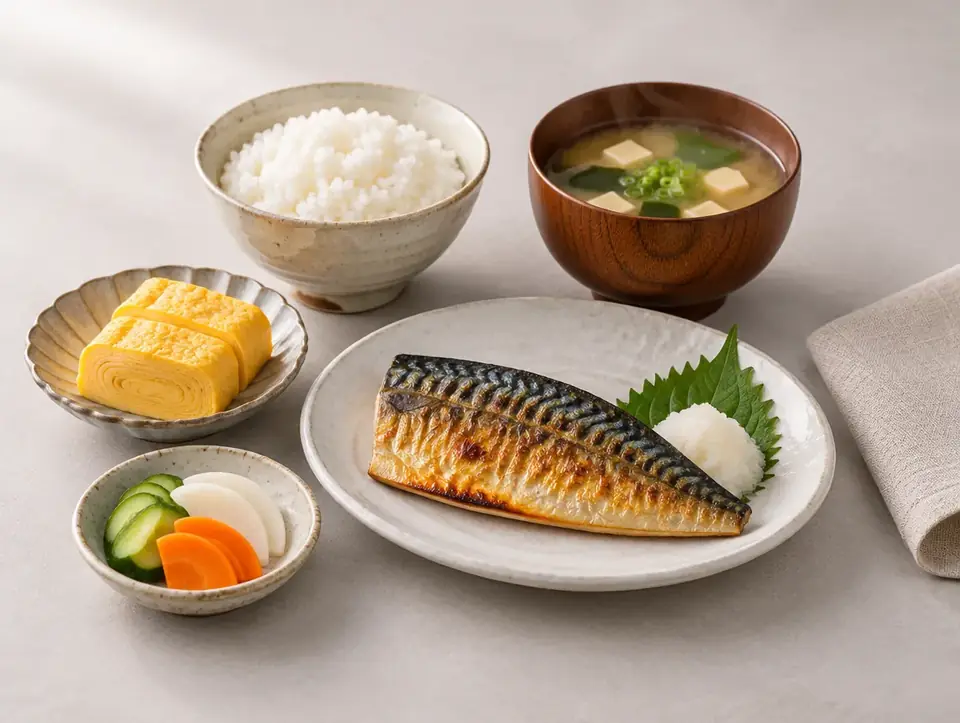
One soup, three sides: rice, grilled mackerel, rolled egg and pickles.
At a glance.
Japanese Breakfast comes from Japan · Ichijū-sansai and appears in The Breakfast Atlas, in the chapter Breakfast Around the World. It serves 2, takes about 1 hr, and uses 21 ingredients and 10 steps.
- Yield
- Serves 2
- Method
- Stovetop
- Time
- 1 hr
Ingredients
Tap an ingredient to tick it off.
- For the awase dashi
- For the miso soup
- For the tamagoyaki
- For the fish, rice and sides
Method
-
Soak the kombu in the cold water for 30 minutes, then bring it slowly to 60–70°C over 10 minutes and lift it out just before the water trembles. Boiled kombu turns the dashi slippery and faintly bitter.
-
Bring the liquid to a boil, kill the heat, and scatter in the katsuobushi. Leave it 90 seconds until the flakes sink, then strain through muslin without pressing. Pressing clouds the dashi and drags out astringency.
-
Salt the mackerel fillets on both sides and leave them skin-side up on a rack for 20 minutes. The salt draws out surface moisture, which is what lets the skin crisp rather than steam under the grill.
-
Cook the rinsed rice with its water, covered, 12 minutes at a bare simmer, then 10 minutes off the heat without lifting the lid. Fluff it with a cutting motion, never a stir, to keep the grains separate.
-
Whisk the tamagoyaki eggs with the dashi, soy, sugar and salt. Warm a rectangular makiyakinabe over medium-low heat and wipe it with oiled paper until it barely shines.
-
Pour in a third of the mixture, tilt to coat, and when the surface is just set but still tacky, roll the sheet toward you in three folds. Oil the empty pan, push the roll back, and pour the next third under and around it.
-
Repeat twice more. The finished block should be pale yellow with no browning, layered like sedimentary rock when cut. Turn it onto a bamboo mat, shape it square, and rest 5 minutes before slicing into 2 cm pieces.
-
Grill the mackerel skin-side up, 8 cm from a hot element, for 6–7 minutes, then turn and give it 3 minutes more. It is done when the skin blisters and splits and the flesh flakes cleanly at the thickest point.
-
Heat the remaining dashi to just below a simmer. Ladle a little into a bowl, whisk the miso into it until smooth, then return that slurry to the pan with the tofu and wakame. Never let miso boil — it dulls the aroma within seconds.
-
Stir each pack of nattō vigorously forty or fifty times with chopsticks until it turns pale and ropy, then add its tare and mustard and stir again. Set out rice, soup, fish, tamagoyaki, pickles and nattō together, and eat by moving between them.
Cook’s notes
- The technique
- Dashi is the whole tray's foundation, and it is made by restraint. Kombu releases glutamates steadily below 70°C but gives up alginates and bitterness above it; katsuobushi surrenders its inosinates in seconds and turns fishy if simmered. Hold the kombu under the boil, steep the flakes for 90 seconds, strain without pressure, and the resulting stock carries the soup, seasons the tamagoyaki and needs almost nothing else.
- Make ahead
- Dashi keeps three days refrigerated and freezes in ice-cube trays for two months. Salt the fish the night before, uncovered on a rack. Tamagoyaki is good cold and is standard bentō food, so make it a day ahead. Cook rice fresh; reheated rice is the one component that shows.
- Troubleshooting
- Cloudy, bitter dashi — the kombu boiled or the bonito was pressed. Browned, rubbery tamagoyaki — pan too hot, so drop the heat and accept slower rolling. Grainy miso soup — the paste went in undissolved. Fish welded to the grill — the rack was cold and unoiled.
- Variations
- Salted salmon, shiozake, is the most common alternative to mackerel and keeps far longer. Tamago kake gohan — a raw egg beaten into hot rice with soy — replaces the omelette in many households. Ryokan trays add hōba-yaki miso grilled on a magnolia leaf in Gifu, or onsen tamago cooked slowly in hot-spring water.
- Serve with
- Green tea, usually sencha, or roasted hōjicha in the morning. Grated daikon goes beside the fish to cut its oil, and a torn sheet of nori with soy is used to wrap mouthfuls of rice. Serve the soup in a lacquer bowl and drink it from the rim. Made in full within this recipe — Awase Dashi, Miso Soup, Tamagoyaki. Also listed in the Component Index at the back.

Where it comes from
The shape of this tray is older than the food on it. Ichijū-sansai — one soup, three sides, arranged around a bowl of rice — descends from the formal honzen ryōri service of the Muromachi period and settled into ordinary households as the template for a balanced meal. Breakfast is where it survives most intact. Rice sits at the center and everything else is placed in relation to it: miso soup on the right, a grilled fish, a rolled omelette, a small mound of pickles, and often nattō, the fermented soybeans that mark a genuine regional divide, eaten daily around Mito in Ibaraki and regarded with more suspicion in parts of Kansai. The full version is now most reliably encountered at a ryokan, where the morning tray arrives with a dozen small dishes, a raw egg for the rice, and fish grilling over a tabletop brazier. At home the pattern persists in shortened form, and the postwar rise of bread and coffee has made the rice breakfast something people choose rather than default to.
Japanese Breakfast: quick answers
How long does Japanese Breakfast take?
About 1 hr.
How many does this Japanese Breakfast recipe make?
This recipe serves 2.
Where does Japanese Breakfast come from?
The shape of this tray is older than the food on it. Ichijū-sansai — one soup, three sides, arranged around a bowl of rice — descends from the formal honzen ryōri service of the Muromachi period and settled into ordinary households as the template for a balanced meal. Breakfast is where it survives most intact. Rice sits at the center and everything else is placed in relation to it: miso soup on the right, a grilled fish, a rolled omelette, a small mound of pickles, and often nattō, the fermented soybeans that mark a genuine regional divide, eaten daily around Mito in Ibaraki and regarded with more suspicion in parts of Kansai. The full version is now most reliably encountered at a ryokan, where the morning tray arrives with a dozen small dishes, a raw egg for the rice, and fish grilling over a tabletop brazier. At home the pattern persists in shortened form, and the postwar rise of bread and coffee has made the rice breakfast something people choose rather than default to.
More from Japan
More in Breakfast Around the World




https://www.atlasserie.com/recipes/breakfast/japanese-breakfast/