The Soup Atlas
Chicken Noodle Broth
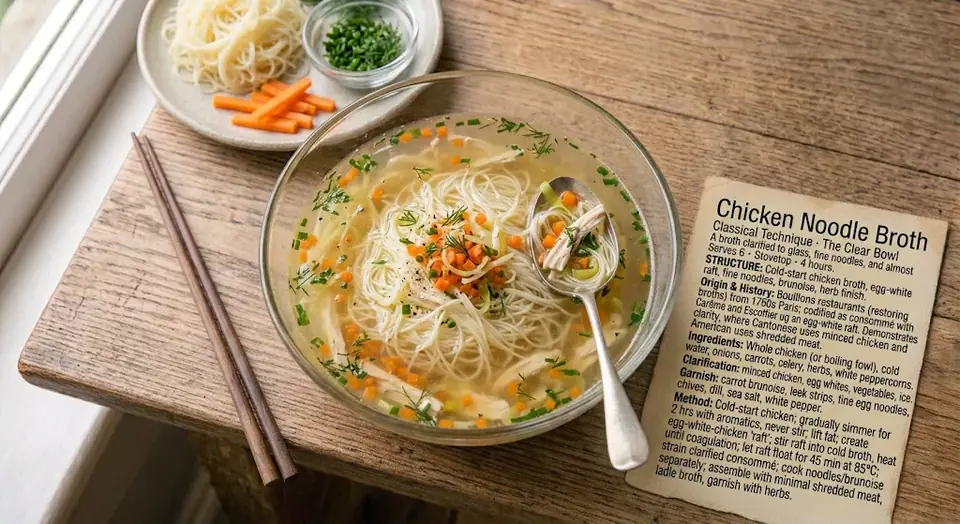
A broth clarified to glass, fine noodles, and almost nothing else.
At a glance.
Chicken Noodle Broth is a recipe from The Soup Atlas, in the chapter Broths & Noodle Soups. It serves 6, takes about 4 hours, and uses 18 ingredients and 11 steps.
- Yield
- Serves 6
- Method
- Stovetop
- Time
- 4 hours
Ingredients
Tap an ingredient to tick it off.
- For the broth
- For the clarification raft
- For the garnish
Method
-
Sit the chicken in a tall pot and pour 2.5 liters of cold water over it, enough to cover by 3 cm. Cold water leaches protein and gelatin outward slowly; water already hot seizes the surface of the bones and locks most of it in.
-
Bring it up so gradually that it takes 30 minutes to reach 85°C (185°F), where a thread of steam rises and a bubble breaks the surface every few seconds. As it heats, gray foam will gather at the rim. Lift it away with a ladle every few minutes for the first 20.
-
Add the onions, carrots, celery, herbs and peppercorns once the surface is clean. Hold that temperature for 2 hours without a lid, without stirring, and without letting it climb. Agitation is what breaks solids into particles too small to strain out.
-
Take out the breast meat after 45 minutes, when it reads 74°C (165°F) at the thickest point, and set it aside. Held longer it goes stringy, and this bowl uses only a little of it.
-
Ladle the broth out through a fine sieve lined with damp muslin, working from the top down and stopping when you reach the last inch, where every particle you spent two hours avoiding has settled. Chill it thoroughly, then lift off the solid fat cap.
-
For the raft, mix the minced breast, egg whites, chopped leek, carrot and celery with the crushed ice. The ice keeps the mixture below 5°C so the egg protein stays dissolved rather than setting the moment it meets the pot.
-
Stir the raft into the cold broth and set it over low heat, stirring slowly and continuously until it reaches 60°C (140°F). Then stop entirely. Between 60 and 80°C the proteins coagulate into a spongy mat, rise, and drag suspended particles up with them.
-
Let the raft float and hold the pot at 85°C for 45 minutes, cutting a small chimney in the mat with a ladle so liquid circulates through it. The broth beneath should be visibly transparent, pale gold, with the vegetables legible through 10 cm of it.
-
Ladle the finished consommé out through the chimney and through a fresh muslin, never tipping the pot. Season it now with the salt and white pepper — a broth reduces as it works, and salt added at the start would have concentrated into something unusable.
-
Simmer the carrot brunoise and leek strips in a little of the broth for 4 minutes, until tender with a trace of bite. Cook the noodles in a separate pan of salted water, drain them and rinse briefly so their starch does not travel into the bowl.
-
Divide the noodles, a spoonful of the brunoise and a little shredded breast between six warmed bowls — a scant handful in each, no more. Ladle over the hot broth, scatter chives and dill, and serve while the surface still steams.
Cook’s notes
- The technique
- Clarity has two enemies and both are mechanical. Fat, agitated at a boil, shears into droplets small enough to stay suspended and turns a broth opaque and greasy; coagulated protein, broken up by stirring or a rolling surface, does the same in gray. Every rule here follows from that — the cold start, the slow climb, the 85°C ceiling, the ladle instead of the pour. The raft is insurance rather than magic: it works because coagulating egg protein forms a physical filter, and it cannot rescue a broth that was boiled.
- Make ahead
- The unclarified broth keeps five days chilled and six months frozen; clarify it on the day you serve, since the finished consommé loses aroma within about forty-eight hours. Keep the fat you skim for another dish. Reheat gently to a shade under a simmer. Noodles are cooked to order and will bloat and cloud the bowl if they sit in it.
- Troubleshooting
- Broth cloudy after clarification — it went above a bare simmer and the raft broke up, or it was stirred after 60°C. Raft sank instead of rising — the mixture was warm when it went in, or there was not enough egg white for the volume. Broth clear but flat — this is a lean, restrained soup and it needs salt, added at the end and tasted hot rather than warm.
- Variations
- Poach a whole egg in each bowl for a fuller course, or float a few slices of blanched shiitake for a savory lift. Consommé double, reduced by a third before clarifying, is served as a small course in its own right. For a Chinese reading, replace the raft with minced chicken alone, add ginger and Shaoxing wine, and serve with the fine wheat noodles used at recipe 60.
- To serve and keep
- Serve in shallow, wide bowls or in handled consommé cups, where clarity is visible from above. No bread and no cream — anything fatty on the surface undoes the point. A dry sherry, an aged fino in particular, is the classical partner, or a cup of the broth itself before a meal. Made in full within this recipe — Clarified Chicken Broth, Egg-White Clarification Raft, Vegetable Brunoise. Also listed in the Component Index at the back.
Where it comes from
Restorative broth is where the restaurant itself begins. Parisian traders in the 1760s sold bouillons restaurants — restoring broths — to customers who considered themselves too delicate for a table d'hôte, and the room took its name from the soup rather than the other way round; the tale of a soup seller named Boulanger founding the first is repeated everywhere and was dismantled by the historian Rebecca Spang in 1999. The technique matured alongside the institution. Carême and then Escoffier, whose Guide Culinaire of 1903 lists consommés by the dozen, codified clarification with a raft of egg white and lean meat, and parallel methods exist elsewhere: Cantonese kitchens sweep a stock clear with minced chicken, Japanese cooks hold a chintan below a simmer and never clarify at all. This bowl belongs to that discipline rather than to the household tradition. The American chicken noodle soup at recipe 2 is a full meal of shredded meat and vegetables; this one is broth as a demonstration, and everything not essential has been taken out of it.
Chicken Noodle Broth: quick answers
How long does Chicken Noodle Broth take?
About 4 hours.
How many does this Chicken Noodle Broth recipe make?
This recipe serves 6.
Where does Chicken Noodle Broth come from?
Restorative broth is where the restaurant itself begins. Parisian traders in the 1760s sold bouillons restaurants — restoring broths — to customers who considered themselves too delicate for a table d'hôte, and the room took its name from the soup rather than the other way round; the tale of a soup seller named Boulanger founding the first is repeated everywhere and was dismantled by the historian Rebecca Spang in 1999. The technique matured alongside the institution. Carême and then Escoffier, whose Guide Culinaire of 1903 lists consommés by the dozen, codified clarification with a raft of egg white and lean meat, and parallel methods exist elsewhere: Cantonese kitchens sweep a stock clear with minced chicken, Japanese cooks hold a chintan below a simmer and never clarify at all. This bowl belongs to that discipline rather than to the household tradition. The American chicken noodle soup at recipe 2 is a full meal of shredded meat and vegetables; this one is broth as a demonstration, and everything not essential has been taken out of it.
More in Broths & Noodle Soups

https://www.atlasserie.com/recipes/soup/chicken-noodle-broth/