Uji & Nishio, Japan · Tencha and the Stone Mill · 36.01° N, 136.71° E
Matcha Latte
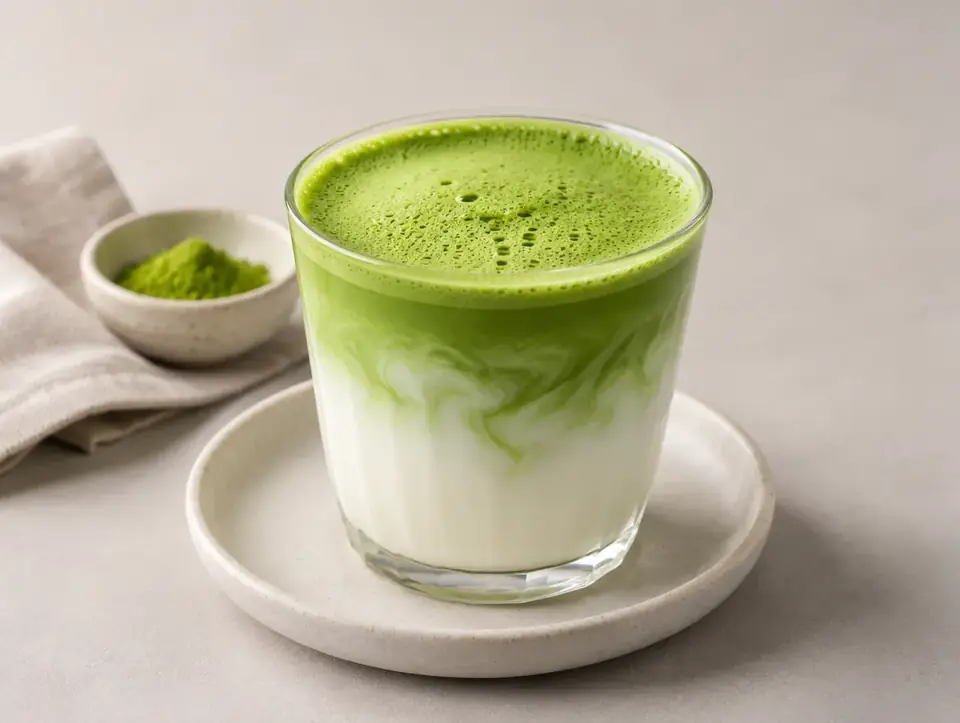
Sifted matcha whisked to a jade foam, milk held below sixty-five degrees.
At a glance.
Matcha Latte comes from Uji & Nishio, Japan · Tencha and the Stone Mill and appears in The Breakfast Atlas, in the chapter Smoothies & Breakfast Drinks. It serves 1, takes about 10 minutes, and uses 6 ingredients and 10 steps.
- Yield
- Serves 1
- Method
- Stovetop
- Time
- 10 minutes
Ingredients
Tap an ingredient to tick it off.
Method
-
Judge the powder before you use it. Good matcha is vivid green, smells sweet and marine, and clings to the side of the tin. A dull khaki color and a hay smell mean old stock or leaf ground with stem still in it.
-
Sift the 4 g through a fine tea strainer into a wide bowl, pushing it through with a spoon. Matcha particles run five to ten microns across and cling together by static; no amount of whisking will break a clump that sifting would have prevented.
-
Soak the tines of the chasen in warm water for 30 seconds. Dry bamboo is brittle and snaps, and a whisk with broken tines leaves splinters in the bowl.
-
Bring water to the boil and let it stand until it reaches 70–80°C, about two minutes in an open jug. Hotter water pulls catechins hard and scorches the powder, giving bitterness and a stewed, flat smell.
-
Pour 60 ml over the powder and whisk in a brisk W or M motion, driving from the wrist with the tines skimming barely clear of the base. Fifteen to twenty seconds is enough.
-
Do not stir in circles. A circular motion pushes the powder outward and packs it against the wall of the bowl, and the froth that results is coarse and short-lived.
-
Look for a fine, even layer of small bubbles across the whole surface. Draw the whisk slowly across to burst any large ones, then lift it straight out from the center.
-
Heat the milk to 60–65°C, steaming it if you can or warming it in a pan and frothing with a hand whisk. Stir the honey into the hot milk, not into the tea, where it would drag the powder back into clumps.
-
Pour the milk into a warmed glass and the matcha over it in a slow stream, or reverse the order for a layered look. Add the pinch of salt, which sharpens the tea against the milk.
-
Drink it promptly. Matcha is a suspension, not an infusion, and the powder begins settling to the bottom within two or three minutes; give it a stir halfway down.
Cook’s notes
- The technique
- Two things decide whether this tastes like tea or like a green milkshake with grit in it. The first is sifting, which is not fussiness — matcha clumps are hydrophobic little pellets that whisking merely chases around the bowl. The second is water temperature. Below 80°C you extract the amino acids, chiefly theanine, that give the savory sweetness; above it you pull catechins and caffeine forward and the cup turns bitter and drying.
- Make ahead
- Matcha oxidizes quickly once opened. Buy 20–30 g tins rather than large bags, keep them sealed in the fridge, bring the tin to room temperature before opening so no moisture condenses inside, and finish it within a month. The drink itself will not hold; it separates.
- Troubleshooting
- Grit at the bottom of the glass — the powder was not sifted. Bitter and astringent — water too hot, or too much powder for the liquid. Olive-drab color and a flat smell — the tin is old. No foam — a worn whisk, a bowl too narrow for the whisk to move, or an arm motion instead of a wrist one.
- Variations
- Usucha, thin tea, is 2 g whisked into 70 ml and drunk alone. Koicha, thick tea, uses 4 g to barely 30 ml and is kneaded rather than whisked into something the consistency of paint, and it demands the best powder you can find. An iced version goes into a sealed shaker with cold water and ice, then over cold milk. Kyoto cafés sweeten with kuromitsu and dust the top with roasted soybean flour.
- Serve with
- A small sweet alongside is traditional and practical — wagashi, a piece of dried persimmon, or shortbread, since the sugar softens the tea's astringency. Serve a glass of plain water with it. Morning is the right time; the caffeine is substantial.

Where it comes from
Powdered tea reached Japan from Song China, and the monk Eisai is credited with bringing both the seeds and the practice of whisking tea home around 1191. Uji, south of Kyoto, contributed the step that matters most: shading the bushes under reed and straw screens for several weeks before picking, a technique developed there by the sixteenth century. Shaded leaves make more chlorophyll and hold more amino acids, which is where matcha's color and its savory sweetness come from. Those leaves, steamed and dried flat without rolling, then stripped of stem and vein, are tencha; ground between granite wheels turning at around thirty revolutions a minute, tencha becomes matcha at a rate of roughly 40 g an hour, which explains the price. Nishio, in Aichi, traces its tea to a thirteenth-century temple planting and has been a major commercial producer since the 1870s. Chanoyu, the tea gathering formalized in the sixteenth century and shaped above all by Sen no Rikyū, has no place for milk; the latte is a café drink of the last thirty years and a frank departure.
Matcha Latte: quick answers
How long does Matcha Latte take?
About 10 minutes.
How many does this Matcha Latte recipe make?
This recipe serves 1.
Where does Matcha Latte come from?
Powdered tea reached Japan from Song China, and the monk Eisai is credited with bringing both the seeds and the practice of whisking tea home around 1191. Uji, south of Kyoto, contributed the step that matters most: shading the bushes under reed and straw screens for several weeks before picking, a technique developed there by the sixteenth century. Shaded leaves make more chlorophyll and hold more amino acids, which is where matcha's color and its savory sweetness come from. Those leaves, steamed and dried flat without rolling, then stripped of stem and vein, are tencha; ground between granite wheels turning at around thirty revolutions a minute, tencha becomes matcha at a rate of roughly 40 g an hour, which explains the price. Nishio, in Aichi, traces its tea to a thirteenth-century temple planting and has been a major commercial producer since the 1870s. Chanoyu, the tea gathering formalized in the sixteenth century and shaped above all by Sen no Rikyū, has no place for milk; the latte is a café drink of the last thirty years and a frank departure.
More from Japan

More in Smoothies & Breakfast Drinks



https://www.atlasserie.com/recipes/breakfast/matcha-latte/