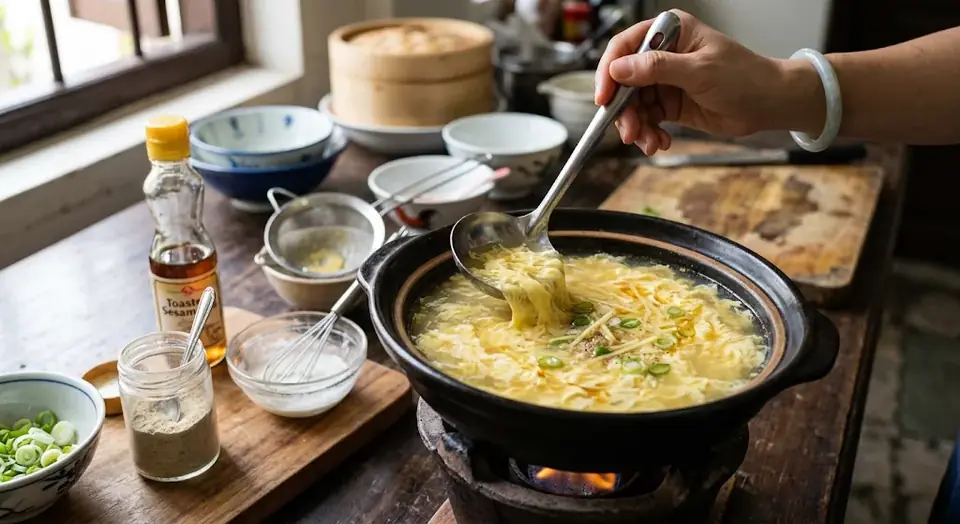
China · Dàn Huā Tāng · 36.75° N, 103.42° E
Egg Drop Soup
Egg poured in a thread through thickened broth, set as ribbons not curds.
At a glance.
Egg Drop Soup comes from China · Dàn Huā Tāng and appears in The Soup Atlas, in the chapter Broths & Noodle Soups. It serves 4, takes about 25 minutes, and uses 15 ingredients and 10 steps.
- Yield
- Serves 4
- Method
- Stovetop
- Time
- 25 minutes
Ingredients
Tap an ingredient to tick it off.
- For the broth
- For the slurry
- For the egg
- To finish
Method
-
Bring the stock to a simmer with the ginger matchsticks, spring onion white and wine, and let it infuse for 8 minutes so the ginger gives up its heat into the liquid. Fish out the spring onion. Season with the salt and sugar and taste it now, while you can still fix it.
-
Whisk the cornstarch into the cold water until no grains remain and the mixture pours like thin cream. Starch mixed into hot liquid seizes on contact and forms lumps that never break down; cold water separates the granules first.
-
Stir the slurry into the simmering stock in a steady stream and cook for 2 minutes, stirring, until the soup thickens a shade and gains a faint gloss. It should still be soup, not sauce — a spoon dragged through it should leave a trail that closes over slowly.
-
Beat the eggs thoroughly with the tablespoon of water and the pinch of salt, until the whites and yolks are one uniform color with no clear strands left. Then pass them through a fine sieve, pressing the last of the chalazae through with a spoon.
-
Add the peas or corn now if you are using them, and let them heat through for a minute. Nothing should go into the pot after the egg.
-
Drop the heat until the surface is barely moving — 80–85°C (175–185°F), steaming with no bubble breaking. This window decides everything. Below about 70°C the egg disperses into the liquid and clouds it into something gray; at a boil, turbulence tears the setting protein into curds.
-
Stir the soup slowly in one direction to set up a lazy whirlpool, then hold the bowl of egg 25–30 cm above the pot and pour in the thinnest thread you can manage, moving the stream across the surface as it falls.
-
Height is doing real work here. A thread falling that far stretches thin and hits water already moving, so it sets in long sheets; poured from the rim, the same egg lands as a blob and sets as a lump.
-
Stop stirring the moment the egg is in and count to ten without touching the pot. The protein needs those seconds undisturbed to set; a spoon through it now is the difference between ribbons and scrambled egg, and it is the mistake almost everyone makes.
-
Fold once, gently, to distribute the ribbons, then take the pan off the heat. Stir in the sesame oil and white pepper, check the salt, and ladle into warmed bowls with the spring onion rings scattered over. Serve straight away, while the ribbons still float.
Cook’s notes
- The technique
- The starch is not there for body, or not mainly. Thickened broth is more viscous, so the egg falls through it slowly and the set ribbons stay in suspension instead of sinking and clumping on the base of the pot; it also buffers the convection currents that would otherwise tear them. Combine that with the temperature window and the pouring height and the whole thing becomes mechanical rather than intuitive: viscous liquid, barely moving, egg arriving thin and fast, then absolute stillness for ten seconds while ovalbumin coagulates around 80°C.
- Make ahead
- The stock can be seasoned and infused with ginger up to three days ahead, and freezes well. Thickening and egg are done at the moment of serving, without exception — a finished soup left to stand goes watery as the starch relaxes and the egg toughens, and reheating turns the ribbons rubbery. Total time from cold stock to table is under ten minutes.
- Troubleshooting
- Egg in dense lumps at the bottom — the broth was boiling, or it was stirred immediately after pouring. Soup cloudy with no visible ribbons — the liquid was too cool, so the egg dissolved rather than set. Thin and watery after five minutes — too little starch, or it was not cooked for the full two minutes needed to gelatinize. Gluey — too much.
- Variations
- Add torn tomato and a dash of vinegar for the northern Chinese home version. West Lake beef gēng builds the same base with minced beef, egg white only, and coriander. A tomato-and-egg soup with a little sesame oil is the Beijing weeknight standard. For a Roman reading, whisk grated Parmesan and semolina into the egg and drop it into a clear meat broth.
- To serve and keep
- Serve in small bowls as a first course or alongside a rice dish, with a spoon rather than chopsticks. A little chile oil or black vinegar on the table for those who want it. Green tea, or plain hot water in the Chinese manner; it is too delicate for beer. Made in full within this recipe — Ginger Chicken Broth, Starch Slurry, Sieved Egg. Also listed in the Component Index at the back.

Where it comes from
Dàn huā tāng means egg flower soup, and the name describes the target: egg suspended in petals rather than lumps. It has no origin story worth reporting, because it belongs to home cooking rather than to any restaurant tradition — a fast soup made from stock, an egg and whatever aromatics are at hand, cooked in Chinese kitchens across every region without anyone claiming it. It sits at the plain end of the gēng family, the starch-thickened soups that also include Hangzhou's West Lake beef gēng and the hot and sour soup at recipe 70. The same problem — how to get raw egg into hot liquid without scrambling it — is solved three different ways across the world's kitchens: Roman stracciatella tears it into rags with cheese and breadcrumb, Greek avgolemono at recipe 98 tempers it into a smooth liaison that leaves no visible egg at all, and this soup aims for the middle, wanting the egg seen but not felt. American takeout menus made it famous in a thickened, faintly yellow version that is not quite anyone's home cooking.
Egg Drop Soup: quick answers
How long does Egg Drop Soup take?
About 25 minutes.
How many does this Egg Drop Soup recipe make?
This recipe serves 4.
Where does Egg Drop Soup come from?
Dàn huā tāng means egg flower soup, and the name describes the target: egg suspended in petals rather than lumps. It has no origin story worth reporting, because it belongs to home cooking rather than to any restaurant tradition — a fast soup made from stock, an egg and whatever aromatics are at hand, cooked in Chinese kitchens across every region without anyone claiming it. It sits at the plain end of the gēng family, the starch-thickened soups that also include Hangzhou's West Lake beef gēng and the hot and sour soup at recipe 70. The same problem — how to get raw egg into hot liquid without scrambling it — is solved three different ways across the world's kitchens: Roman stracciatella tears it into rags with cheese and breadcrumb, Greek avgolemono at recipe 98 tempers it into a smooth liaison that leaves no visible egg at all, and this soup aims for the middle, wanting the egg seen but not felt. American takeout menus made it famous in a thickened, faintly yellow version that is not quite anyone's home cooking.
More from China
More in Broths & Noodle Soups


https://www.atlasserie.com/recipes/soup/egg-drop-soup/