The Soup Atlas
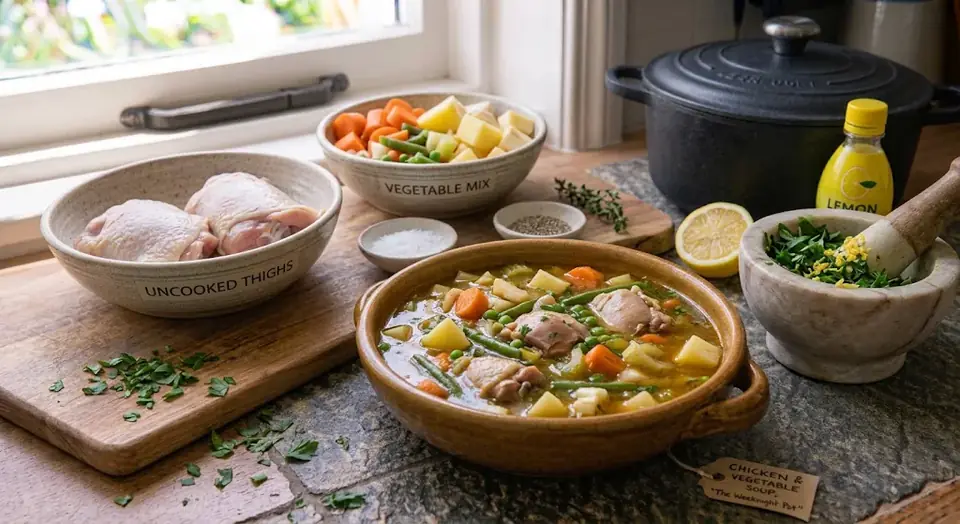
Chicken and Vegetable Soup
No noodles, no cream: chicken and root vegetables in their own browned broth.
At a glance.
Chicken and Vegetable Soup is a recipe from The Soup Atlas, in the chapter Classic & Everyday Soups. It serves 6, takes about 1 hr 15 min, and uses 18 ingredients and 11 steps.
- Yield
- Serves 6
- Method
- Stovetop
- Time
- 1 hr 15 min
Ingredients
Tap an ingredient to tick it off.
- For the browned chicken base
- For the vegetables
- For the parsley and lemon finish
Method
-
Pat the thigh skin thoroughly dry and salt it. Lay the pieces skin-side down in a cold, wide, heavy pot and set it over medium heat. Starting cold lets the fat render out slowly instead of seizing, and it gives you a full pan of clean chicken fat to cook in.
-
Leave them alone for 10–12 minutes. The skin releases itself from the metal when it is ready; if it sticks, it is not done. You want it deep gold and crisp, with a brown crust forming on the base of the pot beneath.
-
Lift the thighs out onto a plate and pour off all but 2 tablespoons of the fat. Add the diced onion and cook for 6 minutes over medium heat, scraping steadily, until the onion's moisture has loosened every brown scrap from the base.
-
Stir in the garlic for a further minute, then return the chicken skin-side up with any juices from the plate, add the stock, bay and thyme, and bring it to a gentle simmer with the surface barely moving.
-
Simmer for 30 minutes, until the thigh meat pulls easily from the bone and reads 74°C (165°F) at the thickest point. Lift the pieces out, discard the skin and bones, and pull the meat into rough bite-sized pieces rather than fine shreds.
-
Skim the surface fat with a wide spoon, taking most but not all of it — a film of chicken fat carries aroma and gives the broth its shine. Discard the bay and thyme stalks, which have finished their work.
-
Now stage the vegetables. Add the carrot, potato and turnip first and simmer them for 10 minutes, until a knife tip meets a little resistance at the center of a potato cube but slides in without any force behind it.
-
Add the celery and green beans and cook for 5 minutes more. Celery loses its structure fast and green beans go from squeaky to olive-gray within a couple of minutes of being overdone.
-
Stir in the peas and the pulled chicken and give it 2 minutes, no longer — long enough for both to heat through and no longer than the peas can take without going dull and mealy.
-
Season now, in stages, tasting between each addition. A pot this size takes about a teaspoon and a half of salt; it should taste savory and slightly under-seasoned, since the lemon is about to lift everything.
-
Off the heat, stir through the parsley, lemon zest, juice and black pepper. Let it sit 5 minutes before serving, which gives the broth time to draw a little starch from the potato and stop tasting like separate ingredients.
Cook’s notes
- The technique
- Everything this pot has comes from the first ten minutes. Chicken skin laid into a cold pan renders slowly, so the fat leaves the skin instead of the skin seizing against hot metal, and what welds itself to the base afterward is fond — a lacquer of caramelized protein and sugar. Left alone it scorches; dissolved by the water the onions give up, it becomes the backbone of a broth built with no cube, no wine and no cream. Brown the skin even if you intend to throw it away, because what it leaves behind stays in the pot.
- Make ahead
- This holds three days refrigerated and reheats better than most because there is no dairy or pasta in it. The potatoes soften a little further overnight, which is no loss. It freezes for two months, though potato turns slightly grainy on thawing; use waxy varieties or leave them out and add fresh on reheating. Add the parsley and lemon after reheating, never before.
- Troubleshooting
- Broth tastes of nothing — the skin was not browned, so there was no fond to build on. Vegetables gone to pulp — everything went in at once, or the pot boiled instead of simmering. Greasy on the lips — too little fat was skimmed after the simmer. Flat at the end despite salt — it needed acid, not more salt; another teaspoon of lemon juice fixes it.
- Variations
- Cock-a-leekie replaces onion with a heap of sliced leek and adds a handful of soaked prunes for sweetness. A Provençal turn stirs a spoonful of garlic and basil paste into each bowl. For a bigger pot, add 100 g of pearl barley with the stock and give it 40 minutes, accepting that the broth will thicken and cloud as the barley works.
- To serve and keep
- Serve in wide bowls with a spoon and a fork, since the chunks warrant it. Crusty bread and salted butter, or buttered soda bread. A light beer suits it better than wine; if wine, an unoaked white with enough acidity to match the lemon. Made in full within this recipe — Browned Chicken Base, Parsley and Lemon Finish. Also listed in the Component Index at the back.
Where it comes from
For most of the last five centuries a chicken in the pot meant a household doing well. Hardouin de Péréfixe, writing a life of Henri IV in 1661, put into the long-dead king's mouth the wish that no peasant in his realm should be so poor as to lack a bird for his Sunday pot — an attribution made half a century after the fact, and treated by historians as a summary of the king's reputation rather than a quotation. The phrase had legs. A 1928 Republican campaign advertisement promised a chicken in every pot and hung the slogan permanently on Herbert Hoover, who never said it. Chicken only became weekday food after the Second World War, when intensive broiler farming collapsed the price, and it is from that moment that the chunky, unthickened chicken-and-vegetable pot became genuinely everyday cooking in Britain and America alike. Its older relatives are still around: Scottish cock-a-leekie with its leeks and prunes, the French poule au pot, the Ashkenazi Sabbath bird. This is the domestic version of all of them, with nothing to hide behind.
Chicken and Vegetable Soup: quick answers
How long does Chicken and Vegetable Soup take?
About 1 hr 15 min.
How many does this Chicken and Vegetable Soup recipe make?
This recipe serves 6.
Where does Chicken and Vegetable Soup come from?
For most of the last five centuries a chicken in the pot meant a household doing well. Hardouin de Péréfixe, writing a life of Henri IV in 1661, put into the long-dead king's mouth the wish that no peasant in his realm should be so poor as to lack a bird for his Sunday pot — an attribution made half a century after the fact, and treated by historians as a summary of the king's reputation rather than a quotation. The phrase had legs. A 1928 Republican campaign advertisement promised a chicken in every pot and hung the slogan permanently on Herbert Hoover, who never said it. Chicken only became weekday food after the Second World War, when intensive broiler farming collapsed the price, and it is from that moment that the chunky, unthickened chicken-and-vegetable pot became genuinely everyday cooking in Britain and America alike. Its older relatives are still around: Scottish cock-a-leekie with its leeks and prunes, the French poule au pot, the Ashkenazi Sabbath bird. This is the domestic version of all of them, with nothing to hide behind.
More in Classic & Everyday Soups
https://www.atlasserie.com/recipes/soup/chicken-and-vegetable-soup/