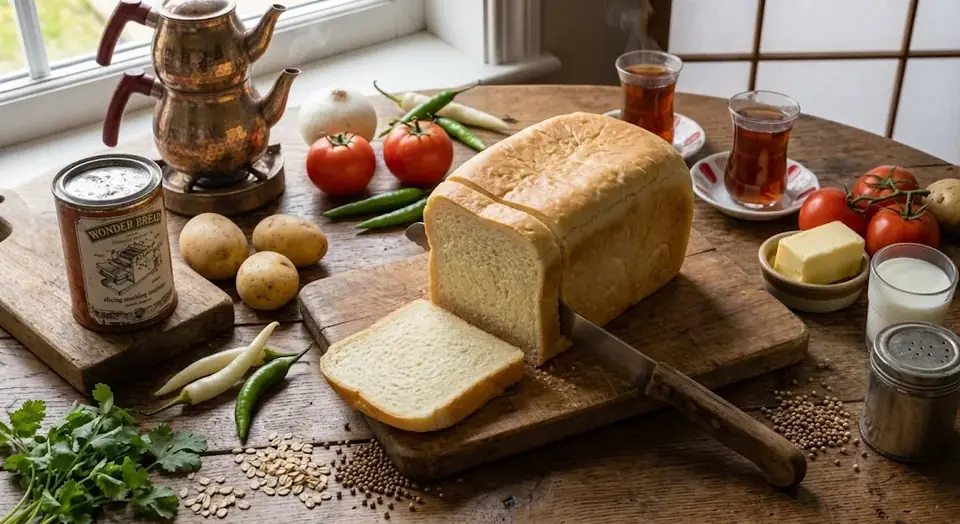
United States · The Pullman Tin · 39.87° N, 98.73° W
Soft White Sandwich Bread
A square milk loaf with a thin crust, cut for sandwiches.
At a glance.
Soft White Sandwich Bread comes from United States · The Pullman Tin and appears in The Bread Atlas, in the chapter Everyday Loaves & Sandwich Breads. It makes 1 Pullman loaf, takes about 4 hours, and uses 7 ingredients and 11 steps.
- Yield
- Makes 1 Pullman loaf
- Method
- Oven 190°C / 375°F
- Time
- 4 hours
Ingredients
Tap an ingredient to tick it off.
- The Dough
- Butter Glaze
Method
-
Warm the milk to 24°C and stir the sugar through until it dissolves. Whisk the flour, salt and yeast together in a wide bowl, add the milk, and mix to a rough, slightly tacky dough. Cover and rest 15 minutes.
-
Knead 8 minutes by hand or 5 on a mixer's second speed, until the dough pulls cleanly from the sides of the bowl. Add the softened butter in three pieces, kneading each in fully before the next goes in.
-
Carry on until a piece stretched between the fingers passes light without tearing. Enriched dough needs the gluten taken further than a lean one, because both fat and sugar slow the network down. Aim for a final dough temperature of 25°C.
-
Round the dough, cover, and bulk ferment 60–75 minutes at 25°C, until risen by about three-quarters. A floured finger pressed in to the first knuckle should leave a dent that fills back slowly and incompletely.
-
Butter a 21 × 10 × 10 cm lidded Pullman tin, paying attention to the runners the lid slides along — a lid glued shut by caramelized sugar is a hard thing to free from a hot loaf. Butter the underside of the lid too.
-
Turn the dough out, press it flat, and divide into three equal pieces. Roll each into a tight cylinder about 9 cm long and set them side by side in the tin, seams down. Three coils rise into one another and give a more even crumb than a single log.
-
Prove covered 45–60 minutes at 25°C, until the dough crowns about 1.5 cm below the rim. This is the one measurement that matters. Proved higher, the dough jams against the lid and bakes with a compressed, gummy band along the top.
-
Heat the oven to 190°C / 375°F with a rack in the lower third. Slide the lid fully closed and bake 35 minutes. The confined steam is what produces the flat top, the fine even crumb and the pale, thin crust.
-
Draw the lid back and check: the top should be blond rather than brown, and the internal temperature 93°C. If it needs more color, give it 3–4 minutes uncovered, no longer, or the crust thickens and the point of the loaf is lost.
-
Turn the loaf out at once — left in the tin it steams and the sides go soft and wrinkled — and brush the top and sides with melted butter while hot. The butter keeps the crust tender as it cools.
-
Cool on a rack for at least 2 hours before slicing. Cut warm, this loaf drags and compresses under the knife; cooled, it slices thin enough to see light through and holds a sandwich without tearing.
Cook’s notes
- To serve and keep
- Cut 12 mm thick for sandwiches, 15 mm for toast. It is the bread for grilled cheese, for tuna salad, for a bacon sandwich, and for bread-and-butter pudding when it is three days old. Store cut-side down on a board for a day, then bag it.

Where it comes from
The square white loaf has two parents. One is French: pain de mie, almost all crumb and barely any crust, baked in a lidded tin so it can be cut into even slabs for canapés and toast. Mie means the crumb itself, and the name tells you which part of the bread was thought to matter. The other parent is American rolling stock. Bakers and pan makers have attached the Pullman name to the lidded tin since at least the early twentieth century, and the explanation usually given is that square loaves stacked efficiently in the narrow galleys of Pullman Palace Car Company dining cars. The story runs through the trade literature but no company order book has been produced to settle it, so hold it loosely. What followed is documented. Otto Frederick Rohwedder's slicing machine went into commercial use at the Chillicothe Baking Company in Missouri in July 1928, Wonder Bread was sold pre-sliced from 1930, and within a decade the soft square loaf was the default shape of American bread.
Soft White Sandwich Bread: quick answers
How long does Soft White Sandwich Bread take?
About 4 hours.
How many does this Soft White Sandwich Bread recipe make?
This recipe makes 1 Pullman loaf.
Where does Soft White Sandwich Bread come from?
The square white loaf has two parents. One is French: pain de mie, almost all crumb and barely any crust, baked in a lidded tin so it can be cut into even slabs for canapés and toast. Mie means the crumb itself, and the name tells you which part of the bread was thought to matter. The other parent is American rolling stock. Bakers and pan makers have attached the Pullman name to the lidded tin since at least the early twentieth century, and the explanation usually given is that square loaves stacked efficiently in the narrow galleys of Pullman Palace Car Company dining cars. The story runs through the trade literature but no company order book has been produced to settle it, so hold it loosely. What followed is documented. Otto Frederick Rohwedder's slicing machine went into commercial use at the Chillicothe Baking Company in Missouri in July 1928, Wonder Bread was sold pre-sliced from 1930, and within a decade the soft square loaf was the default shape of American bread.
More from United States






More in Everyday Loaves & Sandwich Breads

https://www.atlasserie.com/recipes/bread/soft-white-sandwich-bread/