
China · Guangdong and the Superior Broth · 36.75° N, 103.42° E
Wonton Soup
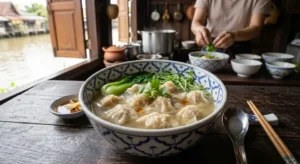
Pork and shrimp parcels with loose tails in a dried-flounder broth.
At a glance.
Wonton Soup comes from China · Guangdong and the Superior Broth and appears in The Soup Atlas, in the chapter Broths & Noodle Soups. It serves 4, takes about 3 hours, and uses 23 ingredients and 11 steps.
- Yield
- Serves 4
- Method
- Stovetop
- Time
- 3 hours
Ingredients
Tap an ingredient to tick it off.
- For the superior broth
- For the toasted flounder powder
- For the pork and shrimp filling
- To assemble
Method
-
Blanch the fowl and pork bones in boiling water for 6 minutes, then rinse them piece by piece and wash out the pot. Return them with 3.5 liters of cold water, the ham, ginger, spring onion whites and dried shrimp, and bring to 85–90°C over 30 minutes.
-
Hold the broth at that whisper of a simmer for 2½ hours, skimming the first 20 minutes and then leaving it undisturbed. Do not stir it. Ladle it out through damp muslin, leaving the last centimeter of sediment in the pot, and you should have around 2 liters.
-
Rub the dried flounder with the oil and toast it in a dry pan over medium-low heat for 4–5 minutes a side, until brittle and deep tan and the kitchen smells frankly of the sea. Cool it, break it up and grind it to a coarse powder in a spice mill.
-
Whisk half the flounder powder into the hot strained broth and let it steep for 15 minutes, then strain again. Taste: it should read savory and faintly sweet with a long marine finish. Keep the rest of the powder for another pot; it holds a month in a jar.
-
Scrub the shrimp with the salt and cornstarch for 30 seconds, rinse under cold water until it runs clear, and dry them hard on a towel. This scrub is what gives Cantonese shrimp their snap. Chop half to a rough paste and leave the rest in 1 cm pieces for texture.
-
Mix the pork with the soy, sesame oil, wine, ginger, spring onions, egg white, pepper and sugar, then stir the whole mass in one direction only for 2 full minutes until it turns sticky and pulls against the spoon. Fold in both cuts of shrimp with a few strokes.
-
Fry a teaspoon of the filling in a small pan and taste it before you commit to forty parcels. It should be assertive, since broth will mute it. Chill the bowl for 20 minutes so the fat firms and the filling stops sliding.
-
Fold Cantonese style: a heaped teaspoon of filling in the middle of a wrapper, dab the lower edge with water, fold it once over on itself and pinch tight around the ball of filling, pressing out every pocket of air. Leave the top edges loose, so each one trails a ruffled tail like a fish.
-
Bring a wide pot of unsalted water to a boil and put the broth back on a low burner. Blanch the choy sum for 90 seconds, until the stems go bright and bend, and divide it between four warmed bowls.
-
Slide in the wontons a dozen at a time, stirring once so they do not stick, and cook them for 60 seconds after they bob to the surface — about 3 minutes in all. Cooked in the broth, they would shed starch and cloud everything you spent the afternoon clarifying.
-
Lift the wontons out with a spider, draining them well, and set eight or ten in each bowl. Ladle over 400 ml of near-boiling broth, scatter spring onion greens, grind over white pepper and add two drops of sesame oil. Serve immediately.
Cook’s notes
- The technique
- Stirring the filling in one direction is not superstition. Salt dissolves myosin out of the ground pork, and consistent one-way agitation draws those long protein molecules into an aligned, tacky network that traps water and fat, so the cooked filling springs back rather than crumbling. Stir in both directions and you tear the same network apart. The visual test is unambiguous: keep going until the mass sticks to the side of the bowl when you tilt it and pulls back as a single mass rather than a heap of meat.
- Make ahead
- The broth is better made a day ahead and keeps four days chilled, three months frozen. Filled wontons freeze well on a tray, then bagged, and go into boiling water from frozen with 90 seconds added. Do not refrigerate raw filled wontons for more than a few hours — the filling weeps and the wrapper turns translucent and tears.
- Troubleshooting
- Wontons burst open — air was sealed inside, or they were overfilled, or the water was at a violent boil rather than a lively one. Filling crumbly and dry — it was underworked, or the pork was too lean. Broth gone cloudy at the last minute — the wontons were cooked in it, or the pot boiled during those two and a half hours.
- Variations
- Sichuan chāoshǒu drops the same idea into chile oil, vinegar and garlic with no broth at all. Shanghai's version is larger, folded around pork and shepherd's purse. Hong Kong shops usually serve these over thin egg noodles as wonton noodle soup, with the noodles blanched hard and rinsed to keep their alkaline bite. Shrimp-only fillings are the luxury standard and cost roughly twice as much to make.
- To serve and keep
- Serve in medium bowls, eight wontons and enough broth to float them, with a saucer of red vinegar and shredded ginger for dipping. Chile oil belongs on the side. Hot jasmine tea, or a light lager if this is dinner rather than a snack. Made in full within this recipe — Superior Broth, Toasted Flounder Powder, Pork and Shrimp Filling. Also listed in the Component Index at the back.

Where it comes from
Húntún are old. A description attributed to the sixth-century scholar Yan Zhitui speaks of a filled dumpling shaped like a crescent moon and eaten everywhere in the country, and the word itself echoes hùndùn, the formless chaos of Chinese cosmology — a resemblance later writers enjoyed and may have invented. What reached Guangdong was rewritten there. Cantonese cooks wrote the name with characters read wan tan, meaning swallowing clouds, and pulled the wrapper thinner than any northern version until the filling showed through it. By the nineteenth century wonton sellers worked the streets of Guangzhou; the trade moved to Hong Kong after 1949 and set the standard the rest of the world now copies. The broth is the second half of the tradition and the half most often skipped: seung tong, superior stock, built on old hen and pork with dried flounder and dried shrimp, marine and savory rather than merely meaty. Wontons in plain chicken stock are a different, lesser dish.
Wonton Soup: quick answers
How long does Wonton Soup take?
About 3 hours.
How many does this Wonton Soup recipe make?
This recipe serves 4.
Where does Wonton Soup come from?
Húntún are old. A description attributed to the sixth-century scholar Yan Zhitui speaks of a filled dumpling shaped like a crescent moon and eaten everywhere in the country, and the word itself echoes hùndùn, the formless chaos of Chinese cosmology — a resemblance later writers enjoyed and may have invented. What reached Guangdong was rewritten there. Cantonese cooks wrote the name with characters read wan tan, meaning swallowing clouds, and pulled the wrapper thinner than any northern version until the filling showed through it. By the nineteenth century wonton sellers worked the streets of Guangzhou; the trade moved to Hong Kong after 1949 and set the standard the rest of the world now copies. The broth is the second half of the tradition and the half most often skipped: seung tong, superior stock, built on old hen and pork with dried flounder and dried shrimp, marine and savory rather than merely meaty. Wontons in plain chicken stock are a different, lesser dish.
More from China
More in Broths & Noodle Soups


https://www.atlasserie.com/recipes/soup/wonton-soup/