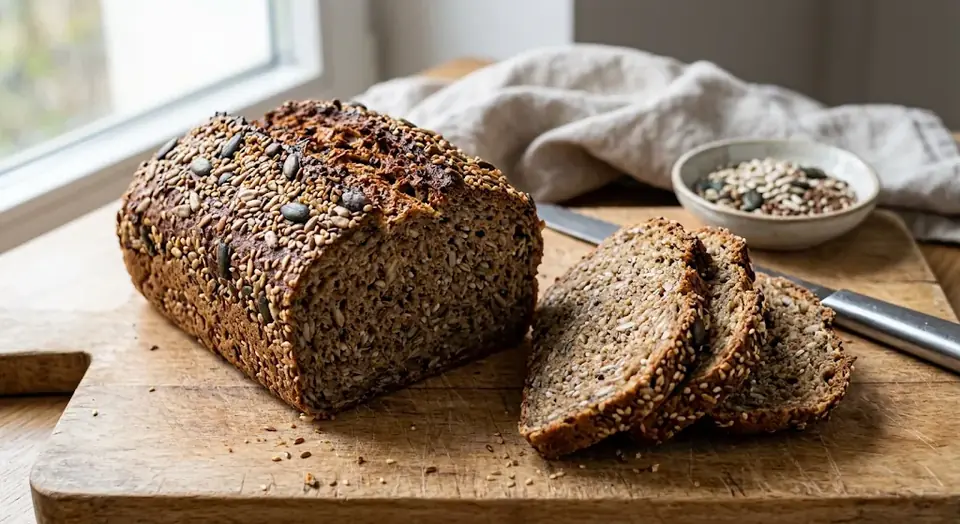
Northern Europe · The Saatenbrot · 56.00° N, 10.00° E
Seeded Whole Grain Bread
A dense grain loaf carrying nearly a third of its weight in seeds.
At a glance.
Seeded Whole Grain Bread comes from Northern Europe · The Saatenbrot and appears in The Bread Atlas, in the chapter Everyday Loaves & Sandwich Breads. It makes 1 loaf, takes about 15 hours, and uses 14 ingredients and 11 steps.
- Yield
- Makes 1 loaf
- Method
- Oven 200°C / 400°F
- Time
- 15 hours
Ingredients
Tap an ingredient to tick it off.
- Seed Soaker
- The Dough
- Seed Coating
Method
-
Make the soaker the night before, or at least 4 hours ahead. Toast the sunflower and pumpkin seeds in a dry pan until they smell nutty and one or two jump, then tip them hot into a bowl with the sesame, flax, salt and the water at 60°C.
-
Stir, cover, and leave until cold and thickened. The flax will have thrown a light gel that binds the whole mass — that gel is holding water which would otherwise be stolen from the dough, and it goes into the loaf as moisture rather than out of it.
-
Mix the two flours with the dough water at 28°C and rest 30 minutes. Add the malt syrup, salt and yeast, and knead 7 minutes to a smooth, moderately firm dough. The dough should finish at 26°C.
-
Flatten the dough, spread the entire soaker over it, fold it in on itself, and knead 2 minutes more — no longer. The aim is even distribution, not further gluten work, and hard seeds tear a developed dough if worked in aggressively.
-
Bulk ferment 75–90 minutes at 26°C with one fold at the halfway point. The dough will look bumpy rather than smooth and should rise by about two-thirds; seeded doughs never show the clean dome of a plain one.
-
Turn out, press into a rectangle, and roll into a tight cylinder for a greased 900 g tin. Seal the seam firmly. Seeds interrupt the gluten sheet, so shape with more pressure than usual to keep the loaf from splitting at the side.
-
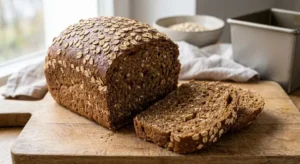
Brush the top with water and roll it through the coating seeds in a tray, pressing them on. Set seam down in the tin. Coat generously — the seeds on the crust toast in the oven and give a different, sharper flavor to the ones inside.
-
Prove 50–60 minutes at 26°C, until the loaf clears the rim by 1.5 cm and a fingertip leaves a dent that fills back most of the way. Set the oven to 200°C / 400°F and slide a steam tray onto its floor.
-
Load, add a cup of boiling water to the tray, and bake 20 minutes. Vent, then bake 25–30 minutes more. Cover the top loosely with foil if the crust seeds darken past chestnut brown; scorched sesame turns bitter fast.
-
Bake to an internal 96°C. This loaf carries a great deal of water — the soaker alone brings 150 g — and it needs the full time to set. Tapped underneath it should sound hollow and feel light for its bulk.
-
Cool at least 4 hours, and ideally overnight wrapped in a cloth. A seeded loaf cut too soon tastes wet and slices raggedly; rested, it firms into something you can shave thin.
Cook’s notes
- To serve and keep
- Cut thin and eat with butter and hard cheese, smoked fish, or a plain boiled egg — northern European habits, and correct. It stands up to strong toppings and dense spreads. Store in a cloth bag; it dries in paper and sweats in plastic.

Where it comes from
Seeds went into northern European bread for the same reason fat went into it elsewhere: they were what the ground gave. Sunflower and flax are field crops of the cool north, pumpkin seeds a byproduct of Styrian oil pressing in Austria and Slovenia, and German bakeries have long sold a whole shelf of loaves classified by their inclusions — Sonnenblumenbrot, Leinsamenbrot, Mehrkornbrot — under labeling rules specific enough to state minimum percentages. The seeded loaf reached English-speaking kitchens through a different door. Wholefood shops and co-operative bakeries of the 1960s and 70s, of which the London restaurant and bakery Cranks, opened in 1961, was among the most visible, sold heavy seeded brown bread as a matter of principle rather than tradition, and the style stuck. What the German bakeries knew and the wholefood shops often did not is that seeds must be soaked before they meet the dough. That single step is the difference between a moist loaf and a dry one.
All 3 recipes from Northern Europe
All 14 recipes from Europe
Seeded Whole Grain Bread: quick answers
How long does Seeded Whole Grain Bread take?
About 15 hours.
How many does this Seeded Whole Grain Bread recipe make?
This recipe makes 1 loaf.
Where does Seeded Whole Grain Bread come from?
Seeds went into northern European bread for the same reason fat went into it elsewhere: they were what the ground gave. Sunflower and flax are field crops of the cool north, pumpkin seeds a byproduct of Styrian oil pressing in Austria and Slovenia, and German bakeries have long sold a whole shelf of loaves classified by their inclusions — Sonnenblumenbrot, Leinsamenbrot, Mehrkornbrot — under labeling rules specific enough to state minimum percentages. The seeded loaf reached English-speaking kitchens through a different door. Wholefood shops and co-operative bakeries of the 1960s and 70s, of which the London restaurant and bakery Cranks, opened in 1961, was among the most visible, sold heavy seeded brown bread as a matter of principle rather than tradition, and the style stuck. What the German bakeries knew and the wholefood shops often did not is that seeds must be soaked before they meet the dough. That single step is the difference between a moist loaf and a dry one.
More from Northern Europe

More in Everyday Loaves & Sandwich Breads
https://www.atlasserie.com/recipes/bread/seeded-whole-grain-bread/