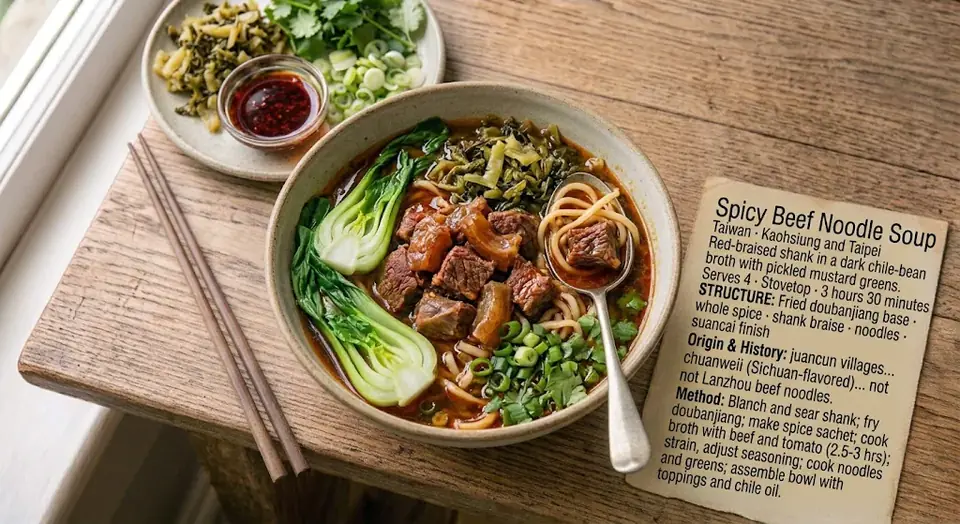
Taiwan · Kaohsiung and Taipei · 23.74° N, 120.97° E
Spicy Beef Noodle Soup
Red-braised shank in a dark chile-bean broth with pickled mustard greens.
At a glance.
Spicy Beef Noodle Soup comes from Taiwan · Kaohsiung and Taipei and appears in The Soup Atlas, in the chapter Broths & Noodle Soups. It serves 4, takes about 3 hr 30 min, and uses 19 ingredients and 10 steps.
- Yield
- Serves 4
- Method
- Stovetop
- Time
- 3 hr 30 min
Ingredients
Tap an ingredient to tick it off.
- For the beef
- For the doubanjiang base
- For the braising liquid
- To serve
Method
-
Cover the shank with cold water, bring to a boil and hold for 5 minutes while a coarse brown scum lifts. Drain, rinse each piece under the tap and pat it dry. Wet meat will not brown, and a broth built on unblanched beef stays muddy no matter how long it cooks.
-
Heat the oil in a heavy casserole and sear the shank hard in two batches, 3–4 minutes a side, until each face is deeply browned and the pan smells roasted rather than merely hot. Lift the meat out and leave the fat behind.
-
Turn the heat to medium-low and fry the doubanjiang alone in that fat for 2 minutes, pressing it against the base. It will loosen, darken and release a slick of brick-red oil. That color moving into the fat is the signal, and it is where the entire dish gets its character.
-
Add the garlic, ginger and spring onions and fry for 90 seconds until fragrant, then the star anise, cassia, bay, Sichuan peppercorns and dried chiles for 30 seconds more, until the spices smell toasted and the pot is on the edge of catching.
-
Pour in the Shaoxing wine and let it hiss and reduce by half, scraping the base clean. Add the soy sauce, rock sugar and stock, then return the beef and tuck in the tomato quarters, which will melt away and lend acidity and body rather than any recognizable tomato flavor.
-
Bring it to a bare simmer, cover, and hold it there for 2½–3 hours. The liquid should move barely at all. A braise that boils tightens muscle fiber and squeezes out the moisture you are trying to keep in the meat.
-
Test at 2½ hours: a skewer should pass through the shank with no resistance and the tendon should have gone translucent and springy, like a firm jelly. If it still fights you, give it another 30 minutes; shank is forgiving in one direction only.
-
Lift the beef out and let it settle for 20 minutes, then strain the broth, discarding the aromatics, and skim the fat, reserving a couple of spoonfuls. Taste and adjust with soy for salt and a pinch more rock sugar for balance; it should be dark, glossy and faintly sweet under the salt.
-
Cook the noodles in a large pot of unsalted water until they still push back at the center, 3–4 minutes for fresh, and blanch the greens in the same water for 90 seconds at the end. Drain both hard.
-
Divide the noodles between four deep bowls, add the greens and the beef, and ladle over 400 ml of the hot broth with a spoonful of the reserved fat. Top with suancai, spring onion, coriander and as much chile oil as you want, and serve while the noodles are still tight.
Cook’s notes
- The technique
- Doubanjiang is fermented broad beans and chile aged in jars, sometimes for years, and it is the one ingredient here with no substitute — chile flakes and soybean paste together do not reproduce it. Frying it in fat before any liquid arrives is the step that decides the bowl. Heat drives its pigments and fat-soluble aroma compounds into the oil, which then disperses through the whole pot; stirred into liquid cold, the same paste stays granular and tastes raw and salty. Fry it low and slow, though, because it scorches in seconds and burnt bean paste is bitter for good.
- Make ahead
- This improves markedly overnight and is arguably better on day two, when the fat has set and can be lifted off cleanly and the spice has settled into the meat. It keeps four days chilled and three months frozen, meat submerged in its broth. Reheat gently to a simmer. Noodles, greens and pickles are always done at the last minute.
- Troubleshooting
- Beef tender but the broth thin — the shank was trimmed of its tendon, so nothing converted to gelatin; add a piece of oxtail next time. Bitter and acrid — the bean paste caught while frying. Salty beyond rescue — soy and doubanjiang are both salt-heavy, so dilute with unsalted stock rather than water, which would strip body along with salt.
- Variations
- Qingdun niurou mian is the clear-broth Taiwanese version, with no bean paste at all and a lighter beef stock — the same island, the opposite philosophy. Tomato-heavy fanqie niurou mian leans sweet and sour. Lanzhou lamian belongs to a different tradition entirely: a clear broth, hand-pulled noodles, white radish, chile oil and coriander, and no braise anywhere in it.
- To serve and keep
- Serve in wide, deep bowls with chopsticks and a spoon, the suancai jar left on the table so people can add more. Sliced cucumber in vinegar and garlic on the side cuts the fat. Cold tea or a plain lager; the chile makes short work of anything more interesting. Made in full within this recipe — Red-Braised Beef Shank, Doubanjiang Base, Suancai and Chile Oil. Also listed in the Component Index at the back.

Where it comes from
Taiwanese niurou mian is younger than it tastes. It was assembled in the juancun, the military dependents' villages built for the families who arrived from the mainland after 1949, and the version usually credited as the original comes from Gangshan in Kaohsiung, where veterans from Sichuan made broad-bean chile paste and put it to work on beef. The dish is often sold as chuanwei — Sichuan-flavored — but no equivalent exists in Sichuan itself; it was invented in Taiwan by people who remembered Sichuan. That it caught on at all is notable, since Taiwanese farming families had long avoided eating cattle that plowed their fields. The city of Taipei has run a Beef Noodle Festival since 2005, with a competition that turns cooks into local celebrities and reliably produces queues. Do not confuse the dish with Lanzhou beef noodles, the Hui Muslim bowl of Gansu: hand-pulled lamian, a clear broth judged by its transparency, and chile oil floating on top rather than braised into the soup. They are opposites that share a name abroad.
Spicy Beef Noodle Soup: quick answers
How long does Spicy Beef Noodle Soup take?
About 3 hr 30 min.
How many does this Spicy Beef Noodle Soup recipe make?
This recipe serves 4.
Where does Spicy Beef Noodle Soup come from?
Taiwanese niurou mian is younger than it tastes. It was assembled in the juancun, the military dependents' villages built for the families who arrived from the mainland after 1949, and the version usually credited as the original comes from Gangshan in Kaohsiung, where veterans from Sichuan made broad-bean chile paste and put it to work on beef. The dish is often sold as chuanwei — Sichuan-flavored — but no equivalent exists in Sichuan itself; it was invented in Taiwan by people who remembered Sichuan. That it caught on at all is notable, since Taiwanese farming families had long avoided eating cattle that plowed their fields. The city of Taipei has run a Beef Noodle Festival since 2005, with a competition that turns cooks into local celebrities and reliably produces queues. Do not confuse the dish with Lanzhou beef noodles, the Hui Muslim bowl of Gansu: hand-pulled lamian, a clear broth judged by its transparency, and chile oil floating on top rather than braised into the soup. They are opposites that share a name abroad.
More in Broths & Noodle Soups


https://www.atlasserie.com/recipes/soup/spicy-beef-noodle-soup/