United States · The Condensed Can · 39.87° N, 98.73° W
Tomato Soup
The everyday American bowl, roasted hard so it tastes of more than the tin.
At a glance.
Tomato Soup comes from United States · The Condensed Can and appears in The Soup Atlas, in the chapter Classic & Everyday Soups. It serves 4, takes about 1 hr 15 min, and uses 21 ingredients and 11 steps.
- Yield
- Serves 4
- Method
- Stovetop & Oven
- Time
- 1 hr 15 min
Ingredients
Tap an ingredient to tick it off.
- For the quick vegetable stock
- For the roasted tomatoes
- To finish
- For the grilled cheese soldiers
Method
-
Heat the oven to 220°C (425°F). Start the stock first so it can work while the tomatoes roast: put the chopped onion, carrot, celery, parsley stalks, bay and peppercorns into a pot with the cold water and bring it slowly up to a bare simmer.
-
Hold it at a lazy simmer for 30 minutes, uncovered, then strain and discard the vegetables. A low-sodium carton stock will stand in here. It costs you a little sweetness and a flatter finish, both of which the roasting mostly covers over.
-
Lay the halved tomatoes cut-side up on a large tray with the onion wedges and the unpeeled garlic. Leave a finger's width between the halves so dry heat can reach every cut surface rather than pooling steam between them.
-
Pour over the olive oil and scatter on the salt, sugar and pepper. Roast for 40–45 minutes, until the cut faces have shrunk and gone brown, the edges are blackened in patches, and the juices on the tray have turned sticky and dark.
-
Squeeze the soft garlic out of its papery skins into a heavy pot and add the tomatoes and onion. Deglaze the empty tray with a ladle of the hot stock, scraping every caramelized scrap loose with a wooden spoon, and tip that in as well.
-
Add the remaining stock and simmer uncovered for 15 minutes, until the pot smells of roasted tomato rather than raw and the liquid has taken on the color of the solids sitting in it.
-
Blend in batches, filling the jug no more than a third full, venting the lid and holding a folded towel over the top. Hot liquid expands hard against a sealed lid and will throw it off along with everything under it.
-
Pass the blended soup through a fine sieve into the clean pot, pressing the solids with a ladle and scraping the underside of the mesh. This takes out the skin and seed fragments that no domestic blender fully breaks down.
-
Warm the soup through and stir in the cream off the boil. Taste for salt — a pot this size usually wants another full teaspoon — then correct with lemon juice if the tomatoes were sugary, or a further pinch of sugar if they were sharp.
-
Butter the outer faces of the bread, pile the cheddar between the slices, and cook in a dry pan over medium heat for about 3 minutes a side, pressing down with a spatula, until the crust is dark gold and the cheese pulls in strands when cut.
-
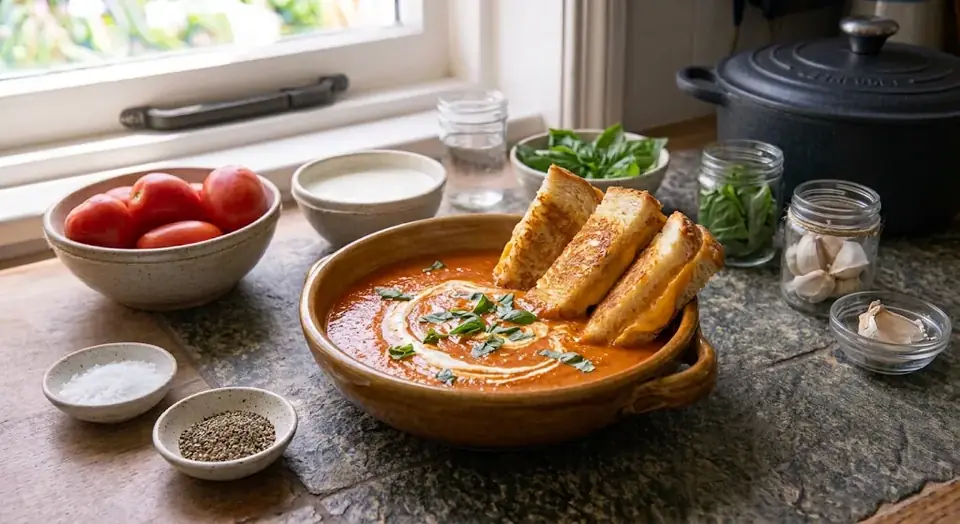
Tear the basil into the pot off the heat, ladle into warm bowls, and cut each sandwich into three fingers. Stand them against the rim so the ends stay crisp until they go into the soup.
Cook’s notes
- The technique
- Roasting is the entire argument of this recipe. At 220°C the cut faces give up water, and the sugars and amino acids left behind brown — caramelization of the fruit's own glucose and fructose alongside Maillard reactions between sugar and protein — building hundreds of aromatic compounds that a simmered pot never makes at all. The heat also drives off moisture, so the soup is concentrated before a drop of stock is added. The teaspoon of sugar is not there to sweeten. It lowers perceived acidity so the finished bowl reads round instead of sharp.
- Make ahead
- The blended base keeps four days refrigerated and freezes for three months, but freeze it before the cream goes in — thawed dairy in an acidic soup goes grainy. Reheat over low heat, stirring, and add the cream only once it is hot. Roasted tomatoes themselves can be done a day ahead and left in their tray juices. Grill the sandwiches to order, never in advance.
- Troubleshooting
- Thin and watery — the tomatoes were under-roasted or the tray was crowded; simmer uncovered another ten minutes to drive off the excess. Sharp and metallic — the fruit was underripe; add sugar a quarter teaspoon at a time and a knob of butter. Split and grainy — the cream met a boiling acidic pot; blend hard to bring it back and add dairy off the heat next time.
- Variations
- In winter, roast two 400 g cans of drained plum tomatoes on the same tray with the onion; the results are closer than pride allows. A roasted red pepper added to the tray gives sweetness without more sugar. For a dairy-free bowl, blend in 40 g of cashews soaked in hot water for an hour, which gives body and gloss without any of the curdling risk.
- To serve and keep
- Serve it in wide mugs if the sandwiches are going in, in shallow bowls if they are not. A crack of black pepper and a thread of olive oil on the surface is the whole garnish. Drink whatever is in the fridge — this is a Tuesday soup — or a cold, dry rosé if it is summer. Made in full within this recipe — Quick Vegetable Stock, Roasted Tomato Base, Grilled Cheese Soldiers. Also listed in the Component Index at the back.

Where it comes from
John Thompson Dorrance took a doctorate in chemistry at Göttingen, turned down the academic posts he was offered, and went to work for his uncle's canning company in Camden, New Jersey, on a nominal wage. In 1897 he worked out how to take most of the water out of a can before it shipped, which cut the freight and put a ten-cent tin within reach of households that had never bought prepared food in their lives. Condensed tomato was the first of that line and is still the one people picture when the words are said. The grilled cheese beside it is a separate American invention, welded on through the 1920s and 1930s when school lunch programs paired subsidized cheese and enriched bread with a bowl of soup that carried some vitamin C, and a generation grew up eating the two together and never stopped. Andy Warhol painted the can thirty-two times in 1962 and fixed it in place as an object. This recipe is not an imitation of that soup. It is the answer to it — fresh tomatoes taken to the edge of burnt, which is the one thing a factory cannot do at scale.
Tomato Soup: quick answers
How long does Tomato Soup take?
About 1 hr 15 min.
How many does this Tomato Soup recipe make?
This recipe serves 4.
Where does Tomato Soup come from?
John Thompson Dorrance took a doctorate in chemistry at Göttingen, turned down the academic posts he was offered, and went to work for his uncle's canning company in Camden, New Jersey, on a nominal wage. In 1897 he worked out how to take most of the water out of a can before it shipped, which cut the freight and put a ten-cent tin within reach of households that had never bought prepared food in their lives. Condensed tomato was the first of that line and is still the one people picture when the words are said. The grilled cheese beside it is a separate American invention, welded on through the 1920s and 1930s when school lunch programs paired subsidized cheese and enriched bread with a bowl of soup that carried some vitamin C, and a generation grew up eating the two together and never stopped. Andy Warhol painted the can thirty-two times in 1962 and fixed it in place as an object. This recipe is not an imitation of that soup. It is the answer to it — fresh tomatoes taken to the edge of burnt, which is the one thing a factory cannot do at scale.
The same dish in another volume
More from United States





More in Classic & Everyday Soups



https://www.atlasserie.com/recipes/soup/tomato-soup/