Thailand · The Central Plains · 14.98° N, 101.00° E
Tom Yum
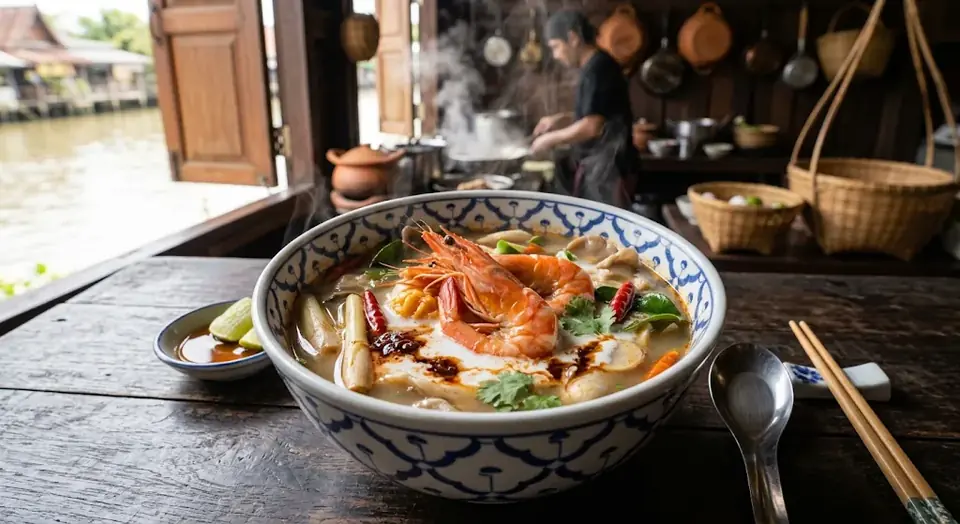
Prawns in a lean, sour, blazing broth of lemongrass, galangal and lime.
At a glance.
Tom Yum comes from Thailand · The Central Plains and appears in The Soup Atlas, in the chapter Broths & Noodle Soups. It serves 4, takes about 1 hr, and uses 22 ingredients and 11 steps.
- Yield
- Serves 4
- Method
- Stovetop
- Time
- 1 hr
Ingredients
Tap an ingredient to tick it off.
- For the prawn shell stock
- For the nam prik pao
- For the aromatics
- To finish, off the heat
Method
-
Peel the prawns, keeping the heads and shells. Squeeze the orange fat from inside the heads into a small bowl with your thumb and set it aside — that mun goong is the richest thing in the pot and takes ten minutes to collect.
-
Fry the shells and heads in the oil over high heat for 3 minutes, pressing them down, until they turn scarlet and smell of grilled shellfish. Pour in the water, add the coriander roots, simmer for 20 minutes, then strain and press the shells firmly before discarding them.
-
Make the nam prik pao while the stock runs. Fry the shallots in the oil over medium heat until golden, 6–8 minutes, then the garlic for 2 minutes, then the drained chiles and dried shrimp for 1 minute. Lift the solids out with a slotted spoon and keep the oil.
-
Pound or blend the fried solids to a coarse paste, return it to the pan with the reserved oil, palm sugar, tamarind and fish sauce, and cook it over low heat for 8 minutes until it darkens to brick and the oil separates out around the edge. It keeps a month refrigerated under its own oil; a good jarred version costs about the same and saves the half hour honestly.
-
Bruise the lemongrass along its full length with the back of a heavy knife until the fibers split and the stalk smells sharply of citrus. Tear the lime leaves in half against the central rib rather than shredding them, which ruptures the oil glands running along the fold.
-
Bring 1.2 liters of the prawn stock to a simmer with the lemongrass, galangal, lime leaves and bird's eye chiles and infuse for 10 minutes. The broth should smell aggressive from across the kitchen; if it does not, bruise the lemongrass harder.
-
Stir in the reserved prawn head fat and 30 g of the nam prik pao, then add the mushrooms and cook for 3 minutes until they soften and give up their liquid. For a nam khon bowl, add the evaporated milk now and keep the pot below a simmer from here.
-
Add the peeled prawns and cook for 2 minutes only, until they turn opaque and curl into a loose C. A tight O means they have gone a minute too far and will be rubbery no matter what you do next.
-
Take the pot off the heat completely. Every remaining seasoning is damaged by it: lime juice loses its top notes within seconds of boiling and leaves a dull bitterness, and fish sauce turns sharp and ammoniac.
-
Stir in the fish sauce, lime juice and palm sugar and taste with a clean spoon. Balance in order — salt first, then sour, then heat, then a trace of sweet that should register last if at all. Scatter the coriander and serve at once.
-
Tell the table what is edible. The prawns, mushrooms and coriander are food; the lemongrass, galangal, lime leaves and whole chiles are there to perfume the broth and get pushed to the rim of the bowl, which is normal and not a failure of prep.
Cook’s notes
- The technique
- Tom yum is a lean broth, and that is the point of it — with no fat to buffer them, acid, salt and chile hit the palate directly and the aromatics read as separate, identifiable things. Its coconut relative at recipe 91 does the opposite, running the same lemongrass and galangal through coconut fat that coats the tongue and slows everything down. Because there is no cushion here, the balance is unforgiving: taste it hot, off the heat, and correct in small increments, since a bowl this sharp shows every overcorrection immediately.
- Make ahead
- The prawn stock keeps three days chilled and freezes for three months; the nam prik pao keeps a month under oil and improves in the first week. The aromatic infusion can be made a day ahead and strained. Prawns, seasoning and serving are one continuous run of about eight minutes, and a finished pot reheated the next day loses its lime entirely.
- Troubleshooting
- Bitter, with a metallic edge — the lime juice went in over heat. Aromatic but hollow — no prawn head fat and no nam prik pao, both of which supply what little richness the bowl has. Blazing hot and nothing else — the chiles were cut rather than bruised; whole bruised chiles release perfume, cut ones release only capsaicin.
- Variations
- Tom yum gai uses chicken and a little more sugar; tom yum pla poaches snakehead or sea bass and needs a gentler hand. The northeastern version cuts the sugar entirely and adds toasted rice powder for body. Nam sai keeps the pot clear, with no paste and no milk, and is the one to make when the prawns are excellent.
- To serve and keep
- Bring it to the table as part of a shared meal, with jasmine rice, an omelette and something grilled. Ladle it over rice rather than drinking it as a course. Cold water or a light lager; a spoonful of prik nam pla on the table for anyone who thinks it is mild. Made in full within this recipe — Prawn Shell and Head Stock, Nam Prik Pao, Lime and Fish Sauce Balance. Also listed in the Component Index at the back.

Where it comes from
The name is a compound instruction: tom is to boil, yam names the family of Thai salads in which sharp, salty and hot ingredients are tossed together. Tom yum is that dressing turned into a soup, and it belongs to the river country of the central plains, where the freshwater prawns of the Chao Phraya are large enough that the orange fat in the head is treated as a separate ingredient. Two versions now coexist. Nam sai, clear, is the older and leaner bowl, all aromatics and acid. Nam khon, cloudy, arrives at the table pink and rounded from a spoon of roasted chile paste and often evaporated milk — commonly explained as a mid-twentieth-century Bangkok adaptation, though the documentation for that story is thin. Abroad, nam khon is what most people have eaten. In December 2024 UNESCO added tom yum kung to its representative list of intangible cultural heritage, which tells you how the dish is regarded at home.
Tom Yum: quick answers
How long does Tom Yum take?
About 1 hr.
How many does this Tom Yum recipe make?
This recipe serves 4.
Where does Tom Yum come from?
The name is a compound instruction: tom is to boil, yam names the family of Thai salads in which sharp, salty and hot ingredients are tossed together. Tom yum is that dressing turned into a soup, and it belongs to the river country of the central plains, where the freshwater prawns of the Chao Phraya are large enough that the orange fat in the head is treated as a separate ingredient. Two versions now coexist. Nam sai, clear, is the older and leaner bowl, all aromatics and acid. Nam khon, cloudy, arrives at the table pink and rounded from a spoon of roasted chile paste and often evaporated milk — commonly explained as a mid-twentieth-century Bangkok adaptation, though the documentation for that story is thin. Abroad, nam khon is what most people have eaten. In December 2024 UNESCO added tom yum kung to its representative list of intangible cultural heritage, which tells you how the dish is regarded at home.
More from Thailand
More in Broths & Noodle Soups


https://www.atlasserie.com/recipes/soup/tom-yum/