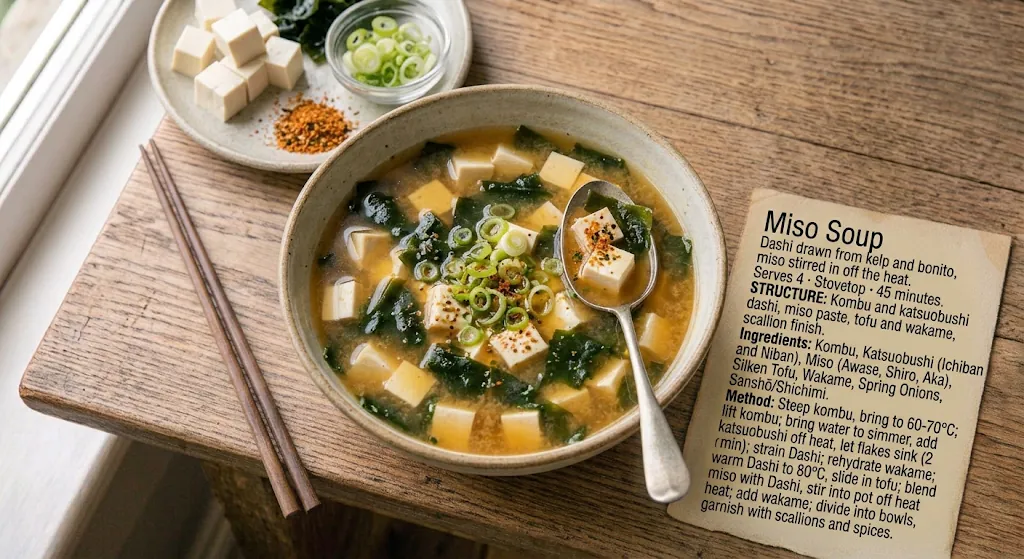
Japan · The Everyday Bowl · 36.01° N, 136.71° E
Miso Soup
Dashi drawn from kelp and bonito, miso stirred in off the heat.
At a glance.
Miso Soup comes from Japan · The Everyday Bowl and appears in The Soup Atlas, in the chapter Broths & Noodle Soups. It serves 4, takes about 45 minutes, and uses 13 ingredients and 10 steps.
- Yield
- Serves 4
- Method
- Stovetop
- Time
- 45 minutes
Ingredients
Tap an ingredient to tick it off.
- For the ichiban dashi
- For the niban dashi (optional second brew)
- For the miso blend
- To finish
Method
-
Wipe the kombu with a dry cloth to take off any grit, but leave the chalky white bloom on the surface — that is mannitol, and it carries much of the flavor. Steep it in the liter of cold water for 30 minutes, or overnight in the refrigerator for a rounder result.
-
Set the pan over low heat and bring it up over about 10 minutes to 60–70°C (140–160°F), where the water steams faintly and small bubbles cling to the kelp. Lift the kombu out before the water reaches a boil; boiled kelp goes slippery and turns faintly bitter, and there is no recovering it.
-
Raise the liquid to the very edge of a simmer, take the pan off the heat entirely, and scatter in the katsuobushi. Push it under with chopsticks, then leave it alone for 2 minutes while the flakes sink.
-
Pour the dashi through a sieve lined with a damp cloth and let it drip. Do not press the flakes; squeezing them forces out bitter compounds and fine particles, and turns a clean broth murky. You should have about 900 ml of pale gold liquid that smells of the sea and smoked wood.
-
For a second brew, return the spent kelp and flakes to the pan with 700 ml of cold water, bring to a gentle simmer for 10 minutes, add the fresh katsuobushi off the heat and strain. Niban dashi is thinner and used for braises and noodle broths rather than for this bowl.
-
Rehydrate the wakame in cold water for 5 minutes. It swells to eight or ten times its dry volume, so measure it dry and mistrust your instincts. Drain it and squeeze it lightly.
-
Warm 800 ml of the ichiban dashi to 80°C (175°F) — steaming, with no bubble breaking — and slide in the tofu cubes. Let them heat through for 2 minutes without stirring; silken tofu breaks up if pushed around.
-
Combine the three misos in a small bowl. Ladle in a little hot dashi and work the paste smooth with the back of a spoon or a small whisk, or push it through a strainer held in the pot. Miso dropped in whole clumps, and the beating needed to break up those clumps drives off everything you are buying it for.
-
Take the pan off the heat before the loosened miso goes in. Stir once to distribute it, then stop. Miso is a live food, and its aroma compounds are volatile; held at a simmer for even a minute it flattens into something that tastes only of salt.
-
Add the drained wakame, divide between four lacquer or ceramic bowls so each gets tofu, seaweed and cloudy broth in fair share, and scatter the spring onion over. Serve immediately, with sanshō or shichimi for those who want it.
Cook’s notes
- The technique
- Choose the miso by its ferment, not its color alone. Shiro miso carries a high proportion of rice kōji and a short ferment of weeks, which leaves it sweet, pale and mild; aka miso runs on more soybean and a year or more in the vat, turning it dark, salty and assertive; awase is a blend sold as the everyday paste and is what most Japanese households actually open. Combining all three gives sweetness, salt and depth in one bowl. Whatever the blend, the never-boil rule is absolute, and it is the only rule that matters after the dashi is made.
- Make ahead
- Dashi keeps three days chilled and freezes well in ice-cube trays for portioning. The miso blend can be mixed a fortnight ahead and kept in a jar. The assembled soup does not keep — reheated, the miso dulls and the tofu weeps water into the broth. Make dashi in quantity and finish bowls in five minutes as you need them.
- Troubleshooting
- Dashi bitter or slick — the kombu boiled, or the bonito flakes were pressed in the sieve. Soup tastes flat and salty at once — it was heated after the miso went in. Tofu collapsed into shreds — it was stirred, or the broth was too hot. Wakame overwhelming the bowl — dry seaweed expands roughly tenfold, and a tablespoon is enough for four.
- Variations
- Swap the tofu for thin-sliced daikon and abura-age in winter, or for clams, which need no dashi at all and make their own. Vegan kombu-and-shiitake dashi is the temple version, shōjin ryōri, and is arguably cleaner. Sendai's household bowl is built on a strong aka miso; Kyoto's on sweet white saikyō miso, thick enough to look like cream.
- To serve and keep
- Serve in small lidded bowls, lifted with both hands and drunk from the rim, chopsticks used for the solids. It belongs beside rice and pickles rather than as a first course on its own. Green tea, or nothing at all — this is the least ceremonial bowl in the book. Made in full within this recipe — Ichiban Dashi, Niban Dashi, Miso Blend. Also listed in the Component Index at the back.

Where it comes from
Miso arrived in Japan from the Asian mainland as a salted fermented paste and had become a domestic industry by the Muromachi period, when the pattern of a Japanese meal settled into ichijū-issai — one soup, one dish, and rice. Soup meant miso soup, and it has been the default of the Japanese table since, drunk at breakfast beside rice, grilled fish and pickles, and again at the end of dinner. Two laboratory findings underwrite what cooks already knew. In 1908 Kikunae Ikeda, working at Tokyo Imperial University, identified glutamic acid as the source of kombu's savor and named the taste umami; in 1913 his student Shintarō Kodama found inosinate in dried bonito. Combined, as they are in dashi, the two compounds amplify one another several times over, which is why a broth that takes fifteen minutes and contains almost nothing tastes as though it had been simmered all day. The old expression temae-miso, praising one's own miso, still means boasting.
Miso Soup: quick answers
How long does Miso Soup take?
About 45 minutes.
How many does this Miso Soup recipe make?
This recipe serves 4.
Where does Miso Soup come from?
Miso arrived in Japan from the Asian mainland as a salted fermented paste and had become a domestic industry by the Muromachi period, when the pattern of a Japanese meal settled into ichijū-issai — one soup, one dish, and rice. Soup meant miso soup, and it has been the default of the Japanese table since, drunk at breakfast beside rice, grilled fish and pickles, and again at the end of dinner. Two laboratory findings underwrite what cooks already knew. In 1908 Kikunae Ikeda, working at Tokyo Imperial University, identified glutamic acid as the source of kombu's savor and named the taste umami; in 1913 his student Shintarō Kodama found inosinate in dried bonito. Combined, as they are in dashi, the two compounds amplify one another several times over, which is why a broth that takes fifteen minutes and contains almost nothing tastes as though it had been simmered all day. The old expression temae-miso, praising one's own miso, still means boasting.
The same dish in another volume

More from Japan


More in Broths & Noodle Soups





https://www.atlasserie.com/recipes/soup/miso-soup-soup/