
Vietnam · Nam Định and Hanoi · 16.56° N, 106.33° E
Pho
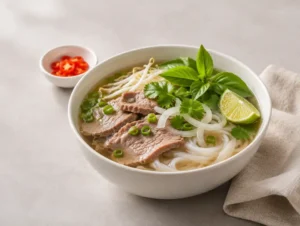
Clear beef broth over rice noodles, raw sirloin cooked by the ladle.
At a glance.
Pho comes from Vietnam · Nam Định and Hanoi and appears in The Soup Atlas, in the chapter Broths & Noodle Soups. It serves 4, takes about 6 hours, and uses 22 ingredients and 11 steps.
- Yield
- Serves 4
- Method
- Stovetop
- Time
- 6 hours
Ingredients
Tap an ingredient to tick it off.
- For the beef broth
- For the charred aromatics
- For the spice sachet
- To season
- To serve
Method
-
Hold the onion halves and the ginger directly in a gas flame with tongs, or set them under a broiler at full heat, turning until the cut faces are black in patches and the kitchen smells of scorched sugar — 10–12 minutes. Scrape off the loose carbon, leaving the color behind.
-
Cover the bones and oxtail with cold water in your largest pot, bring to a boil and let them roll for 10 minutes. Pour the lot away, rinse every bone under the tap until no gray matter clings to it, and scour the pot. Restaurant phở is clear because of this step and nothing else.
-
Toast the star anise, cassia, cloves, coriander, fennel and black cardamom in a dry pan over medium heat for about 90 seconds, moving them constantly, until they smell warm and resinous. Tie them into a square of muslin so they can be pulled out whole.
-
Return the clean bones to the clean pot with 5 liters of fresh cold water and the brisket. Bring it up slowly over 40 minutes to 90°C (195°F), where the surface trembles and throws the occasional bubble, and skim off every trace of foam as it collects.
-
Add the charred onion and ginger, the spice sachet and the salt. Hold that bare simmer, uncovered, for 4 hours, skimming every half hour. A boil at any point emulsifies fat into the liquid and the broth will never come clear again.
-
Lift the brisket out after 90 minutes, when a skewer meets slight resistance, and plunge it into iced water for 10 minutes to keep it from drying. Chill it, then slice it across the grain 3 mm thick and hold it at room temperature.
-
Pull the sachet after 2 hours; longer and the cassia turns medicinal and dominates. Strain the finished broth through a fine sieve lined with damp muslin, ladling rather than pouring so the sediment stays behind, and skim the fat from the surface.
-
Season the strained broth with the fish sauce and rock sugar and taste it hot. It should read savory and faintly sweet, and slightly stronger than you want it, since noodles and raw beef will pull it back. You need about 2 liters.
-
Freeze the sirloin for 20 minutes, then slice it against the grain as thinly as your knife allows — 2 mm or less, translucent at the edges. Firm meat cuts thin; soft meat tears. Lay the slices out flat, not stacked.
-
Soak the dried noodles in warm water for 20 minutes, then dip them in a pot of boiling water for 20 seconds, basket and all, and shake them dry. Divide between four deep bowls and lay the raw sirloin, the sliced brisket, the shaved onion and the spring onion on top.
-
Bring the seasoned broth to a hard, rolling boil and ladle 500 ml over each bowl, pouring straight onto the raw beef so it turns from red to gray-pink as it goes. Serve at once with the herb plate, sprouts, lime and chile alongside.
Cook’s notes
- The technique
- Phở asks for two opposite temperatures and gets them in sequence. For four hours the pot must never exceed a shiver, because a rolling boil shears fat and coagulated protein into droplets small enough to hang in suspension, which is the whole difference between amber and mud. Then, at the last second, the same broth must be driven to a genuine rolling boil, because paper-thin raw beef needs liquid above 95°C arriving all at once to cook through in the bowl. Broth that is merely hot leaves the meat raw and slack.
- Make ahead
- The broth is better on day two and keeps five days chilled or three months frozen, with the fat cap left on until you use it — it seals the surface. Cooked brisket keeps three days in a little broth so it does not dry out. Noodles, raw sirloin and herbs are day-of work. Never reheat and re-boil the broth repeatedly; each cycle dulls the spice.
- Troubleshooting
- Cloudy and gray — the bones went unblanched, or the pot boiled at some point while your back was turned. Broth tastes of medicine — the sachet stayed in the full four hours; next time pull it at two. Raw beef still red in the bowl — the broth was not at a rolling boil when it was ladled, or it was poured down the side rather than over the meat.
- Variations
- Order by cut in Vietnam: tái is the rare sirloin here, chín the well-done brisket, nạm flank, gầu fatty brisket, gân tendon. Phở tái lăn flashes the beef in a hot wok with garlic before it hits the bowl. Phở sốt vang, a Hanoi oddity, serves the noodles under a red-wine beef stew and is a clear French inheritance. Nam Định's version leans harder on fish sauce and less on spice.
- To serve and keep
- Serve in bowls wide enough to work in, with chopsticks, a deep spoon and the herb plate in the middle of the table. Hoisin and chile sauce belong in a saucer for dipping meat, not stirred into the broth, whatever the habit abroad. Iced tea, or strong black coffee afterward. Made in full within this recipe — Beef Bone Broth, Charred Aromatics, Toasted Spice Sachet, Herb Plate. Also listed in the Component Index at the back.

Where it comes from
Phở took shape in the north around the turn of the twentieth century, in the country between Nam Định and Hanoi, where French demand for beef left bones and trimmings that Vietnamese cooks had not previously had in quantity. The village of Vân Cù in Nam Định claims the dish and supplied generations of Hanoi vendors who carried the whole operation on a shoulder pole. Where the name came from is genuinely unsettled: some trace it to the French pot-au-feu, others to the Cantonese ngau yuk fan and its noodle word, and a third account has it evolving out of xáo trâu, a buffalo-and-noodle dish sold in Hanoi's markets. None of these is proven. What is certain is 1954, when partition sent close to a million northerners south, and the bowl changed as it travelled: Hanoi keeps it austere, broth and beef and spring onion, while Saigon added a plate of herbs, bean sprouts, lime and sauces to be worked into the bowl by the eater.
Pho: quick answers
How long does Pho take?
About 6 hours.
How many does this Pho recipe make?
This recipe serves 4.
Where does Pho come from?
Phở took shape in the north around the turn of the twentieth century, in the country between Nam Định and Hanoi, where French demand for beef left bones and trimmings that Vietnamese cooks had not previously had in quantity. The village of Vân Cù in Nam Định claims the dish and supplied generations of Hanoi vendors who carried the whole operation on a shoulder pole. Where the name came from is genuinely unsettled: some trace it to the French pot-au-feu, others to the Cantonese ngau yuk fan and its noodle word, and a third account has it evolving out of xáo trâu, a buffalo-and-noodle dish sold in Hanoi's markets. None of these is proven. What is certain is 1954, when partition sent close to a million northerners south, and the bowl changed as it travelled: Hanoi keeps it austere, broth and beef and spring onion, while Saigon added a plate of herbs, bean sprouts, lime and sauces to be worked into the bowl by the eater.
The same dish in another volume
More from Vietnam
More in Broths & Noodle Soups

https://www.atlasserie.com/recipes/soup/pho-soup/