
United States · Boston · 39.87° N, 98.73° W
Parker House Rolls
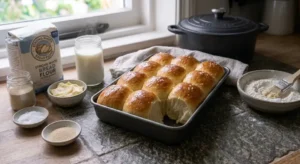
Folded half-moons with butter sealed into the crease.
At a glance.
Parker House Rolls comes from United States · Boston and appears in The Bread Atlas, in the chapter Rolls, Buns & Bagels. It makes 12 rolls, is made by oven 190°c / 375°f, and uses 10 ingredients and 11 steps.
- Yield
- Makes 12 rolls
- Method
- Oven 190°C / 375°F, 3½ hours
Ingredients
Tap an ingredient to tick it off.
- The Dough
- Butter for the Fold
- Finishing Butter
Method
-
Whisk the dry ingredients together — flour, sugar, salt, yeast. Warm the milk to 30°C, beat the egg through it, and mix to a soft dough. Rest 15 minutes, then knead 8 minutes and work in the softened butter in three additions.
-
Take the dough to a full windowpane at a final temperature of 25°C, then bulk ferment covered 75–90 minutes at 25°C until doubled. A well-developed dough is what lets you roll this out thin without it tearing or springing back.
-
Chill the risen dough for 20 minutes. Cold dough sheets evenly and holds a crease; warm dough closes the crease as soon as you make it, and the fold will fuse in the oven.
-
Roll the dough on a lightly floured counter to an even 1 cm thick. Cut 12 rounds with an 8 cm cutter, pressing straight down without twisting — a twisted cut seals the edge and the roll rises lopsided.
-
Take the floured handle of a wooden spoon and press a firm crease across each round, slightly off center so that one side is a little larger than the other. Press nearly through the dough. This crease is the hinge.
-
Brush the whole surface of each round with the lukewarm melted butter, taking care to get it into the crease itself. Butter between two dough faces stops them knitting together, which is the difference between a roll that opens and one that is merely thick.
-
Fold the larger half over the smaller so the lower edge protrudes by about 5 mm. That offset lip anchors the fold; folded edge to edge, the top half slides back open as the roll proves.
-
Butter a 23 × 33 cm tin and set the rolls in four rows of three, folded edges facing the same way, each row overlapping the last slightly. They should sit close but not compressed.
-
Prove covered 45–60 minutes at 25°C, until puffed and touching and the folds have opened a little. Bring the oven up to 190°C / 375°F. Brush the tops lightly with any butter left from the fold.
-
Bake 18–20 minutes, rotating once, until the crowns are golden brown and the creases still pale, to an internal 88–90°C. That contrast between browned dome and pale seam is the visual signature of the roll.
-
Brush generously with the finishing butter as they come out of the oven, scatter flaked salt, and rest 10 minutes in the tin before lifting the slab onto a rack. Serve within the hour, warm enough that the butter in the fold is still soft.
Cook’s notes
- To serve and keep
- These are dinner rolls in the formal sense — served with a roast, pulled open at the fold and buttered again at the table. Keep them in the tin under a cloth for a few hours. To revive, cover with foil and warm 6 minutes at 170°C; uncovered, they dry before they heat through.

Where it comes from
The Parker House opened on School Street in Boston in 1855, built by Harvey D. Parker, and by the 1870s its kitchen had attached its name to a folded roll served at the hotel's tables. The name spread through print quickly: recipes titled Parker House rolls appear in American cookbooks through the 1880s and 1890s, and Fannie Farmer included them in the Boston Cooking-School Cook Book of 1896, by which time the shape was standard in domestic baking well beyond Boston. The origin anecdote is another matter. It is usually told that a German baker or pantry man at the hotel, in a temper over a guest or a colleague, flung a batch of unfinished rolls into the oven half-folded and produced the shape by accident; the man is named differently in different tellings, no contemporaneous record supports any version, and the story has the shape of hotel publicity. The roll's later career is better documented than its birth — the hotel, now the Omni Parker House, has served it continuously for well over a century.
Parker House Rolls: quick answers
How many does this Parker House Rolls recipe make?
This recipe makes 12 rolls.
Where does Parker House Rolls come from?
The Parker House opened on School Street in Boston in 1855, built by Harvey D. Parker, and by the 1870s its kitchen had attached its name to a folded roll served at the hotel's tables. The name spread through print quickly: recipes titled Parker House rolls appear in American cookbooks through the 1880s and 1890s, and Fannie Farmer included them in the Boston Cooking-School Cook Book of 1896, by which time the shape was standard in domestic baking well beyond Boston. The origin anecdote is another matter. It is usually told that a German baker or pantry man at the hotel, in a temper over a guest or a colleague, flung a batch of unfinished rolls into the oven half-folded and produced the shape by accident; the man is named differently in different tellings, no contemporaneous record supports any version, and the story has the shape of hotel publicity. The roll's later career is better documented than its birth — the hotel, now the Omni Parker House, has served it continuously for well over a century.
More from United States
More in Rolls, Buns & Bagels
https://www.atlasserie.com/recipes/bread/parker-house-rolls/