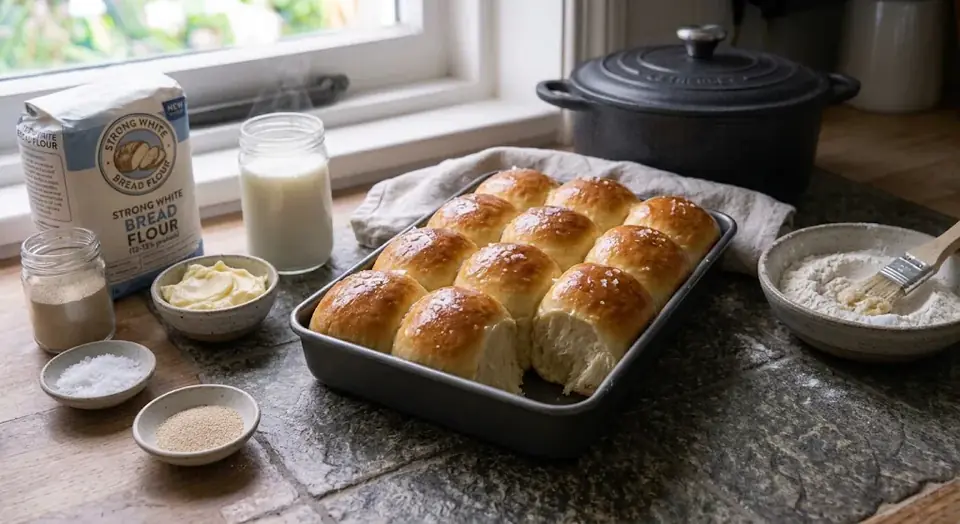
United States · The Pull-Apart Pan · 39.87° N, 98.73° W
Soft Dinner Rolls
Twelve rolls baked shoulder to shoulder, buttered hot and buttered again.
At a glance.
Soft Dinner Rolls comes from United States · The Pull-Apart Pan and appears in The Bread Atlas, in the chapter Rolls, Buns & Bagels. It makes 12 rolls, is made by oven 190°c / 375°f, and uses 10 ingredients and 11 steps.
- Yield
- Makes 12 rolls
- Method
- Oven 190°C / 375°F, 3½ hours
Ingredients
Tap an ingredient to tick it off.
- The Dough
- Butter, Brushed Twice
Method
-
Whisk the flour, sugar, salt and yeast in a wide bowl. Warm the milk to 32°C, beat the egg into it, and pour the lot in. Mix to a rough, sticky dough, cover, and leave 15 minutes for the flour to drink.
-
Knead 8 minutes by hand or 5 on a mixer's second speed. Add the softened butter in four pieces, letting each disappear before the next goes in — added all at once it coats the flour and the gluten never links up.
-
Work on until the dough is glossy, pulls away from the bowl, and a stretched piece passes light without tearing. Target a final dough temperature of 26°C; on a cold day use the milk to steer it, on a hot one chill the bowl.
-
Round the dough, cover, and bulk ferment 75–90 minutes at 25°C, until doubled and domed. A floured finger pressed 1 cm in should leave a dent that fills back slowly and does not quite disappear.
-
Butter a 23 × 33 cm tin, sides included. Turn the dough out, press it flat without degassing it entirely, and divide into 12 pieces of about 80 g. Weigh them; uneven rolls bake unevenly and tear badly.
-
Shape each piece: flatten, fold the edges to the center, turn seam down, then cup your palm and drag the ball in small circles on an unfloured patch of counter until the surface goes taut and the base seals shut.
-
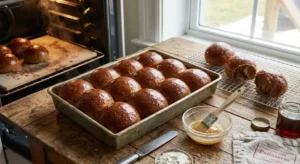
Set them in the tin four by three, leaving 1 cm between neighbors. They will close the gaps as they proof and finish the job in the oven, which is what fuses them into a sheet you can tear apart.
-
Cover and prove 45–60 minutes at 25°C, until the rolls are touching, puffed, and slow to spring back from a light press. Heat the oven to 190°C / 375°F with a rack in the middle.
-
Brush the tops with the first 20 g of melted butter. This is not decoration: it keeps the crown from drying into a skin during oven spring and gives the sugars something to brown into.
-
Bake 20–24 minutes, rotating once, until the tops are deep gold and the internal temperature reads 88–90°C. Enriched dough is baked well below the 96°C of a lean loaf; take it further and the crumb goes dry.
-
Brush again the moment they come out — the hot crust drinks it — and scatter flaked salt if you like. Rest 10 minutes in the tin, then lift the whole slab onto a rack so the bases do not sweat, and serve within the hour.
Cook’s notes
- To serve and keep
- These belong beside gravy, roast meat and butter that has been left out to soften — Thanksgiving, Christmas, Sunday. Tear rather than cut. Keep them in the tin under a cloth for a day, and refresh in a covered dish for 5 minutes at 160°C, which brings back most of what a night on the counter takes away.

Where it comes from
A pan roll is defined by what it touches. Set close in a tin, rolls rise into one another, and every surface that meets a neighbor stays pale, damp and tender, so a dozen rolls give you one browned crown apiece and almost no crust anywhere else. Northern European bakers had done this for centuries with small milk breads — Milchbrötchen in Germany, boller in Denmark — and the habit crossed the Atlantic with the people who baked them. What American kitchens added was the occasion. The soft roll became the fixture of the church supper, the Sunday table and the Thanksgiving dinner, made from a general-purpose sweet dough that also became cinnamon rolls and coffee cake, which is why so many mid-century community cookbooks print one dough and five shapes. Industry then removed the baking itself. Part-baked brown-and-serve rolls went national in the late 1940s, and the story usually told — that a volunteer fireman who also baked, in Avon Park, Florida, pulled a pale tray when the alarm sounded and finished them later to his own surprise — is repeated everywhere and firmly documented nowhere.
Soft Dinner Rolls: quick answers
How many does this Soft Dinner Rolls recipe make?
This recipe makes 12 rolls.
Where does Soft Dinner Rolls come from?
A pan roll is defined by what it touches. Set close in a tin, rolls rise into one another, and every surface that meets a neighbor stays pale, damp and tender, so a dozen rolls give you one browned crown apiece and almost no crust anywhere else. Northern European bakers had done this for centuries with small milk breads — Milchbrötchen in Germany, boller in Denmark — and the habit crossed the Atlantic with the people who baked them. What American kitchens added was the occasion. The soft roll became the fixture of the church supper, the Sunday table and the Thanksgiving dinner, made from a general-purpose sweet dough that also became cinnamon rolls and coffee cake, which is why so many mid-century community cookbooks print one dough and five shapes. Industry then removed the baking itself. Part-baked brown-and-serve rolls went national in the late 1940s, and the story usually told — that a volunteer fireman who also baked, in Avon Park, Florida, pulled a pale tray when the alarm sounded and finished them later to his own surprise — is repeated everywhere and firmly documented nowhere.
More from United States

More in Rolls, Buns & Bagels
https://www.atlasserie.com/recipes/bread/soft-dinner-rolls/