Germany · Bavaria · 51.08° N, 10.27° E
Soft Pretzels
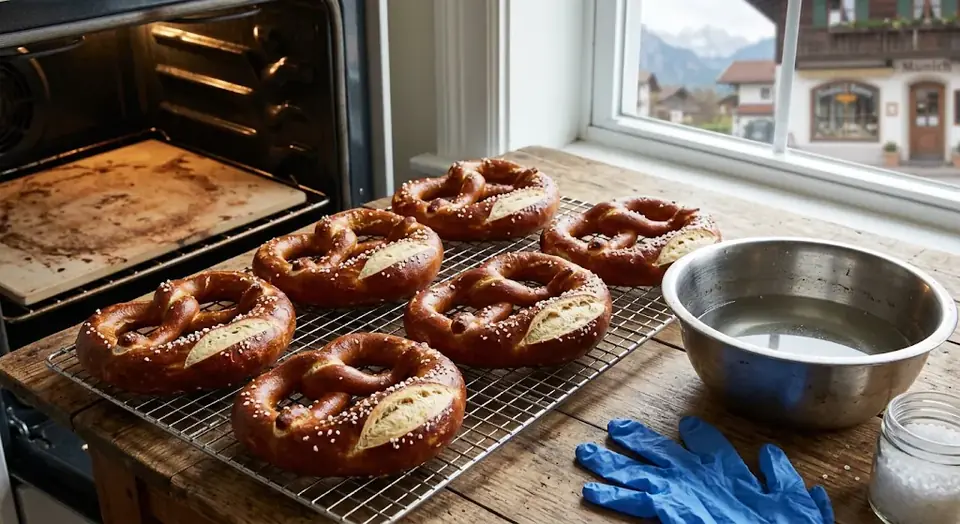
Laugenbrezn: a caustic bath, a mahogany skin, coarse salt on the belly.
At a glance.
Soft Pretzels comes from Germany · Bavaria and appears in The Bread Atlas, in the chapter Rolls, Buns & Bagels. It makes 8 pretzels, takes about 5 hours, and uses 13 ingredients and 12 steps.
- Yield
- Makes 8 pretzels
- Method
- Oven 230°C / 450°F
- Time
- 5 hours
Ingredients
Tap an ingredient to tick it off.
- The Dough
- The Lye Bath — read step 1 before you buy anything
- The Baked-Soda Alternative
- To Finish
Method
-
Safety first, and it is not a formality. Sodium hydroxide burns skin and blinds eyes. Wear nitrile gloves and sealed goggles, cover your arms, clear children and animals from the room, work beside a running cold tap, and use only stainless steel, glass or polypropylene. Lye attacks aluminium violently, releasing hydrogen and wrecking both bowl and dough.
-
Mix the bath: measure the cold water into the bowl first, then add the lye to the water, a spoonful at a time, stirring with stainless or plastic. Never pour water onto lye — it can boil and throw caustic solution back at you. The solution warms to about 40°C; leave it to cool while you make the dough.
-
Whisk the flour, salt and yeast. Dissolve the malt in the water at 18°C, add it with the butter, and mix to a stiff, dry dough. Knead 10 minutes to a smooth, tight mass. Target a final dough temperature of 23°C — a cool dough gives the close, meaty crumb a pretzel needs.
-
Bulk ferment only 45–60 minutes at 22°C. Pretzels are not meant to be airy; a long, gassy bulk gives a bready crumb that tears under the lye skin instead of holding it.
-
Divide into 8 pieces of 100 g, roll each into a short log, and rest 10 minutes covered. Rolling a long rope from an unrested piece is a fight you will lose.
-
Roll each log into a rope 55–60 cm long, working from the middle outward and bearing down harder toward the ends so you finish with a fat belly and two thin tapering arms. If the rope springs back, leave it 5 minutes and return to it.
-
Lay the rope in a wide U on the counter, cross the arms over each other twice, then bring the tips down onto the belly at four and eight o'clock and press them on hard. Loose tips come adrift in the bath.
-
Set the pretzels on lined trays and chill uncovered 1–3 hours at 4°C, or 40 minutes in the freezer, until the surface is dry and slightly leathery to the touch. A dry skin takes lye evenly; a wet one dissolves into the bath and comes out slimy.
-
Gloves and goggles back on. Immerse each pretzel for 15–20 seconds, turning once, lift with a stainless spider, drain, and set on parchment or a silicone mat — bare aluminium trays will pit. Slash the belly with a blade held almost flat, and scatter over the coarse salt.
-
For the baked-soda route instead: spread the bicarbonate on a parchment-lined steel tray and bake at 120°C / 250°F for 1 hour, which drives off water and carbon dioxide and converts it to sodium carbonate. Dissolve 60 g of it in 1 L of warm water and dip for 30 seconds. Still wear gloves; it is alkaline enough to irritate.
-
Be honest about the difference. Baked soda reaches around pH 11 against lye's 13, so the crust browns lighter, stays matte rather than glassy, and lacks the particular mineral tang that makes a Laugenbrezel taste of itself. It makes a good pretzel. It does not make that pretzel.
-
Bake at 230°C / 450°F for 12–15 minutes, until deep mahogany and 96°C inside. Brush with melted butter while warm if you like, and eat within four hours — the lye skin softens by evening. Dispose of the bath with gloves on, poured slowly down the drain under a hard cold tap, then rinse the bowl twice.
Cook’s notes
- To serve and keep
- In Bavaria this is breakfast — Weisswurst, sweet mustard, wheat beer, before noon by custom. Otherwise it belongs with butter, obatzda or a plate of radishes. Eat the day it is baked. Storage is not really the point of a pretzel; there is nothing you can do overnight that will keep the crust glassy.

Where it comes from
The pretzel's shape is older than any recipe for it. A knot of dough with crossed arms appears in the Hortus deliciarum, the illuminated manuscript compiled by Herrad of Landsberg in Alsace in the late twelfth century, sitting on a banquet table, and it has been the sign hanging outside German bakeries ever since. The origin story told in every guidebook — that a monk somewhere in northern Italy or southern France around 610 shaped scraps into crossed praying arms and called them pretiola, little rewards for children who learned their prayers — is folklore. It has no medieval source, and the Latin pun arrived long after the bread. What can be dated is the lye. The dark, glassy Laugenbrezel is a nineteenth-century Bavarian development; Munich tells the story of a court baker in 1839 who splashed his trays with the caustic solution kept for cleaning and baked them anyway, which is repeated locally and cannot be verified. The Bayerische Breze won EU protected status in 2014, which settles at least where it belongs.
Soft Pretzels: quick answers
How long does Soft Pretzels take?
About 5 hours.
How many does this Soft Pretzels recipe make?
This recipe makes 8 pretzels.
Where does Soft Pretzels come from?
The pretzel's shape is older than any recipe for it. A knot of dough with crossed arms appears in the Hortus deliciarum, the illuminated manuscript compiled by Herrad of Landsberg in Alsace in the late twelfth century, sitting on a banquet table, and it has been the sign hanging outside German bakeries ever since. The origin story told in every guidebook — that a monk somewhere in northern Italy or southern France around 610 shaped scraps into crossed praying arms and called them pretiola, little rewards for children who learned their prayers — is folklore. It has no medieval source, and the Latin pun arrived long after the bread. What can be dated is the lye. The dark, glassy Laugenbrezel is a nineteenth-century Bavarian development; Munich tells the story of a court baker in 1839 who splashed his trays with the caustic solution kept for cleaning and baked them anyway, which is repeated locally and cannot be verified. The Bayerische Breze won EU protected status in 2014, which settles at least where it belongs.
More from Germany




More in Rolls, Buns & Bagels
https://www.atlasserie.com/recipes/bread/soft-pretzels/