France · Paris and Normandy · 46.56° N, 2.35° E
Brioche Buns
Buns with enough butter to earn the name, chilled hard before shaping.
At a glance.
Brioche Buns comes from France · Paris and Normandy and appears in The Bread Atlas, in the chapter Rolls, Buns & Bagels. It makes 8 buns, takes about 20 hours, and uses 8 ingredients and 11 steps.
- Yield
- Makes 8 buns
- Method
- Oven 190°C / 375°F
- Time
- 20 hours
Ingredients
Tap an ingredient to tick it off.
- The Dough
- Egg Wash
Method
-
Put the mixer bowl and hook in the fridge for 20 minutes. Everything about this dough is a race against the butter melting, and you win it at the start rather than in the middle.
-
Combine the flour, sugar, salt and yeast, then the cold eggs and cold milk. Mix 4 minutes on low to bring it together, then 10–12 minutes on medium until the dough climbs the hook, clears the bowl and windowpanes cleanly. Build all the gluten now; you cannot build it once fat is in.
-
Meanwhile, beat the cold butter: lay the block between two sheets of parchment and pound it flat with a rolling pin, folding and pounding again, until it is pliable but still cold, around 15°C — waxy and matte, never greasy or shining.
-
Cut the butter into 2 cm pieces and add them to the running mixer three or four at a time on medium-low, waiting each time until no streaks remain. The whole incorporation takes 15–20 minutes and cannot be hurried.
-
Watch the temperature rather than the clock. If the dough exceeds 26°C, or turns slack and greasy with butter smearing on the bowl, stop, refrigerate 15 minutes, and restart on low. That is a broken emulsion, and cold is the only repair.
-
Finish when the dough is glossy, elastic and pulls from the sides in a single mass, with a final temperature of 23–24°C. Ferment 1 hour at 22°C, giving one fold at 30 minutes, then cover tightly and chill 8–14 hours at 4°C.
-
Divide the cold dough into 8 pieces of about 130 g. Round each one quickly and firmly on an unfloured counter, working with cool hands. Warm hands melt the surface butter and the dough will stop taking tension.
-
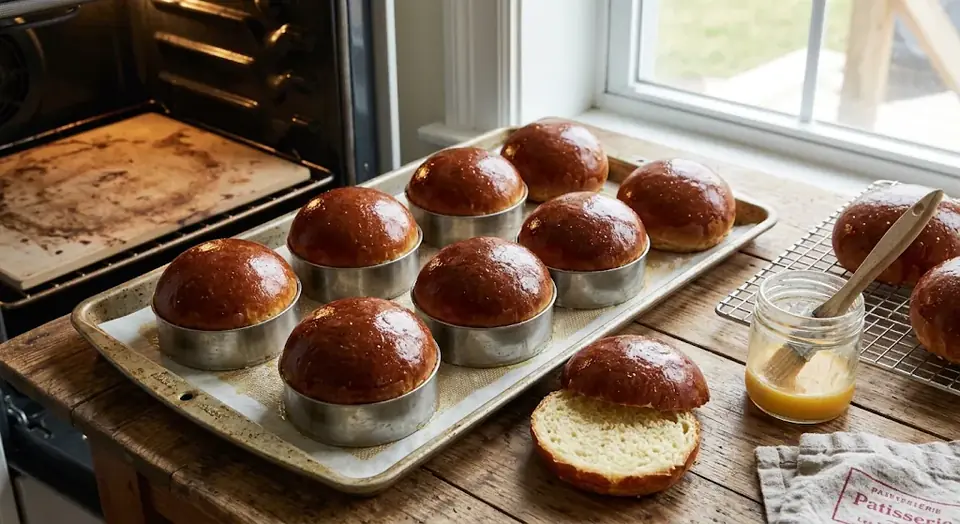
Press each ball into a disc 9 cm across and set it in a greased 10 cm ring on a lined tray, or straight onto the tray if you accept a wider, lower bun. Brush with egg wash now, thinly.
-
Prove 2–2½ hours at 24°C, until half again in size and wobbling when the tray is nudged. Keep it below 26°C: past that the butter renders out and pools on the paper, and the crumb bakes coarse and damp.
-
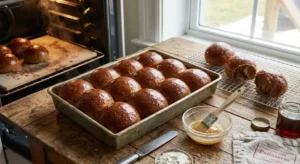
Wash a second time, very lightly, and bake at 190°C / 375°F for 16–18 minutes, until glossy and deep chestnut, to an internal 88–90°C. This much sugar and butter browns early, so tent with foil if the tops darken before the centers are set.
-
Rest 5 minutes in the rings, then cool on a rack at least an hour before splitting. The crumb is held together by butter that is still liquid when the bun leaves the oven; cut it warm and you get a smeared, dense face instead of a clean one.
Cook’s notes
- To serve and keep
- Split and toast the faces in butter for burgers, or eat the buns as they are with jam and coffee, which is what they are actually for. Store in a paper bag at room temperature — the fridge turns a brioche stale and waxy in a day. Day-three buns make the best pain perdu you will ever make.

Where it comes from
Brioche appears in French by the early fifteenth century, and Normandy has the strongest claim on it — a butter country with a butter bread. The name's derivation is still argued: one camp takes it from brier, the Norman verb for working dough with a wooden roller, another from broyer, to grind or pound. What is not in dispute is that brioche was always defined by proportion rather than shape, and French pastry teaching still grades it that way — commune at roughly 30% butter, riche at 50 to 60%, mousseline at 80% and above, the last so soft it is baked in a collar to hold it up. Shapes came later and locally: the topknotted brioche à tête, the tinned brioche de Nanterre, the sugar-crusted brioches of Vendée and Saint-Genix. The line about the great princess and the brioche comes from Rousseau's Confessions, written around 1765, and refers to no one identifiable; Marie-Antoinette was a child in Vienna at the time and never said it.
Brioche Buns: quick answers
How long does Brioche Buns take?
About 20 hours.
How many does this Brioche Buns recipe make?
This recipe makes 8 buns.
Where does Brioche Buns come from?
Brioche appears in French by the early fifteenth century, and Normandy has the strongest claim on it — a butter country with a butter bread. The name's derivation is still argued: one camp takes it from brier, the Norman verb for working dough with a wooden roller, another from broyer, to grind or pound. What is not in dispute is that brioche was always defined by proportion rather than shape, and French pastry teaching still grades it that way — commune at roughly 30% butter, riche at 50 to 60%, mousseline at 80% and above, the last so soft it is baked in a collar to hold it up. Shapes came later and locally: the topknotted brioche à tête, the tinned brioche de Nanterre, the sugar-crusted brioches of Vendée and Saint-Genix. The line about the great princess and the brioche comes from Rousseau's Confessions, written around 1765, and refers to no one identifiable; Marie-Antoinette was a child in Vienna at the time and never said it.
More from France




More in Rolls, Buns & Bagels

https://www.atlasserie.com/recipes/bread/brioche-buns/