United States · The Griddle Counter · 39.87° N, 98.73° W
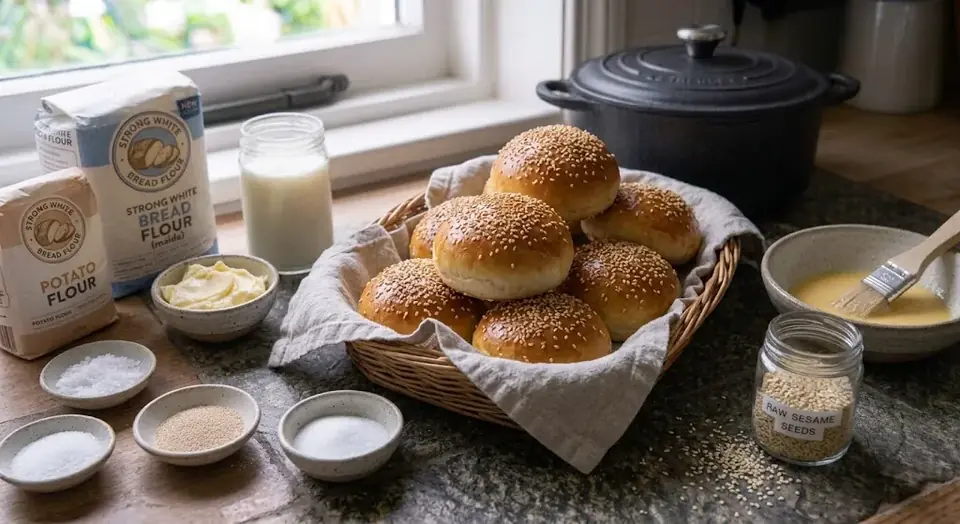
Sesame Burger Buns
Glossy sesame-topped buns built to survive a burger intact.
At a glance.
Sesame Burger Buns comes from United States · The Griddle Counter and appears in The Bread Atlas, in the chapter Rolls, Buns & Bagels. It makes 8 buns, is made by oven 190°c / 375°f, and uses 12 ingredients and 11 steps.
- Yield
- Makes 8 buns
- Method
- Oven 190°C / 375°F, 3¾ hours
Ingredients
Tap an ingredient to tick it off.
- The Dough
- Egg Wash
- Sesame Coating
Method
-
Whisk both flours with the sugar, salt and yeast. Warm the milk to 30°C, whisk the egg through it, and combine to a shaggy dough. Cover and rest 20 minutes — potato flour is slow to hydrate and needs the head start.
-
Knead 8–10 minutes, then add the butter in three additions and carry on until the dough is satiny and clears the bowl. Aim for a final dough temperature of 25°C. Enriched dough hides underdevelopment until the bun collapses under a patty.
-
Bulk ferment covered 70–90 minutes at 25°C, until risen by about three-quarters rather than fully doubled. Overshoot this and the crumb turns coarse and open, which is the beginning of a bun that leaks juice into your hands.
-
Divide into 8 pieces of about 120 g and round each one firmly, sealing the base. Rest 10 minutes uncovered so the surface dries slightly and takes the wash evenly later.
-
Flatten each ball with the flat of your hand to a disc 10 cm across and 2 cm thick. Press harder than feels right. A ball proves into a sphere, and a spherical bun cannot be sliced into two useful halves.
-
Set them well apart on two lined trays, cover, and prove 50–70 minutes at 25°C, until swollen to about 12 cm and slow to fill a light dent. Heat the oven to 190°C / 375°F.
-
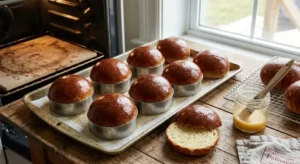
Beat the wash ingredients smooth and pass through a sieve if it looks stringy. Brush each bun thinly from the crown down to the shoulder — pooled wash at the base welds the bun to the paper and bakes into a hard brown collar.
-
Scatter the sesame over the wet wash from a height so it lands evenly, and press it very lightly with a fingertip. Seed applied to a dry surface falls off in the oven and again in the hand.
-
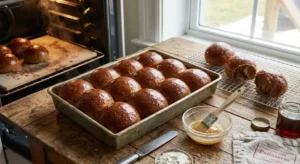
Bake 18–20 minutes, rotating at 12, until the tops are dark gold and the seeds toasted. The internal temperature should read 88–90°C; the base should be firm and pale bronze, not soft.
-
Cool on a rack for at least 45 minutes. The crumb is still setting as steam leaves it, and a bun split hot will compress into a paste under the knife rather than opening cleanly.
-
Split horizontally with a serrated knife and toast the cut faces in a dry pan or in the burger fat, 30–45 seconds, until spotted gold. That thin toasted layer is the waterproofing; it is why a good bun survives the second half of the burger.
Cook’s notes
- To serve and keep
- Assemble hot bun to hot patty and eat at once — every minute after cutting is a minute the bread is losing. Cheese goes on the patty, not the bread, and sauce goes on the toasted face where it belongs. Store cut side down under a cloth for a few hours, no longer.

Where it comes from
The hamburger arrived before its bread did. Ground-beef patties were sold from lunch wagons and fairground stands through the 1890s on whatever was to hand — a slice of bread, a roll, a split biscuit — and the round bun that now seems inevitable had to be designed. Walter Anderson, who opened the first White Castle stand in Wichita in 1921, is regularly credited with commissioning a bun proportioned to the patty, though the claim rests on company history rather than an independent record. What is certain is that the format standardized fast: by mid-century, American wholesale bakeries were turning out four-inch buns in clusters, sized to the machinery on both sides of the counter. Sesame came from the central European bakery habit of seeding rolls, and it became the bun's signature almost by accident when McDonald's put a sesame seed bun into the Big Mac jingle broadcast from 1974. The reaction of the 2000s went the other way, restaurants replacing the standard bun with potato, milk-bread and self-described brioche versions, most of which are this dough under another name.
Sesame Burger Buns: quick answers
How many does this Sesame Burger Buns recipe make?
This recipe makes 8 buns.
Where does Sesame Burger Buns come from?
The hamburger arrived before its bread did. Ground-beef patties were sold from lunch wagons and fairground stands through the 1890s on whatever was to hand — a slice of bread, a roll, a split biscuit — and the round bun that now seems inevitable had to be designed. Walter Anderson, who opened the first White Castle stand in Wichita in 1921, is regularly credited with commissioning a bun proportioned to the patty, though the claim rests on company history rather than an independent record. What is certain is that the format standardized fast: by mid-century, American wholesale bakeries were turning out four-inch buns in clusters, sized to the machinery on both sides of the counter. Sesame came from the central European bakery habit of seeding rolls, and it became the bun's signature almost by accident when McDonald's put a sesame seed bun into the Big Mac jingle broadcast from 1974. The reaction of the 2000s went the other way, restaurants replacing the standard bun with potato, milk-bread and self-described brioche versions, most of which are this dough under another name.
More from United States

More in Rolls, Buns & Bagels
https://www.atlasserie.com/recipes/bread/sesame-burger-buns/