
United States · New York · 39.87° N, 98.73° W
Sesame Bagels
The New York master formula: stiff dough, a cold night, the kettle.
At a glance.
Sesame Bagels comes from United States · New York and appears in The Bread Atlas, in the chapter Rolls, Buns & Bagels. It makes 8 bagels, takes about 20 hours, and uses 10 ingredients and 11 steps.
- Yield
- Makes 8 bagels
- Method
- Oven 220°C / 425°F
- Time
- 20 hours
Ingredients
Tap an ingredient to tick it off.
- The Dough
- The Kettle
- Sesame Coating
Method
-
Stir the malt syrup into the water at 20°C until it dissolves; cold syrup sits in a lump and never distributes. Whisk the flour, salt and yeast, add the liquid, and mix to a dry, unpromising dough. It is meant to look short of water.
-
Knead 10–12 minutes by hand or 8 minutes on a mixer's second speed, resting the machine if it strains. The dough should finish smooth, dense and barely tacky. A windowpane here will be thick and opaque rather than translucent — that is correct at 55% hydration.
-
Bulk ferment covered for only 60 minutes at 24°C. Most of the fermentation happens later, in the cold; this stage only wakes the yeast. Target a final dough temperature of 24°C.
-
Divide into 8 pieces of 100 g, round each one tightly against the counter, and rest 15 minutes under a cloth. A stiff dough fights any attempt to roll it straight from the divider, and the rest is what buys you an even rope.
-
Roll each ball into a rope 22 cm long, tapering slightly at the ends. Wrap it around four fingers so the ends overlap by 4 cm across your palm, then roll that overlap on the counter under your palm until the seam welds shut and vanishes.
-
Set the rings on an oiled, lined tray, cover tightly, and rest 20 minutes at room temperature before retarding 12–18 hours at 4°C. The cold night is where the flavor comes from — the acid and alcohol notes that make a bagel taste of more than flour.
-
In the morning, run a float test: drop one bagel into a bowl of cold water. It should surface within 10 seconds. If it sinks, leave the tray out for 20–30 minutes and test again. Return the tested bagel to the tray.
-
Bring the kettle to a rolling boil with the malt and bicarbonate, and heat the oven to 220°C / 425°F with a stone or heavy tray inside. Boil the bagels two or three at a time, 45 seconds a side, keeping the water moving.
-
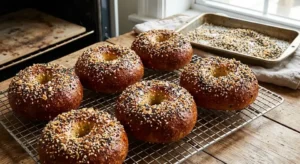
Lift each one out with a spider, let it drain for 5 seconds, then press the top face straight into the sesame tray while the surface is still streaming. Set them seeded side up on a sheet dusted with semolina.
-
Bake 18–22 minutes, rotating at 12, until deeply mahogany and the seeds are toasted; the internal temperature should reach 96–98°C. For the flat, hard bottom of a bakery bagel, flip them face-down onto the stone for the last 3 minutes, as the old boards-and-hearth method did.
-
Cool on a rack for 30 minutes at minimum. A bagel cut hot gums under the knife and tastes raw at the center — the crumb finishes setting as the steam leaves. Eat the same day, or freeze once cooled.
Cook’s notes
- To serve and keep
- Split, and argue about toasting — a fresh bagel wants none. Cream cheese schmeared thick, smoked salmon, capers, thin red onion, a grind of pepper. Store cut side down in paper for a few hours; after that, freeze rather than refrigerate, which stales it faster than the counter does.

Where it comes from
The bagel came out of Polish-Jewish baking, a cousin of the Kraków obwarzanek, a ring of dough scalded before baking. The document everyone cites is a 1610 Kraków community ordinance listing beygl among the gifts proper to a woman after childbirth; the ordinance is real, its exact reading is argued over, and it is best treated as evidence that ring breads were already familiar rather than as a birth certificate. The bread that matters here is the one built on the Lower East Side after the 1880s. New York's bagel trade organized itself around Bagel Bakers Local 338, formed in the 1930s, a closed shop of a few hundred hand-rollers whose sons inherited their cards and who supplied most of the city from cellar bakeries. Two things ended that world: Daniel Thompson's bagel-forming machine, developed through the 1960s, and Lender's of New Haven, which froze bagels and sold them nationally. The supermarket bagel that followed is larger, sweeter and softer, and a New Yorker will tell you it is a roll with a hole.
Sesame Bagels: quick answers
How long does Sesame Bagels take?
About 20 hours.
How many does this Sesame Bagels recipe make?
This recipe makes 8 bagels.
Where does Sesame Bagels come from?
The bagel came out of Polish-Jewish baking, a cousin of the Kraków obwarzanek, a ring of dough scalded before baking. The document everyone cites is a 1610 Kraków community ordinance listing beygl among the gifts proper to a woman after childbirth; the ordinance is real, its exact reading is argued over, and it is best treated as evidence that ring breads were already familiar rather than as a birth certificate. The bread that matters here is the one built on the Lower East Side after the 1880s. New York's bagel trade organized itself around Bagel Bakers Local 338, formed in the 1930s, a closed shop of a few hundred hand-rollers whose sons inherited their cards and who supplied most of the city from cellar bakeries. Two things ended that world: Daniel Thompson's bagel-forming machine, developed through the 1960s, and Lender's of New Haven, which froze bagels and sold them nationally. The supermarket bagel that followed is larger, sweeter and softer, and a New Yorker will tell you it is a roll with a hole.
More from United States





More in Rolls, Buns & Bagels
https://www.atlasserie.com/recipes/bread/sesame-bagels/