United States · New England · 39.87° N, 98.73° W
Hot Dog Buns
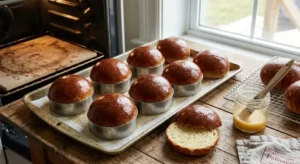
Top-split buns with bare flat sides made for butter and a griddle.
At a glance.
Hot Dog Buns comes from United States · New England and appears in The Bread Atlas, in the chapter Rolls, Buns & Bagels. It makes 8 buns, is made by oven 190°c / 375°f, and uses 9 ingredients and 11 steps.
- Yield
- Makes 8 buns
- Method
- Oven 190°C / 375°F, 3½ hours
Ingredients
Tap an ingredient to tick it off.
- The Dough
- For the Pan and the Tops
- Butter for Griddling
Method
-
Whisk the flour, sugar, salt and yeast. Add the milk at 30°C and mix to a soft dough. Rest 15 minutes, then knead 8 minutes, adding the soft butter in three additions once the dough has come together.
-
Continue to a smooth, slightly tacky dough that windowpanes without tearing, at a final temperature of 26°C. This crumb has to fold around a sausage without cracking, and that flexibility is bought with full gluten development, not with extra fat.
-
Bulk ferment covered 70–90 minutes at 25°C, until doubled and slack enough that a finger pressed into the surface leaves a dent that barely recovers. A soft, well-fermented dough is what allows the bun to fold around a sausage later without cracking.
-
Butter the tin generously, sides included. Divide the dough into 8 pieces of about 105 g and press each into a rectangle roughly 12 × 8 cm, knocking out the larger bubbles as you go.
-
Roll each rectangle up tightly from the long edge, pinching the seam shut along its whole length, then roll it under your palms into an even log 13 cm long. An unsealed seam unrolls in the oven and splits the bun open along its flank.
-
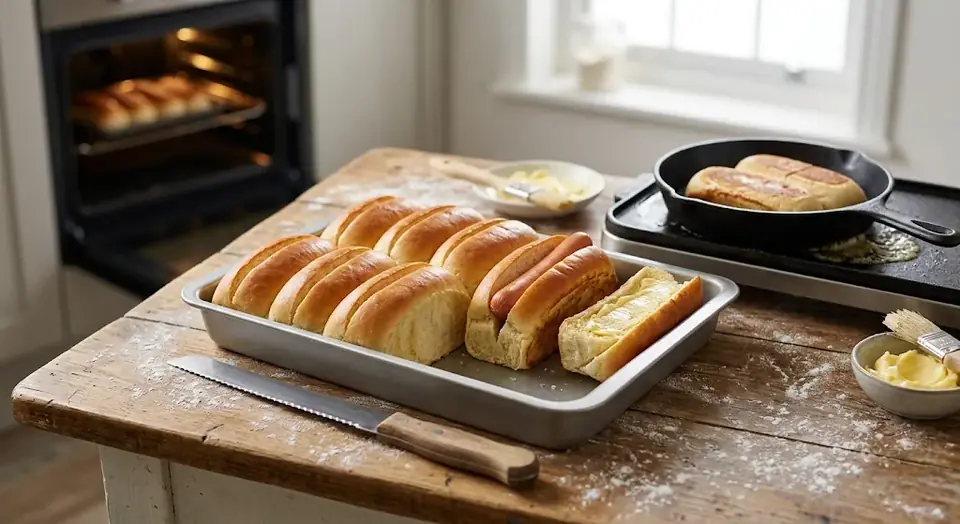
Lay the logs in the tin, seam down, running across the short dimension with about 1 cm between them and a gap at each end. They should be close enough to fuse into a slab, which is the entire mechanism of this bun.
-
Prove covered 45–60 minutes at 25°C, until the logs touch along their whole length, have risen to about 5 cm, and hold a shallow dent from a fingertip. Set the oven to 190°C / 375°F, rack in the lower third.
-
Brush the tops with milk — not egg. Egg builds a shiny, chewy crust; milk browns to a matte pale gold and leaves a crown soft enough to cut through without crushing the bun.
-
Bake 18–22 minutes, rotating once, until the tops are light gold and the internal temperature reads 88–90°C. The buns should be joined into one block with white, tender walls where they met.
-
Cool in the tin 5 minutes, then lift the slab out onto a rack and cool completely, at least 45 minutes. Cut them apart warm and the soft walls smear rather than separate.
-
Separate the buns with a serrated knife, sawing straight down the fused seams to leave two clean bare sides on each. Split the crown two-thirds of the way down, butter the outer sides, and griddle them in a dry pan over medium heat, 1–2 minutes a side, until crisp and gold.
Cook’s notes
- To serve and keep
- Griddled in butter, always, and filled while the sides are still crisp — hot dogs with mustard and relish, fried clams, or lobster with mayonnaise and celery. Store in the bag they cooled in, and refresh a stale bun by griddling it a little longer rather than reheating it in the oven.

Where it comes from
There are two hot dog buns in America and they are not interchangeable. The side-split bun is the national default: baked in clusters, hinged along one edge, torn from its neighbors at the table. The top-split — the New England frankfurter roll — is cut square, split down the crown, and leaves two bare vertical sides where the buns were pulled apart. The story usually told is that the J. J. Nissen bakery in Maine developed it in the 1940s at the request of Howard Johnson's, whose restaurants wanted a roll that would stand upright on a plate and could be buttered and griddled like a piece of toast; the account appears in company histories and newspaper features and is thin on primary documentation. Its consequences are not in doubt. Once the sides were flat and crustless, they could be browned in butter on the flat top, and that griddled plane is why New England lobster rolls, clam rolls and hot dogs are all served in this bun and nowhere else in the country by default.
Hot Dog Buns: quick answers
How many does this Hot Dog Buns recipe make?
This recipe makes 8 buns.
Where does Hot Dog Buns come from?
There are two hot dog buns in America and they are not interchangeable. The side-split bun is the national default: baked in clusters, hinged along one edge, torn from its neighbors at the table. The top-split — the New England frankfurter roll — is cut square, split down the crown, and leaves two bare vertical sides where the buns were pulled apart. The story usually told is that the J. J. Nissen bakery in Maine developed it in the 1940s at the request of Howard Johnson's, whose restaurants wanted a roll that would stand upright on a plate and could be buttered and griddled like a piece of toast; the account appears in company histories and newspaper features and is thin on primary documentation. Its consequences are not in doubt. Once the sides were flat and crustless, they could be browned in butter on the flat top, and that griddled plane is why New England lobster rolls, clam rolls and hot dogs are all served in this bun and nowhere else in the country by default.
More from United States


More in Rolls, Buns & Bagels


https://www.atlasserie.com/recipes/bread/hot-dog-buns/