Canada · Montreal · 58.45° N, 97.86° W
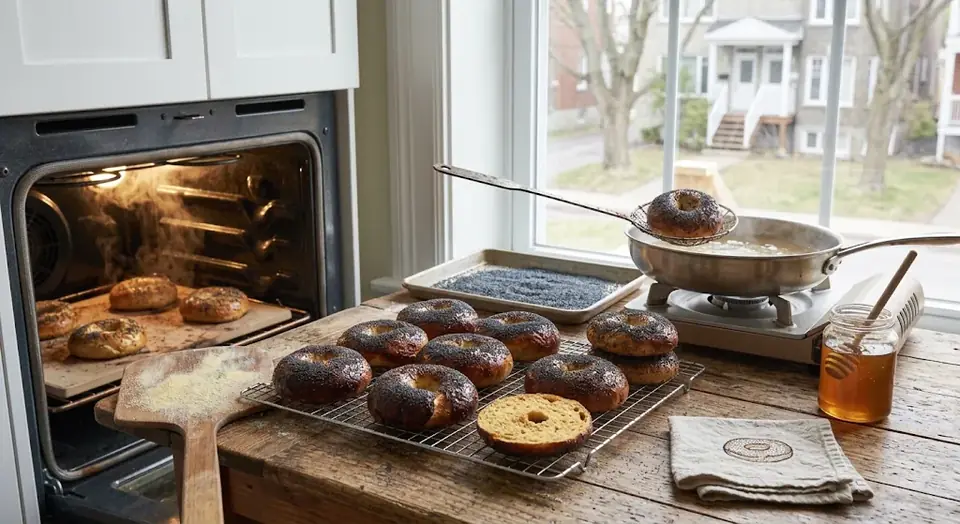
Poppy Seed Bagels
Montreal-style: honey in the kettle, no salt, a wide open hole.
At a glance.
Poppy Seed Bagels comes from Canada · Montreal and appears in The Bread Atlas, in the chapter Rolls, Buns & Bagels. It makes 12 bagels, takes about 5 hours, and uses 11 ingredients and 11 steps.
- Yield
- Makes 12 bagels
- Method
- Oven 260°C / 500°F
- Time
- 5 hours
Ingredients
Tap an ingredient to tick it off.
- The Dough
- The Honey Kettle
- Poppy Seed Tray
Method
-
Beat the egg, oil, honey and water at 20°C together until the honey has dissolved, then mix into the flour and yeast. The dough will be very stiff and slightly slick from the oil. Knead 12 minutes to a smooth, dense mass at a final temperature of 24°C.
-
Bulk ferment 60–75 minutes at 24°C. Without salt the yeast runs unchecked, so this stage is short by design and the dough should rise by about half rather than doubling. If your kitchen is above 26°C, cut it to 45 minutes.
-
Divide into 12 pieces of 65 g — noticeably smaller than a New York bagel, and deliberately so, since a dense sweet dough eats better in a smaller unit. Round each piece and rest it 10 minutes under a cloth.
-
Roll each ball into a rope 24 cm long. Wrap it around your palm so the ends cross by 4 cm, then roll the join against the counter until it welds. Open the ring until the hole is 4–5 cm across, wider than looks sensible.
-
The wide hole is the Montreal signature and it is functional. A small, dense, sweet bagel expands more in a very hot oven than a New York bagel does in a moderate one, and a modest hole will close entirely.
-
Prove uncovered on lined trays for 20–30 minutes at 24°C, only until the rings look slightly puffed. There is no overnight retard here. The flavor comes from honey, egg and smoke rather than from long fermentation.
-
Heat the oven as high as it will go with a baking steel or stone on the upper-middle shelf — 260°C / 500°F, and higher if the oven allows. Bring the kettle to a rolling boil and stir in the honey.
-
Boil the bagels four at a time for 60 seconds a side. They will bob, darken slightly and take on a lacquered look. Longer than this and the sugar coat thickens into something that scorches before the crumb has set.
-
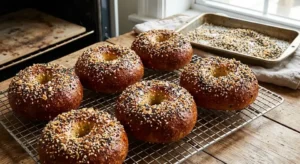
Lift out with a spider, drain briefly, and press both faces into the poppy tray — Montreal bagels are seeded generously on both sides, not the crown alone. Set them on a semolina-dusted peel or tray.
-
Bake 12–15 minutes on the stone, turning each bagel over with tongs at the halfway mark so both seeded faces meet the heat, until the crust is dark, blistered and the honey has caramelized at the edges. Internal temperature 96–98°C.
-
Cool on a rack for 15 minutes and eat them warm — that is the whole point of this bagel, and it is why both Mile End bakeries never close. What is not eaten within a few hours should be bagged and frozen the same day.
Cook’s notes
- To serve and keep
- Eaten warm from the paper bag on the walk home, plain, unsplit and untoasted — locals will tell you toasting a fresh Montreal bagel is a confession. Otherwise cream cheese, or butter, or smoked salmon on the day-old ones. Store in paper for a day and freeze the rest; the fridge is the wrong place for any bagel.

Where it comes from
Montreal's bagel came from the same Polish-Jewish emigration as New York's and turned out differently. Isadore Shlafman was baking bagels in the city from 1919 and moved his bakery to Fairmount Street in 1949, where Fairmount Bagel still is; in 1957 Myer Lewkowicz, who had survived Buchenwald, opened St-Viateur a few blocks away, and the two shops have been the argument ever since — both in Mile End, both open around the clock, both baking in wood-fired ovens on long-handled planks. The rivalry is real but domestic; a great many Montrealers buy from whichever is nearer. The bagels themselves are smaller and sweeter than New York's, boiled in honeyed water, made without salt, hand-rolled with a wide hole, and marked by wood smoke. Which city makes the better bagel is unresolvable, because the two are answering different questions: Montreal wants a bagel eaten warm out of the paper bag, New York wants one that will carry cream cheese and lox. Gregory Chamitoff took a bag of St-Viateur sesame to the International Space Station in 2008, which settles nothing.
Poppy Seed Bagels: quick answers
How long does Poppy Seed Bagels take?
About 5 hours.
How many does this Poppy Seed Bagels recipe make?
This recipe makes 12 bagels.
Where does Poppy Seed Bagels come from?
Montreal's bagel came from the same Polish-Jewish emigration as New York's and turned out differently. Isadore Shlafman was baking bagels in the city from 1919 and moved his bakery to Fairmount Street in 1949, where Fairmount Bagel still is; in 1957 Myer Lewkowicz, who had survived Buchenwald, opened St-Viateur a few blocks away, and the two shops have been the argument ever since — both in Mile End, both open around the clock, both baking in wood-fired ovens on long-handled planks. The rivalry is real but domestic; a great many Montrealers buy from whichever is nearer. The bagels themselves are smaller and sweeter than New York's, boiled in honeyed water, made without salt, hand-rolled with a wide hole, and marked by wood smoke. Which city makes the better bagel is unresolvable, because the two are answering different questions: Montreal wants a bagel eaten warm out of the paper bag, New York wants one that will carry cream cheese and lox. Gregory Chamitoff took a bag of St-Viateur sesame to the International Space Station in 2008, which settles nothing.
More from Canada




More in Rolls, Buns & Bagels
https://www.atlasserie.com/recipes/bread/poppy-seed-bagels/