United States & Korea · Soda-Fountain Lineage · 39.87° N, 98.73° W
Banana Smoothie
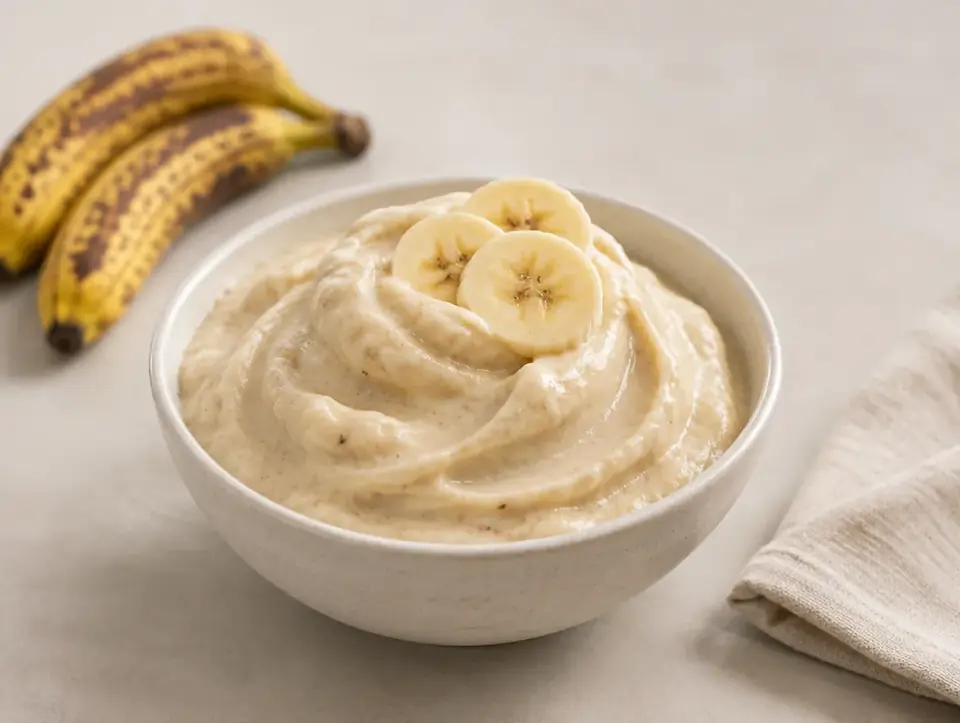
Two black-speckled bananas, frozen in coins, blended thick without any cream.
At a glance.
Banana Smoothie comes from United States & Korea · Soda-Fountain Lineage and appears in The Breakfast Atlas, in the chapter Smoothies & Breakfast Drinks. It serves 1, takes about 4 hr 10 min, and uses 8 ingredients and 10 steps.
- Yield
- Serves 1
- Method
- Blender
- Time
- 4 hr 10 min
Ingredients
Tap an ingredient to tick it off.
Method
-
Ripen the fruit properly first. A green-tipped banana is about 20 percent starch; as it ripens, its own amylase enzymes convert nearly all of that to sugar, leaving under 1 percent starch in a heavily speckled fruit. Buy them a week early and wait.
-
Speed the process if you must by closing the bananas in a paper bag with an apple. Ethylene given off by both fruits accumulates in the bag and drives ripening forward, in a day or two rather than five.
-
Peel before freezing, always. A frozen skin welds itself to the flesh and you will end up gouging the fruit out in shreds while it thaws in your hands.
-
Slice into 2 cm coins and freeze in a single layer on a lined tray for 4 hours, then bag them. Whole frozen bananas jam against the blades and stall even a powerful motor.
-
Soak the oats in the milk for 5 minutes before blending. Hydrated oats release beta-glucan, a soluble fiber that thickens the drink, and they blend to smoothness instead of grit.
-
Blend the milk, oats, malted milk powder and salt for 15 seconds to a smooth base. Doing this alone means the oats are broken down before the jar goes cold and thick.
-
Add the frozen coins, start low, then take it to full speed for 50–60 seconds, pushing the fruit down onto the blades with a tamper as it climbs the wall.
-
Add the cinnamon and vanilla and pulse twice. Ground spice blended for a full minute goes muddy and bitter; a couple of pulses is all it needs to distribute.
-
Check the thickness with a spoon. Lift and let it fall: the drink should hold a ribbon on the surface for a second or two before sinking. Loosen with milk 15 ml at a time.
-
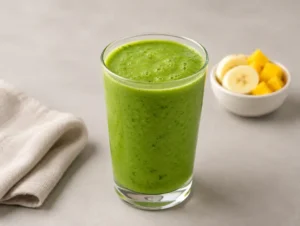
Pour into a chilled glass, dust with cinnamon and drink at once, while it is still the color of ivory.
Cook’s notes
- The technique
- Banana is its own thickener and its own emulsifier, and freezing is what turns it into something like ice cream. Ice crystals form inside the fruit's cells; the blades shear those frozen cells into particles fine enough to feel creamy on the tongue, while the fruit's pectin holds water and air in suspension. The creamiest ratio without any dairy fat is about 240 g of frozen banana to 150 ml of liquid, near 1.6 to 1. Add more liquid and it becomes a drink rather than a spoonable one.
- Make ahead
- Freeze coins in 120 g portions and they keep three months. Bananas that have gone too far for the fruit bowl can be peeled and frozen on the spot rather than thrown out. The blended drink cannot be held — polyphenol oxidase browns the cut flesh within twenty minutes.
- Troubleshooting
- Gray-brown color — oxidation; add 5 ml lemon juice, or work faster. Icy and grainy rather than creamy — bananas frozen while still yellow, so there was not enough sugar to depress the freezing point. Thin and sweet with no body — no oats, or too much milk. Warm and dull — over a minute at full speed.
- Variations
- Korean banana milk is thinner and meant for a bottle: blend one ripe banana with 200 ml cold milk, 10 g sugar and a pinch of salt, then chill hard. The soda-fountain banana malt adds 20 g malted milk powder and a scoop of vanilla ice cream. A Brazilian vitamina de banana blends banana with papaya, oats and cold milk, and is drunk at breakfast rather than as a dessert.
- Serve with
- Serve it in a tall chilled glass with a wide straw and cinnamon toast alongside, or with a shot of espresso poured over the top for an improvised affogato. It is thick enough to stand as breakfast on its own.

Where it comes from
Bananas arrived in American cities as an expensive novelty in the late nineteenth century and had become everyday fruit by the 1910s, which put them within reach of the soda fountain. Malted milk powder, patented by William Horlick in Racine, Wisconsin in 1883, gave fountain operators a thickener that tasted of toasted grain, and the banana malt joined the banana split on their menus — the split's origin is claimed by both Latrobe, Pennsylvania, where David Strickler is said to have built one in 1904, and Wilmington, Ohio, and the evidence does not settle it. A second lineage runs through Korea. Binggrae launched Banana Flavored Milk in 1974 in a squat, pot-bellied bottle modeled on a traditional earthenware danji jar, at a moment when the government was pushing domestic milk consumption and banana was still a costly import. The flavor read as luxury, and the bottle became a national fixture sold on train platforms and in bathhouses. Both traditions solved the same problem: banana carries dairy flavor and gives body without any cream at all.
Banana Smoothie: quick answers
How long does Banana Smoothie take?
About 4 hr 10 min.
How many does this Banana Smoothie recipe make?
This recipe serves 1.
Where does Banana Smoothie come from?
Bananas arrived in American cities as an expensive novelty in the late nineteenth century and had become everyday fruit by the 1910s, which put them within reach of the soda fountain. Malted milk powder, patented by William Horlick in Racine, Wisconsin in 1883, gave fountain operators a thickener that tasted of toasted grain, and the banana malt joined the banana split on their menus — the split's origin is claimed by both Latrobe, Pennsylvania, where David Strickler is said to have built one in 1904, and Wilmington, Ohio, and the evidence does not settle it. A second lineage runs through Korea. Binggrae launched Banana Flavored Milk in 1974 in a squat, pot-bellied bottle modeled on a traditional earthenware danji jar, at a moment when the government was pushing domestic milk consumption and banana was still a costly import. The flavor read as luxury, and the bottle became a national fixture sold on train platforms and in bathhouses. Both traditions solved the same problem: banana carries dairy flavor and gives body without any cream at all.
More from United States
More in Smoothies & Breakfast Drinks
https://www.atlasserie.com/recipes/breakfast/banana-smoothie/