United States · The Raw-Food Revival · 39.87° N, 98.73° W
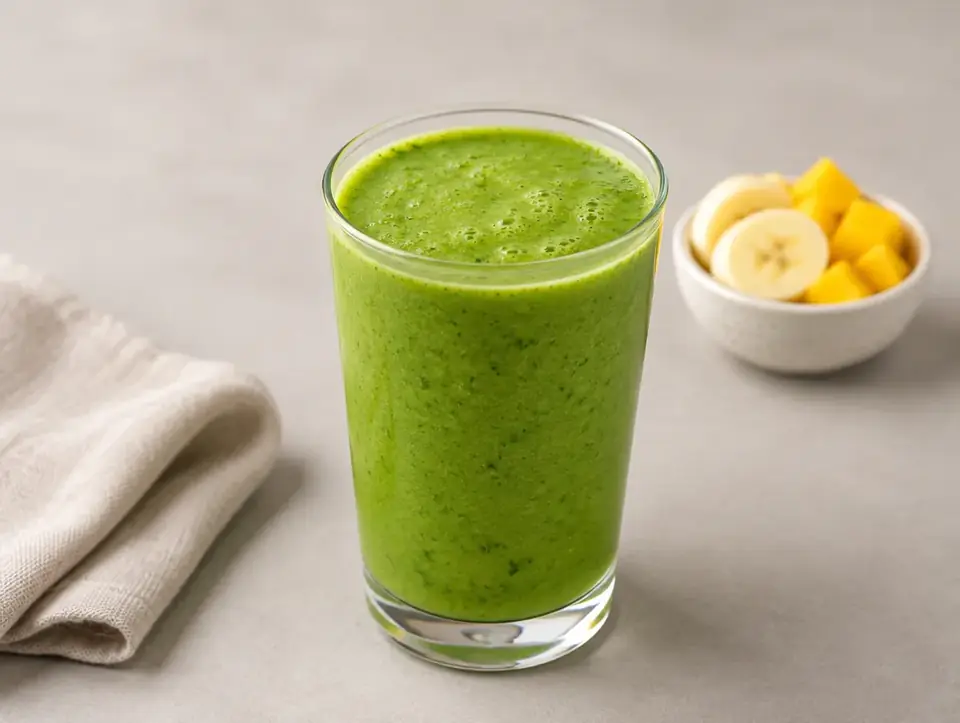
Green Smoothie
Leaves blended to a vortex first, fruit second, by the 60/40 rule.
At a glance.
Green Smoothie comes from United States · The Raw-Food Revival and appears in The Breakfast Atlas, in the chapter Smoothies & Breakfast Drinks. It serves 1, takes about 8 minutes, and uses 8 ingredients and 9 steps.
- Yield
- Serves 1
- Method
- Blender
- Time
- 8 minutes
Ingredients
Tap an ingredient to tick it off.
Method
-
Strip the tough midribs from kale or chard and discard them. They are lignified enough that no domestic blender will reduce them, and they surface later as green threads that catch in the straw.
-
Load the leaves and all 250 ml of liquid — nothing else. This first stage is the whole point of the recipe, and it needs the leaves loose in free water to work.
-
Blend on high for 45–60 seconds until the jar holds a smooth green liquid with no visible flecks. Stop and look against the light; specks now mean specks in the glass.
-
Confirm the vortex before you go on. The surface should hold a steady funnel drawing down to the blades. A stalled, domed surface means the jar is too full or the speed too low.
-
Add the frozen mango, banana coins, ginger and salt. Fruit added at this stage sits in a liquid that is already thin enough to circulate around it.
-
Ramp from low to high again and blend 50–60 seconds, tamping the fruit downward once or twice. The mix will thicken visibly as the frozen fruit breaks up.
-
Add the lime juice at the end, off the blade, and pulse twice. Acid added early dulls the chlorophyll to a drab olive; added last it keeps the green bright and lifts the mango.
-
Taste for balance. Kale and chard need more acid and a little fat to sit right; if the drink reads bitter and green rather than fruity, add the seeds and another 5 ml of lime.
-
Pour and drink within ten minutes. Chlorophyll oxidizes in contact with air and acid, and the color slides from grass toward khaki as it stands.
Cook’s notes
- The technique
- Blend order decides texture. Leaves are sheets of cellulose that need to be caught in a moving current and shredded against themselves; put fruit in first and the mix thickens into a slurry that holds leaf fragments still, safely out of the blades' reach. Boutenko's 60/40 rule is 60 percent fruit to 40 percent greens by volume, which on the scale means roughly 260 g of fruit to 60 g of leaf, because leaves weigh almost nothing.
- Make ahead
- Blend the greens and water alone, then freeze the green liquid in an ice-cube tray; six cubes plus fruit gives a one-minute drink. Washed leaves keep four days wrapped in a damp cloth. Do not blend the whole drink ahead — it separates and browns.
- Troubleshooting
- Green threads in the glass — midribs not stripped, or the first blend cut short. Swampy, cabbage-like taste — too high a proportion of leaf, and no acid to lift it. Gritty mouthfeel — chia seeds added dry rather than soaked. Khaki color — acid went in too early.
- Variations
- A tropical green swaps water for coconut water and mango for pineapple, with a handful of mint. A low-oxalate rotation uses romaine, bok choy or parsley instead of spinach, chard and beet greens, which carry several hundred milligrams of oxalate per 100 g — worth alternating day to day, and worth taking seriously if you are prone to calcium-oxalate stones. A savory version drops the banana and adds cucumber, celery and a pinch of black pepper.
- Serve with
- This is a drink to have before food rather than with it. Serve very cold in a tall glass, with a wedge of lime on the rim, and follow it with eggs or toast — on its own it will not hold anyone to lunchtime.

Where it comes from
Blended raw leaves belong to the health movements of the 1990s and 2000s rather than to any older kitchen. Raw foodism had circulated in European and American reform circles since the nineteenth century, but its modern form — uncooked, plant-only, built around juices and blenders — took hold in California and Colorado in the 1990s. Victoria Boutenko, a Russian émigré who had moved her family onto a raw diet after a family health crisis, is the person most responsible for the green smoothie itself. Her 2005 book Green for Life argued that people ate far fewer leaves than they needed and that a blender could do what chewing does not, and the drink spread outward through raw-food networks, then gyms, then supermarket chillers. Her supporting argument drew on comparisons with chimpanzee diets and has been fairly criticized, but the practical claim survives it: high-speed blades rupture plant cell walls and put a bowl of raw leaves within reach of anyone who will not sit down to a salad. By the 2010s the drink had left the movement entirely and become café furniture.
Green Smoothie: quick answers
How long does Green Smoothie take?
About 8 minutes.
How many does this Green Smoothie recipe make?
This recipe serves 1.
Where does Green Smoothie come from?
Blended raw leaves belong to the health movements of the 1990s and 2000s rather than to any older kitchen. Raw foodism had circulated in European and American reform circles since the nineteenth century, but its modern form — uncooked, plant-only, built around juices and blenders — took hold in California and Colorado in the 1990s. Victoria Boutenko, a Russian émigré who had moved her family onto a raw diet after a family health crisis, is the person most responsible for the green smoothie itself. Her 2005 book Green for Life argued that people ate far fewer leaves than they needed and that a blender could do what chewing does not, and the drink spread outward through raw-food networks, then gyms, then supermarket chillers. Her supporting argument drew on comparisons with chimpanzee diets and has been fairly criticized, but the practical claim survives it: high-speed blades rupture plant cell walls and put a bowl of raw leaves within reach of anyone who will not sit down to a salad. By the 2010s the drink had left the movement entirely and become café furniture.
More from United States



More in Smoothies & Breakfast Drinks


https://www.atlasserie.com/recipes/breakfast/green-smoothie/