Punjab, India · The Lassi Lineage · 22.82° N, 79.54° E
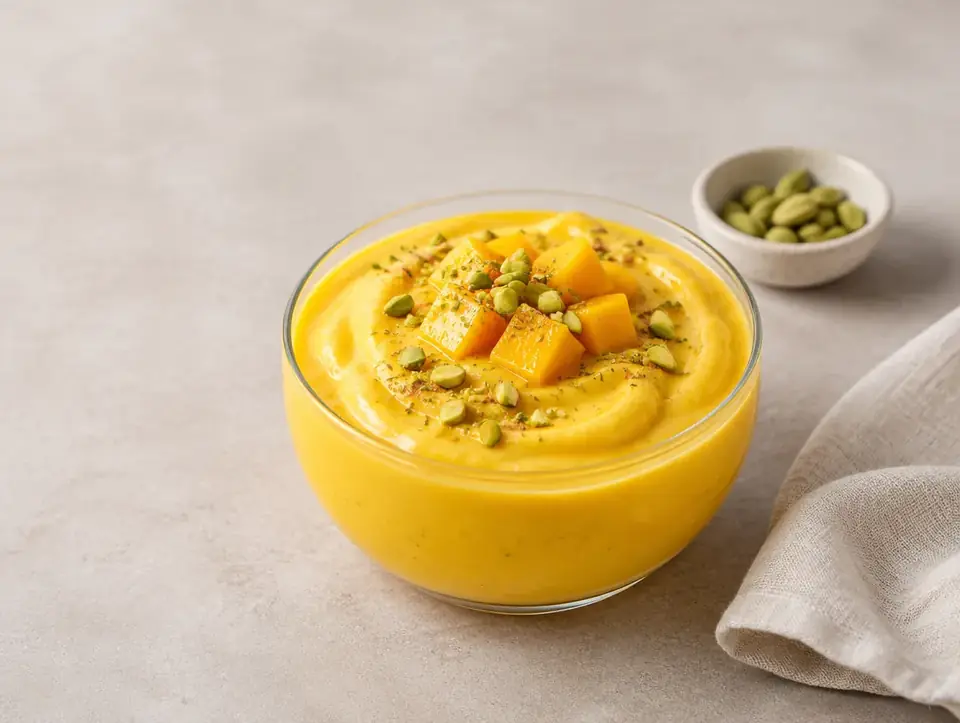
Mango Smoothie
Alphonso pulp folded through cold dahi, cardamom-scented, thicker than any smoothie.
At a glance.
Mango Smoothie comes from Punjab, India · The Lassi Lineage and appears in The Breakfast Atlas, in the chapter Smoothies & Breakfast Drinks. It serves 2, takes about 15 minutes, and uses 8 ingredients and 9 steps.
- Yield
- Serves 2
- Method
- Blender
- Time
- 15 minutes
Ingredients
Tap an ingredient to tick it off.
Method
-
Choose fruit by nose and hand. A ripe Alphonso gives slightly at the shoulder and smells resinous and sweet at the stem end. Color tells you nothing useful; Kesar stays green-skinned when ready.
-
Slice the two cheeks away from either side of the flat stone, score the flesh in a grid down to the skin, and push the skin inside out to lift the cubes free. Scrape the stone as well; it holds a good tablespoon.
-
Judge the fiber before blending. Alphonso and Kesar are fiberless and blend clean. Totapuri, Badami and most local desi mangoes are stringy, and are better pushed through a sieve with the back of a ladle than whipped in a jar.
-
Grind the cardamom yourself. Crack four pods, discard the papery husks, and pound the black seeds to a powder in a mortar. Pre-ground cardamom loses its volatile oils within weeks and tastes of little but dust.
-
Blend the mango, sugar and salt alone for 20 seconds, until you have a smooth, glossy pulp with no lumps. Everything that needs real blending happens now, before the yogurt goes anywhere near the blades.
-
Add the chilled yogurt and the milk and blend for no more than 10 seconds on the lowest speed. Long blending is the single mistake that ruins this drink.
-
Stir in the ground cardamom by hand. Check the body: it should coat the back of a spoon and pour slowly, in a thick rope rather than a stream.
-
Loosen with cold milk 15 ml at a time if it is too heavy to drink. Resist ice entirely — it dilutes as it melts and mutes both the cardamom and the fruit.
-
Swirl in the saffron milk with a spoon so it streaks rather than blends, pour into chilled steel tumblers, and scatter the pistachios over the surface.
Cook’s notes
- The technique
- The ratio is the definition. Two hundred grams of yogurt to 300 g of fruit, with only 60 ml of free liquid, gives a drink that is dairy-led and barely thinned — a lassi. A smoothie inverts that: fruit-led, loosened with milk or juice, blended hard. The second rule follows from the first. Yogurt is a set gel of casein, and sustained shear tears that gel apart, releasing whey and turning a thick drink watery within seconds. Blend the fruit; fold in the dahi.
- Make ahead
- Purée and sweeten the mango up to two days ahead, or freeze it in an ice-cube tray for months. Bring it back to fridge-cold and blend in the yogurt at the last moment. A finished lassi left overnight separates, and no amount of stirring brings it back.
- Troubleshooting
- Thin and watery — over-blended, or the yogurt was low-fat; strain full-fat yogurt for 30 minutes to fix it next time. Sour and sharp — the dahi has aged; add 20 g cream and a little more sugar. Stringy on the tongue — a fibrous variety, so sieve rather than blend. Tasting flat despite being sweet — salt was left out.
- Variations
- Namkeen lassi drops fruit and sugar entirely for salt, roasted cumin and crushed mint, and is drunk at midday in the Punjab heat. A halwai's sweet lassi is churned with a wooden madani and topped with malai and a drop of rose water. Gujarati chaas is thinner still, spiked with green chilli and asafoetida. Mumbai juice-bar mango shake uses milk instead of yogurt and is sweeter and looser.
- Serve with
- Serve in a chilled steel tumbler beside parathas, or after a heavy meal as a cooling counterweight. A slick of malai on top is traditional at a halwai's counter, and the pistachios are not decoration — the salt and fat in them sharpen the fruit.

Where it comes from
Lassi belongs to Punjab, on both sides of the border, where it answers the heat and a summer surplus of milk. It begins with dahi — milk soured overnight with a spoonful of yesterday's curd — churned with water in a tall pot until it foams. Salted lassi, namkeen, seasoned with roasted cumin and black salt, is the older everyday form; the sweet version, crowned with a slab of malai, belongs to the halwai's shop and to weddings, and Lahore and Amritsar each claim the definitive glass. Mango lassi is a much later arrival and largely a restaurant drink: it turns up on Indian menus in Britain and North America from the later twentieth century and is usually described as a diaspora creation rather than a village one, since fresh mango in season was drunk on its own or sucked straight from the skin. The season is short, roughly April to July. Alphonso, from Ratnagiri and Devgad in Maharashtra, and Kesar, from the Gir foothills in Gujarat, both hold Geographical Indication status and both have the dense, fiberless flesh this drink needs.
Mango Smoothie: quick answers
How long does Mango Smoothie take?
About 15 minutes.
How many does this Mango Smoothie recipe make?
This recipe serves 2.
Where does Mango Smoothie come from?
Lassi belongs to Punjab, on both sides of the border, where it answers the heat and a summer surplus of milk. It begins with dahi — milk soured overnight with a spoonful of yesterday's curd — churned with water in a tall pot until it foams. Salted lassi, namkeen, seasoned with roasted cumin and black salt, is the older everyday form; the sweet version, crowned with a slab of malai, belongs to the halwai's shop and to weddings, and Lahore and Amritsar each claim the definitive glass. Mango lassi is a much later arrival and largely a restaurant drink: it turns up on Indian menus in Britain and North America from the later twentieth century and is usually described as a diaspora creation rather than a village one, since fresh mango in season was drunk on its own or sucked straight from the skin. The season is short, roughly April to July. Alphonso, from Ratnagiri and Devgad in Maharashtra, and Kesar, from the Gir foothills in Gujarat, both hold Geographical Indication status and both have the dense, fiberless flesh this drink needs.
More from India




More in Smoothies & Breakfast Drinks


https://www.atlasserie.com/recipes/breakfast/mango-smoothie/