Valencia & Florida · Citrus · 40.32° N, 3.62° W
Fresh Orange Juice
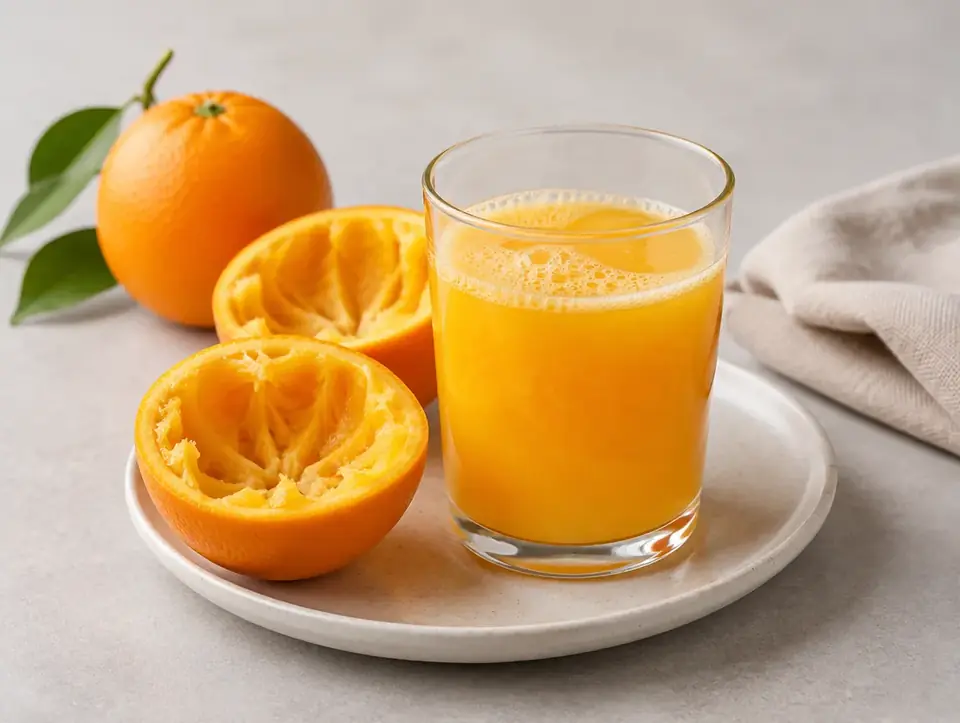
Valencias rolled, halved across the equator and reamed, drunk within the hour.
At a glance.
Fresh Orange Juice comes from Valencia & Florida · Citrus and appears in The Breakfast Atlas, in the chapter Smoothies & Breakfast Drinks. It serves 2, takes about 15 minutes, and uses 4 ingredients and 9 steps.
- Yield
- Serves 2
- Method
- No-cook
- Time
- 15 minutes
Ingredients
Tap an ingredient to tick it off.
Method
-
Take the fruit out of the fridge an hour ahead. Cold flesh is firm and holds onto its juice; at room temperature the same oranges give noticeably more, often a fifth again.
-
Roll each orange on the counter under the flat of your palm, pressing firmly enough to feel the fruit give. This ruptures the juice vesicles inside the segments so they release rather than resist.
-
Halve across the equator, not from stem to navel. Cutting through the middle of the segments opens every one of them to the reamer; cutting the other way leaves half of them intact and folded.
-
Choose your tool. A ridged wooden or glass reamer worked by hand tells you through your wrist exactly how deep you are going. An electric reamer is faster and fine for volume, but it will happily grind on past the point it should stop.
-
Ream with a quarter-turn back and forth rather than a full rotation, pressing steadily. Stop the moment the membrane inside goes white and slack. Grinding into the albedo drags bitter flavonoids and peel oil into the glass.
-
Never squeeze the peel itself. The oil in the rind is largely limonene, bracing in a twist of zest and harsh in any quantity, and it will make the juice taste of furniture polish.
-
Strain through a coarse sieve to catch seeds and torn membrane, but stop there. A fine sieve strips out the suspended pulp that carries much of the aroma and all of the body, leaving something thin and oddly sweet.
-
Taste, then add the pinch of salt if the fruit is very sweet. Salt suppresses bitterness more effectively than sugar covers it, and a barely detectable amount makes late-season oranges read brighter.
-
Pour into small chilled glasses and drink within fifteen minutes. If you must hold it, fill a bottle to the very brim so no air sits on top, cap it, and refrigerate for up to a day.
Cook’s notes
- The technique
- Fresh juice separates because crushing the fruit releases an enzyme, pectin methylesterase, that immediately begins stripping methyl groups from the pectin holding the cloud in suspension. The stripped pectin binds calcium, the particles clump, and within an hour a clear layer floats above a settled sediment. Shaking redistributes it but never fully restores it. Commercial juice is pasteurized precisely to kill that enzyme, which is why a carton stays uniform for weeks.
- Make ahead
- Juice keeps a day in a full, sealed bottle in the fridge, and freezes well in ice-cube trays for three months. Never juice navels ahead — their bitterness develops with time in the glass, so squeeze them to order or not at all.
- Troubleshooting
- Bitter after half an hour — navel oranges; switch to Valencias for juicing. Bitter from the first sip — you reamed into the white pith. Poor yield — cold fruit, or halved the wrong way. Watery and pale — over-strained, so the pulp has gone.
- Variations
- Sicilian spremuta uses blood oranges — Tarocco, Moro or Sanguinello — from December to April, and needs no additions. A Floridian half-and-half cuts the orange with ruby grapefruit for something drier and more bracing. Seville sour oranges are not for drinking straight, but their juice is the acid in a Yucatán marinade and in British marmalade.
- Serve with
- Serve cold but not iced, around 6–8°C, in small glasses rather than tumblers — this is a concentrated thing and half a glass is generous. Pastry and strong coffee are the standard company. Stir before pouring the second glass.

Where it comes from
Two oranges dominate the breakfast glass, and only one belongs there. The Valencia, despite its name, was brought to California by the nurseryman William Wolfskill in the 1870s and named for the Spanish city as a piece of marketing; it is thin-skinned, late-ripening and its juice holds its flavor for hours. The navel arose as a mutation in Bahia, Brazil, and reached America when the Department of Agriculture sent two trees to Eliza Tibbets in Riverside, California in 1873 — every navel since is a cutting from that clone. It is the better eating orange and the worse juicing one, because compounds in its flesh convert to bitter limonin within an hour or two of squeezing. Brazil, chiefly São Paulo state, now grows more oranges than anywhere, and most of the crop leaves the country as frozen concentrate. That trade was built on work done in Florida: a Citrus Commission team led by Louis MacDowell developed a workable concentrate in 1945, patented in 1948, and orange juice stopped being seasonal and became a year-round breakfast fixture.
Fresh Orange Juice: quick answers
How long does Fresh Orange Juice take?
About 15 minutes.
How many does this Fresh Orange Juice recipe make?
This recipe serves 2.
Where does Fresh Orange Juice come from?
Two oranges dominate the breakfast glass, and only one belongs there. The Valencia, despite its name, was brought to California by the nurseryman William Wolfskill in the 1870s and named for the Spanish city as a piece of marketing; it is thin-skinned, late-ripening and its juice holds its flavor for hours. The navel arose as a mutation in Bahia, Brazil, and reached America when the Department of Agriculture sent two trees to Eliza Tibbets in Riverside, California in 1873 — every navel since is a cutting from that clone. It is the better eating orange and the worse juicing one, because compounds in its flesh convert to bitter limonin within an hour or two of squeezing. Brazil, chiefly São Paulo state, now grows more oranges than anywhere, and most of the crop leaves the country as frozen concentrate. That trade was built on work done in Florida: a Citrus Commission team led by Louis MacDowell developed a workable concentrate in 1945, patented in 1948, and orange juice stopped being seasonal and became a year-round breakfast fixture.
More from Spain

More in Smoothies & Breakfast Drinks
https://www.atlasserie.com/recipes/breakfast/fresh-orange-juice/