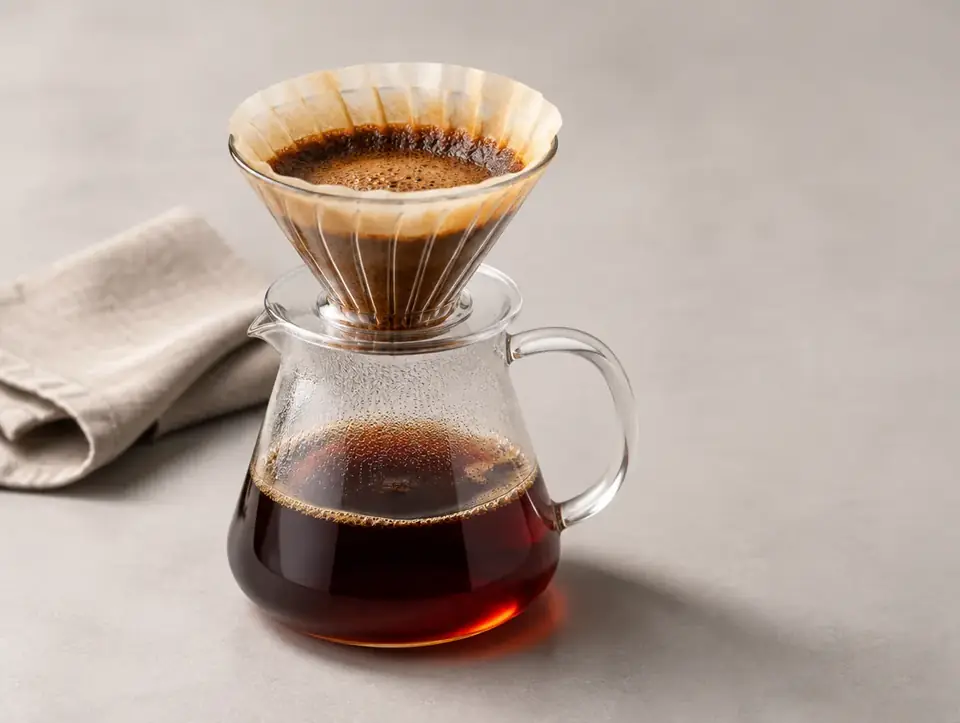
Dresden, 1908 · The Paper Filter · 51.08° N, 10.27° E
Drip Coffee
Thirty grams to five hundred, bloomed, poured in three, drawn down clean.
At a glance.
Drip Coffee comes from Dresden, 1908 · The Paper Filter and appears in The Breakfast Atlas, in the chapter Smoothies & Breakfast Drinks. It serves 2, takes about 12 minutes, and uses 4 ingredients and 10 steps.
- Yield
- Serves 2
- Method
- Stovetop
- Time
- 12 minutes
Ingredients
Tap an ingredient to tick it off.
Method
-
Weigh both sides. Thirty grams of coffee to 500 g of water is a ratio of 1:16.7, comfortably inside the 1:16 to 1:17 band that gives a cup with body but no muddiness. Scales, not spoons — ground coffee varies by density.
-
Consider the water, which is 98.5 percent of what you are about to drink. Aim for total hardness around 50–175 ppm and alkalinity near 40 ppm. Distilled water brews something hollow and sour; very hard water flattens acidity and scales the kettle.
-
Boil, then take the kettle off the heat and count 30–45 seconds. That lands you at 92–96°C. Water straight off a rolling boil scalds the grounds and pulls harsh, papery flavors forward.
-
Set the paper in the brewer and pour hot water through it, then discard what collects below. This rinses out the taste of the paper and warms the cone and carafe, which otherwise steal several degrees.
-
Grind now, not earlier. Aim for the texture of coarse sand or granulated sugar. Coffee ground in advance loses its volatile aromatics within minutes, and no technique afterward brings them back.
-
Tip the grounds in, level the bed with a tap, and pour 60 g of water — twice the coffee weight — in a slow spiral. Wait 30–45 seconds while it foams and swells. This is the bloom.
-
Watch what the bloom tells you. Roasting traps carbon dioxide in the bean, and until it escapes it repels water and forces it to run in channels. A fresh coffee domes and crackles; a flat, sullen bloom means the bag is old.
-
Pour again to 300 g, then, once the level drops, to 500 g. Keep to slow concentric circles, stay off the paper, and keep the bed flat rather than washing grounds up the sides.
-
Time the whole brew: 3 minutes 30 to 4 minutes 30 from the first drop for this dose. Much longer and the grind is too fine; much shorter and it is too coarse.
-
Swirl the brewer gently as the last water drains, so the bed settles flat rather than in a ring high on the wall. Serve at 60–65°C. Sour and thin means grind finer; drying and bitter means grind coarser.
Cook’s notes
- The technique
- Ratio and grind do different jobs and are worth keeping separate in your head. The ratio sets strength — how much coffee ends up dissolved in the cup — and you set it once, by weight. The grind sets extraction, how much of each particle actually dissolves in the time available. Only about 30 percent of a roasted bean is soluble at all, and the sweet spot takes 18 to 22 percent of it. Change one variable per brew.
- Make ahead
- Nothing about this improves with waiting. Store beans in an airtight tin at room temperature and use them within three weeks of roasting; the freezer works for long storage but only unopened. Brewed coffee holds around twenty minutes in a preheated vacuum flask, and dies on a hotplate.
- Troubleshooting
- Sour, thin, finishing quickly — under-extracted; grind finer or pour more slowly. Bitter and drying at the back of the tongue — over-extracted; grind coarser. The bed stalls and sits in water — grind far too fine. Streaky, uneven cup with dry patches in the spent bed — channeling from a careless pour.
- Variations
- Nordic roasters brew light roasts nearer 1:15 with a finer grind for a tea-like, acidic cup. A flat-bottomed Melitta or Kalita basket gives a thicker, more forgiving brew than a cone. Vietnamese phin drips slowly onto condensed milk at roughly 1:8, closer to a concentrate than a filter coffee.
- Serve with
- Drink the first cup black, before anything sweet, while it is hot enough to read as aromatic and cool enough to taste. Toast, a plain pastry, or nothing at all. Milk suits darker roasts; a light Ethiopian is wasted under it.

Where it comes from
Melitta Bentz was a housewife in Dresden with a specific complaint: cloth bags left sediment, and percolators boiled the same coffee through the grounds until it turned harsh. In 1908 she punched holes in the base of a brass pot and lined it with a sheet of blotting paper torn from her son Willy's school exercise book. She registered the design that June and started the company with a tiny sum of capital and her family as staff. Her first filter was flat-bottomed; the cone that most people now picture, Filter No. 1, came in 1937. Paper filtering spread slowly against the percolator, which held American kitchens until the electric drip machine displaced it in the 1970s. The numbers came later still. In the 1950s the Coffee Brewing Institute funded work at MIT under Earl Lockhart that produced the brewing control chart, fixing the targets the specialty trade still uses: extract 18 to 22 percent of the ground coffee's mass, and land the finished cup between 1.15 and 1.35 percent dissolved solids.
Drip Coffee: quick answers
How long does Drip Coffee take?
About 12 minutes.
How many does this Drip Coffee recipe make?
This recipe serves 2.
Where does Drip Coffee come from?
Melitta Bentz was a housewife in Dresden with a specific complaint: cloth bags left sediment, and percolators boiled the same coffee through the grounds until it turned harsh. In 1908 she punched holes in the base of a brass pot and lined it with a sheet of blotting paper torn from her son Willy's school exercise book. She registered the design that June and started the company with a tiny sum of capital and her family as staff. Her first filter was flat-bottomed; the cone that most people now picture, Filter No. 1, came in 1937. Paper filtering spread slowly against the percolator, which held American kitchens until the electric drip machine displaced it in the 1970s. The numbers came later still. In the 1950s the Coffee Brewing Institute funded work at MIT under Earl Lockhart that produced the brewing control chart, fixing the targets the specialty trade still uses: extract 18 to 22 percent of the ground coffee's mass, and land the finished cup between 1.15 and 1.35 percent dissolved solids.
More from Germany



More in Smoothies & Breakfast Drinks





https://www.atlasserie.com/recipes/breakfast/drip-coffee/