Japan · Shokupan · 36.01° N, 136.71° E
Milk Bread
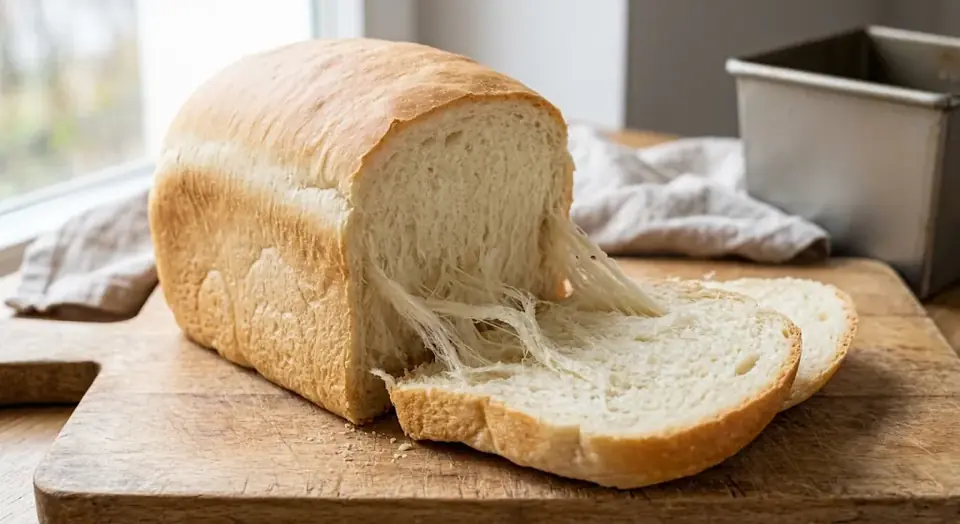
Shokupan: a pillowy loaf that pulls apart in silky shreds.
At a glance.
Milk Bread comes from Japan · Shokupan and appears in The Bread Atlas, in the chapter Everyday Loaves & Sandwich Breads. It makes 1 loaf, takes about 4 hours, and uses 9 ingredients and 11 steps.
- Yield
- Makes 1 loaf
- Method
- Oven 175°C / 350°F
- Time
- 4 hours
Ingredients
Tap an ingredient to tick it off.
- Tangzhong (Water Roux)
- The Dough
Method
-
Whisk the tangzhong flour into its milk in a small pan until no lumps remain, then cook over medium heat, stirring constantly, until it thickens to the consistency of soft paste and the whisk leaves tracks — about 65°C, two to three minutes.
-
Scrape the tangzhong into a bowl, press cling film onto its surface, and cool to room temperature. Used hot it kills yeast; used cold from the refrigerator it seizes the butter later. Twenty-five degrees is right.
-
Combine the remaining flour, sugar, milk powder, salt and yeast in a mixer bowl, add the cool milk and the whole of the tangzhong, and mix on low to a rough dough. Rest 15 minutes.
-
Knead 8 minutes on second speed. The dough will be soft and slightly sticky — resist adding flour, since the flour is already carrying more liquid than it looks. Then add the butter in four pieces, waiting each time.
-
Mix a further 6–8 minutes until the dough is glossy, pulls from the bowl in one mass, and stretches into a membrane you can read print through. This is further than most doughs go, and it is what produces the shred. Target 26°C.
-
Bulk ferment 60–70 minutes at 26°C until doubled — one of the few doughs in this chapter that genuinely should double. Press two fingers in; the dents should stay, softening only slowly at the edges.
-
Divide into three equal pieces, round them, and rest 15 minutes. Roll each into an oval, fold the long sides to the middle, then roll up from the short end into a tight spiral. The rolled spiral is what makes the crumb pull apart in strands.
-
Set the three spirals cut-side to the sides in a greased 900 g tin, evenly spaced. Prove 50–60 minutes at 28°C until the crowns rise 1 cm above the rim and the three domes have just met each other.
-
Heat the oven to 175°C / 350°F. Bake 30–33 minutes on a low rack. Shokupan is baked cool and long so the crust stays thin and golden rather than crisping; tent it with foil at 20 minutes if it colors early.
-
The loaf is baked at an internal 90°C. Enriched dough sets lower than lean, and pushing this one to 96°C dries the crumb and costs it the softness that the whole method exists to create.
-
Turn out at once and cool on its side on a rack for 2 hours. Milk bread tears rather than slices while warm. Once cool, tear a corner off with your fingers — it should come away in a long silky strip.
Cook’s notes
- To serve and keep
- Cut thick — 25 mm, four slices to the loaf — and toast until barely gold, then eat with butter and nothing else, or with a scrape of condensed milk. Thin slices, crusts off, make katsu sando and tamago sando. Keep it sealed against air; the crust is too thin to protect it.

Where it comes from
Bread reached Japan with Portuguese traders in the sixteenth century, and the Japanese word pan still carries the Portuguese pão inside it, but for three centuries it stayed marginal. The Meiji period brought bakeries in earnest — Kimuraya in Tokyo was selling its sake-leavened anpan by 1874 — and the decisive change came after 1945, when American wheat arrived first as occupation relief and then through the national school lunch program, which put a bread roll in front of Japanese children daily from the late 1940s. A generation grew up eating wheat. Yamazaki Baking, founded in 1948, industrialized the soft white loaf, and shokupan — literally eating bread, the plain everyday loaf — became a supermarket staple cut thick, four, six or eight slices to the loaf, in a country that had barely eaten bread within living memory. The tangzhong method that gives it that famous shred was popularized much later, through Yvonne Chen's 2004 Taiwanese book on the 65°C water roux.
Milk Bread: quick answers
How long does Milk Bread take?
About 4 hours.
How many does this Milk Bread recipe make?
This recipe makes 1 loaf.
Where does Milk Bread come from?
Bread reached Japan with Portuguese traders in the sixteenth century, and the Japanese word pan still carries the Portuguese pão inside it, but for three centuries it stayed marginal. The Meiji period brought bakeries in earnest — Kimuraya in Tokyo was selling its sake-leavened anpan by 1874 — and the decisive change came after 1945, when American wheat arrived first as occupation relief and then through the national school lunch program, which put a bread roll in front of Japanese children daily from the late 1940s. A generation grew up eating wheat. Yamazaki Baking, founded in 1948, industrialized the soft white loaf, and shokupan — literally eating bread, the plain everyday loaf — became a supermarket staple cut thick, four, six or eight slices to the loaf, in a country that had barely eaten bread within living memory. The tangzhong method that gives it that famous shred was popularized much later, through Yvonne Chen's 2004 Taiwanese book on the 65°C water roux.
More from Japan






More in Everyday Loaves & Sandwich Breads
https://www.atlasserie.com/recipes/bread/milk-bread/