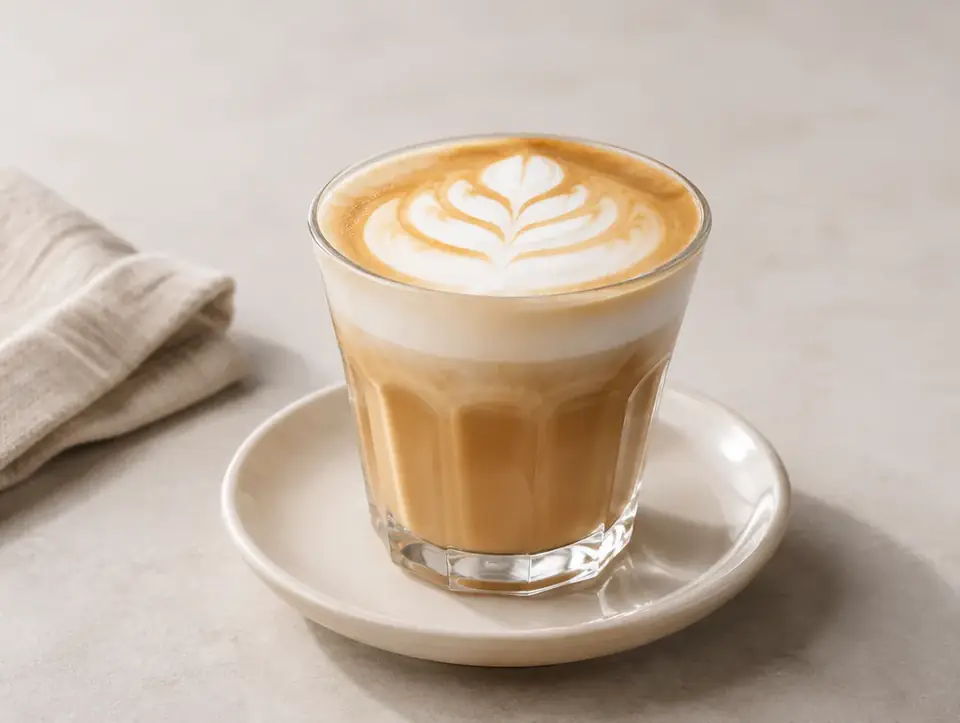
Italy & Seattle · Espresso and Milk · 43.43° N, 12.37° E
Latte
Espresso beneath milk textured to sixty degrees, glossy and never scalded.
At a glance.
Latte comes from Italy & Seattle · Espresso and Milk and appears in The Breakfast Atlas, in the chapter Smoothies & Breakfast Drinks. It serves 1, takes about 8 minutes, and uses 8 ingredients and 11 steps.
- Yield
- Serves 1
- Method
- Stovetop
- Time
- 8 minutes
Ingredients
Tap an ingredient to tick it off.
- For the moka-pot alternative, if you have no machine
Method
-
Warm a 200 ml cup with hot water and tip it out at the last moment. A cold cup pulls five to eight degrees out of the finished drink before it reaches the table.
-
Dose 18 g into the basket, distribute the grounds level, and tamp flat with steady pressure. An uneven bed sends water down one side and the shot arrives sour and thin.
-
Pull 36 g of espresso in 25–30 seconds, a 1 to 2 ratio by weight. Running faster than that gives sourness and running much slower gives a burnt, drying bitterness.
-
Start with cold milk in a cold jug, filled to a little below the base of the spout — around 180 ml in a 350 ml pitcher. Milk expands by roughly a fifth as you texture it, and a full jug has nowhere to go.
-
Stretch first. Set the steam tip barely under the surface and open the valve; you want a steady tearing sound, like paper. Keep introducing air only until the jug still feels neutral against your palm, about 37°C — three or four seconds for a latte.
-
Roll second. Sink the tip deeper and slightly off-center so the milk turns in a whirlpool, folding the coarse bubbles you have made back into the body. This is where microfoam is created, not during the stretch.
-
Cut the steam at 60–65°C, when the jug has become uncomfortable to hold for more than a second or two. Past about 70°C the whey proteins unfold and release sulfur compounds, and the milk tastes cooked and faintly of cabbage.
-
Knock the jug once on the counter to burst any surface bubbles, then swirl until the milk turns glossy and moves as one body, like wet paint. Textured milk waits about twenty seconds before it starts to separate.
-
Pour from a height of several centimetres to sink the milk beneath the crema, then drop the spout close to the surface and let the foam float up as you finish. Serve at once.
-
For the moka version, fill the boiler with already-boiling water to a finger below the valve, fill the basket level without tamping, assemble with a cloth to protect your hand, and set it over low heat.
-
Pull the moka off the heat the instant the stream pales and starts to gurgle, and cool the base under the tap. Use 50 g of the roughly 70 g it yields, and froth your milk by heating it to 60°C and plunging a French press twenty times.
Cook’s notes
- The technique
- Texturing is two distinct phases and merging them is the commonest failure. Stretching introduces air into cold milk, where the proteins can still stabilize small bubbles; rolling shears those bubbles smaller and distributes them evenly. Once the milk passes body temperature, its proteins begin to denature and any air added after that point sets into stiff, dry foam that sits on top of the drink like meringue instead of blending through it.
- Make ahead
- Nothing can be made ahead, and reheating textured milk destroys it. What helps is preparation: warm the cups, keep the jug and the milk in the fridge, weigh out beans, and purge the steam wand before and after every drink.
- Troubleshooting
- Large bubbles and a stiff cap — air introduced after the milk warmed past 37°C. No texture at all, only hot milk — the tip sat too deep from the start. A cooked, eggy smell — you went past 70°C. A pale, fast shot tasting sour — grind finer or increase the dose.
- Variations
- The Italian original is moka coffee poured into a bowl of hot milk at breakfast, with no foam and no art. Latte macchiato reverses the build: textured milk first, espresso poured through it to leave a dark mark. A flat white, from Australia and New Zealand, uses the same shot with less milk and a thinner foam. A cortado halves the milk again and comes in a small glass.
- Serve with
- In Italy this is breakfast and nothing else, with a cornetto and no ceremony. Elsewhere it stands in for the whole morning. Serve at 60°C, drink within a few minutes, and skip sugar if the shot is well pulled. Made in full within this recipe — Moka-Pot Coffee Base. Also listed in the Component Index at the back.

Where it comes from
In Italy, caffè latte is a domestic drink rather than a bar order — moka coffee lengthened with hot milk, taken from a bowl or a tumbler before ten in the morning and not after lunch, when milk is considered too heavy. Ask for un latte in an Italian bar and you may well be handed a glass of cold milk, since latte is the word for milk itself. The bar's milk drink is the cappuccino, small and foam-capped. The American latte is a different animal: espresso under a much larger volume of textured milk, served in a cup that would startle a Milanese barista. Its invention is often credited to Lino Meiorin at Caffè Mediterraneum in Berkeley in the 1950s, though that account is repeated far more often than it is documented. What is not in doubt is the Seattle decade. Howard Schultz visited Milan in 1983, opened Il Giornale in 1986, and the espresso carts that multiplied around Puget Sound made the latte an American default within ten years. Latte art spread from the same few blocks.
Latte: quick answers
How long does Latte take?
About 8 minutes.
How many does this Latte recipe make?
This recipe serves 1.
Where does Latte come from?
In Italy, caffè latte is a domestic drink rather than a bar order — moka coffee lengthened with hot milk, taken from a bowl or a tumbler before ten in the morning and not after lunch, when milk is considered too heavy. Ask for un latte in an Italian bar and you may well be handed a glass of cold milk, since latte is the word for milk itself. The bar's milk drink is the cappuccino, small and foam-capped. The American latte is a different animal: espresso under a much larger volume of textured milk, served in a cup that would startle a Milanese barista. Its invention is often credited to Lino Meiorin at Caffè Mediterraneum in Berkeley in the 1950s, though that account is repeated far more often than it is documented. What is not in doubt is the Seattle decade. Howard Schultz visited Milan in 1983, opened Il Giornale in 1986, and the espresso carts that multiplied around Puget Sound made the latte an American default within ten years. Latte art spread from the same few blocks.
More from Italy





More in Smoothies & Breakfast Drinks



https://www.atlasserie.com/recipes/breakfast/latte/