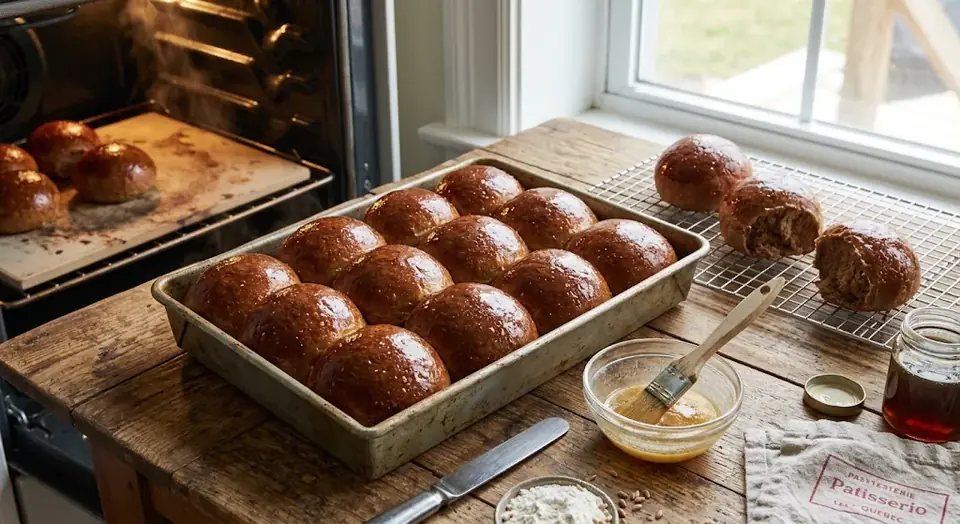
North America · The Honey Wheat Roll · 39.87° N, 98.73° W
Whole Wheat Rolls
Whole grain rolls kept soft by an overnight soaker and honey.
At a glance.
Whole Wheat Rolls comes from North America · The Honey Wheat Roll and appears in The Bread Atlas, in the chapter Rolls, Buns & Bagels. It makes 12 rolls, takes about 14 hours, and uses 10 ingredients and 11 steps.
- Yield
- Makes 12 rolls
- Method
- Oven 190°C / 375°F
- Time
- 14 hours
Ingredients
Tap an ingredient to tick it off.
- Overnight Soaker (Quellstück)
- The Dough
- Honey Butter Finish
Method
-
The night before, stir the soaker flour, water and the small measure of salt to a stiff paste, cover, and leave 8–12 hours at cool room temperature, or up to 16 at 4°C. It will smell nutty and sweet by morning, not sour.
-
Next day, mix the remaining flour with the milk at 30°C, the honey and the yeast, holding back the butter and the remaining salt. Rest 30 minutes. Keeping the soaker out of this stage matters — see the technique note.
-
Add the remaining salt and knead 6 minutes, then work in the butter. Now add the soaker in three pieces and mix only until it disappears, 2–3 minutes more. Aim for a final dough temperature of 26°C.
-
The dough will feel soft, slightly tacky and a little rough, and it will never windowpane like white dough — bran cuts the sheets. Look instead for a dough that holds a dome for a few seconds when gathered.
-
Bulk ferment covered 75–90 minutes at 26°C, folding once at 40 minutes. Whole wheat ferments faster than white because bran carries both nutrients and wild enzymes, so watch the dough rather than the clock; it should rise by about three-quarters.
-
Butter a 23 × 33 cm tin. Divide into 12 pieces of about 85 g, and round each with a light hand — over-tightening a bran-rich dough tears the surface into rough patches that never smooth out.
-
Set the rolls in the tin with 1 cm between them, cover, and prove 50–70 minutes at 26°C. They are ready when they touch and a dented surface fills back most of the way, but not all.
-
Set the oven to 190°C / 375°F. Whole wheat rolls take a slightly hotter oven than white ones would at this size, because bran shades the crumb and the color of the crust is a poor guide to what is happening inside.
-
Bake 20–24 minutes, rotating once, until the tops are a deep russet brown and the internal temperature reads 90–92°C. Under-baked whole wheat tastes raw and grassy in a way white bread never does.
-
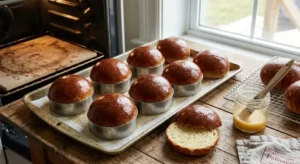
Brush with the honey butter the moment the tin leaves the oven, going over the tops twice so it soaks in rather than sitting on the surface as a slick.
-
Rest 10 minutes, then lift the slab onto a rack. Let them cool at least 30 minutes before pulling apart: the soaker's water is still redistributing through the crumb, and a roll torn straight from the tin tastes wetter and heavier than the same roll twenty minutes later.
Cook’s notes
- To serve and keep
- Warm, with butter and honey, beside soup or a roast — this is the roll of the American supper table and it makes no other claim. Keep them in the tin under a cloth and refresh 5 minutes at 160°C. They toast poorly and split well; use them for small ham sandwiches the following day.

Where it comes from
A whole wheat dinner roll is a harder proposition than a whole wheat loaf, and for a mechanical reason: a roll is mostly surface, so it dries in a way a big loaf does not, and bran gives it very little to hold on to. Two traditions solved this separately. German bakeries formalized the soaking piece — the Quellstück, cold-steeped, and the Brühstück, made with hot water — as standard shop practice for any dough carrying coarse grain, and bakers there have used them for well over a century. American kitchens reached for sweetness instead. The honey wheat roll became a fixture of the restaurant bread basket from the 1970s, a soft brown roll served warm with whipped butter, its honey covering the faint bitterness that bran phenolics give whole wheat and its softness quietly supplied by white flour. This recipe declines the white flour and takes the German route: all the grain, and water given time to do its work.
Whole Wheat Rolls: quick answers
How long does Whole Wheat Rolls take?
About 14 hours.
How many does this Whole Wheat Rolls recipe make?
This recipe makes 12 rolls.
Where does Whole Wheat Rolls come from?
A whole wheat dinner roll is a harder proposition than a whole wheat loaf, and for a mechanical reason: a roll is mostly surface, so it dries in a way a big loaf does not, and bran gives it very little to hold on to. Two traditions solved this separately. German bakeries formalized the soaking piece — the Quellstück, cold-steeped, and the Brühstück, made with hot water — as standard shop practice for any dough carrying coarse grain, and bakers there have used them for well over a century. American kitchens reached for sweetness instead. The honey wheat roll became a fixture of the restaurant bread basket from the 1970s, a soft brown roll served warm with whipped butter, its honey covering the faint bitterness that bran phenolics give whole wheat and its softness quietly supplied by white flour. This recipe declines the white flour and takes the German route: all the grain, and water given time to do its work.
More from United States






More in Rolls, Buns & Bagels
https://www.atlasserie.com/recipes/bread/whole-wheat-rolls/