Austria · Vienna · 47.62° N, 14.06° E
Kaiser Rolls
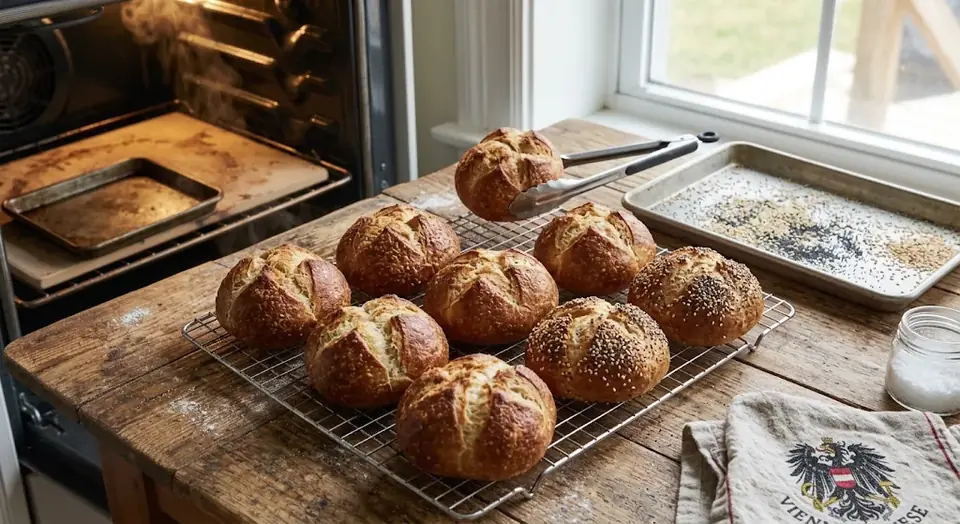
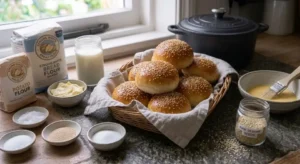
A five-point knot with a crust that shatters and a hollow crumb.
At a glance.
Kaiser Rolls comes from Austria · Vienna and appears in The Bread Atlas, in the chapter Rolls, Buns & Bagels. It makes 8 rolls, takes about 4 hours, and uses 9 ingredients and 11 steps.
- Yield
- Makes 8 rolls
- Method
- Oven 220°C / 425°F
- Time
- 4 hours
Ingredients
Tap an ingredient to tick it off.
- The Dough
- Egg White Wash
- Seed Tray
Method
-
Dissolve the malt in the water at 20°C. Mix with the flour, salt, butter and yeast to a firm dough — noticeably tighter than a sandwich dough, because a crisp roll needs a crumb that holds its walls rather than one that billows.
-
Knead 10 minutes to a smooth, springy dough that windowpanes thinly. Hold the final dough temperature at 24°C. Bulk ferment 90 minutes at 24°C with one fold at 45 minutes, until risen by three-quarters.
-
Divide into 8 pieces of 105 g, round each firmly, and rest 15 minutes covered. The knot needs a relaxed piece; a tight one springs open as you fold it.
-
To knot by hand, flatten a ball to a 10 cm disc. Lift the edge nearest you, fold it over to a little past the center, and press. Move a fifth of the way round and repeat, working in one direction, until you have made five overlapping folds.
-
Thread the tip of the fifth fold down through the small opening left by the first, and press it home underneath. Done correctly, the top shows five points spiralling into a center that will open into a star in the oven.
-
For the stamp, skip the folding: press a metal Kaiser stamp straight down into a rounded ball until it nearly reaches the counter, and hold for a second. Fast, even, and honest about what it is — but the pattern is shallower and it fades as the roll proves.
-
Brush the tops with egg white and press them face-down into the seed tray. Prove the rolls face-down on a heavily floured cloth for 40–50 minutes at 24°C. Proving inverted keeps the folds from opening too early and setting flat.
-
Meanwhile heat the oven to 220°C / 425°F with a baking stone and an empty steel tray on the floor. Boil a kettle. A lean roll makes its crust from steam and then from dry heat, in that order.
-
Turn the rolls the right way up onto a peel or lined tray, load them, and pour 150 ml of boiling water into the hot tray. Bake with steam for 8 minutes, by which time the pattern will have sprung open.
-
Open the door for a few seconds to vent the steam, then bake a further 10–12 minutes until deep gold and hard-shelled, to an internal 96°C. That dry second phase is what turns a leathery crust into a brittle one.
-
Cool on a rack with plenty of air underneath, and listen — a good Kaiser crackles audibly for a minute or two as it cools and the crust contracts. Eat within four hours; after that, refresh for 3 minutes at 200°C to bring the shatter back.
Cook’s notes
- To serve and keep
- Split horizontally, buttered, with cured ham, Emmental or Liptauer, or filled with schnitzel and eaten standing up. In Vienna it is bought the morning it is eaten and no later. Store in paper for a few hours only; a plastic bag will turn that crust to leather in twenty minutes.

Where it comes from
Vienna's Semmel is the ancestor of a great deal of modern white bread. Through the nineteenth century, Viennese bakers were the technical leaders of Europe: they had pressed yeast from the city's distilleries decades before anyone else did, and they baked in ovens fitted to inject steam, which is what gives a lean roll a thin, crackling crust. When the Vienna Bakery drew crowds at the Paris Exposition Universelle of 1867, French bakers took the method home with them, and pain viennois — and eventually the baguette's steam-baked crust — followed from it. The Kaisersemmel is the dressed version of that roll, its five folded points read as a crown. The name's origin is where the evidence thins: it is variously tied to an imperial decree freeing Viennese bakers from price control, or to Franz Joseph himself, and neither account carries a document you can point to. The stamp came later still, an industrial answer to a hand-knot that took an apprentice a season to learn.
Kaiser Rolls: quick answers
How long does Kaiser Rolls take?
About 4 hours.
How many does this Kaiser Rolls recipe make?
This recipe makes 8 rolls.
Where does Kaiser Rolls come from?
Vienna's Semmel is the ancestor of a great deal of modern white bread. Through the nineteenth century, Viennese bakers were the technical leaders of Europe: they had pressed yeast from the city's distilleries decades before anyone else did, and they baked in ovens fitted to inject steam, which is what gives a lean roll a thin, crackling crust. When the Vienna Bakery drew crowds at the Paris Exposition Universelle of 1867, French bakers took the method home with them, and pain viennois — and eventually the baguette's steam-baked crust — followed from it. The Kaisersemmel is the dressed version of that roll, its five folded points read as a crown. The name's origin is where the evidence thins: it is variously tied to an imperial decree freeing Viennese bakers from price control, or to Franz Joseph himself, and neither account carries a document you can point to. The stamp came later still, an industrial answer to a hand-knot that took an apprentice a season to learn.
More from Austria
More in Rolls, Buns & Bagels
https://www.atlasserie.com/recipes/bread/kaiser-rolls/