France · The Wheat Ear · 46.56° N, 2.35° E
Épi de Blé
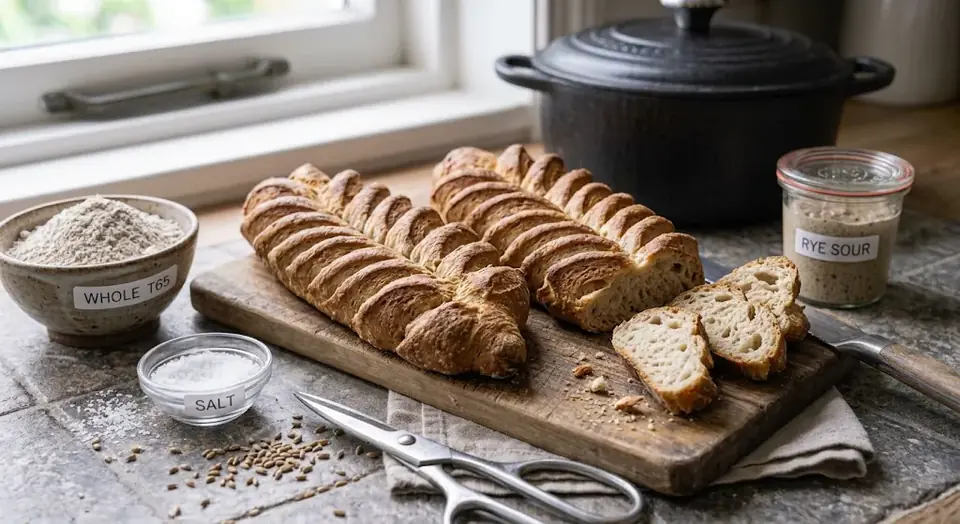
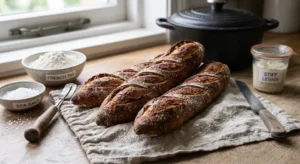
A baguette cut into a wheat ear, made to be pulled apart by hand.
At a glance.
Épi de Blé comes from France · The Wheat Ear and appears in The Bread Atlas, in the chapter Artisan & Sourdough. It makes 2 épis, takes about 16 hours, and uses 10 ingredients and 11 steps.
- Yield
- Makes 2 épis
- Method
- Oven 245°C / 475°F
- Time
- 16 hours
Ingredients
Tap an ingredient to tick it off.
- Poolish
- The Dough
- For Shaping and Baking
Method
-
Build the poolish 12 hours ahead as in recipe 17 and use it domed and just dipping. Mix it into the water at 22°C, add the flour and rest 30 minutes, then add salt and yeast and work 4 minutes to a firm dough at 24°C — two points drier than the baguette, so the cut points hold their shape.
-
Bulk ferment 2 hours at 24°C with folds at 40 and 80 minutes. Divide into two pieces of 400 g, preshape into oblongs, and rest 25 minutes under a cloth.
-
Shape by the three-fold roll of recipe 17 and roll each piece out to 40 cm, no longer. An épi lengthens by a third as it is cut, so a loaf shaped to full baguette length will not fit the tray or the oven.
-
Lay the loaves seam down — not seam up — on floured parchment, because you will cut them where they lie and cannot turn them over afterwards. Prove 40–45 minutes at 22°C, deliberately a little short of full: a fully proved loaf collapses under the shears.
-
Now cut. Hold the shears almost flat, at 20–30° to the loaf and to the parchment, not upright. A near-horizontal angle drives the blade under a long tongue of dough; a vertical one chops the loaf into blocks.
-
Start 5 cm from one end. Cut deep — about three-quarters of the way through the loaf — leaving perhaps a centimetre of dough uncut at the base to act as a hinge. Cut in one decisive squeeze rather than sawing, and wipe the blades between cuts if they drag.
-
Immediately lay the cut piece over to one side, flat against the paper. Make the next cut 4–5 cm along and lay that piece to the opposite side. Continue alternating left and right down the whole loaf: six or seven points a side is right for 40 cm.
-
Work quickly and finish one loaf before starting the next. The alternating lay is what makes the shape read as a wheat ear rather than a row of rolls — each grain sits in the notch left by the one before, and the spine stays visible down the middle.
-
Prove a further 15 minutes only, uncovered, while the oven comes up to 245°C / 475°F with a stone on the middle shelf and a tray on the floor. The exposed cut faces should just skin over, which keeps them defined in the oven.
-
Slide loaves and parchment onto the stone, pour boiling water into the tray, and bake 20 minutes, venting after 12. Do not score — the shears have already given the dough every escape it needs, and a scored épi tears in the wrong places.
-
The points bake far crisper than the body of the loaf, which is the whole object: each is a small piece of dough with cut faces exposed directly to the heat, drying and coloring on three sides while the spine stays soft. Cool 15 minutes and take it to the table whole.
Cook’s notes
- To serve and keep
- Set whole in the middle of the table and let people break off points; it is the French sharing loaf, common at a picnic or alongside an apéritif with charcuterie. Eat it the day it is made. Any points left over are excellent split and toasted for soup.

Where it comes from
The wheat ear is the oldest emblem of the trade that makes bread, painted on bakery signs, molded into shopfront plaster and stamped on the aprons of the profession, so a loaf shaped as one is a baker showing his hand. The épi belongs to the French repertoire of pains de fantaisie — the decorative breads made from ordinary baguette dough and distinguished only by what the baker does to them in the last five minutes: the tabatière with its folded flap, the fendu split down the middle, the couronne baked as a ring, the épi cut into points. These forms are taught as a matter of course in French apprenticeship and remain part of the CAP boulanger syllabus, which is why they are consistent from one town to another rather than being personal inventions. No dated origin exists for the épi and none should be manufactured. Its function is clear enough and probably always was: an épi has more crust than any other shape and comes apart into equal portions without a knife, which makes it a bread for a table with several people at it.
Épi de Blé: quick answers
How long does Épi de Blé take?
About 16 hours.
How many does this Épi de Blé recipe make?
This recipe makes 2 épis.
Where does Épi de Blé come from?
The wheat ear is the oldest emblem of the trade that makes bread, painted on bakery signs, molded into shopfront plaster and stamped on the aprons of the profession, so a loaf shaped as one is a baker showing his hand. The épi belongs to the French repertoire of pains de fantaisie — the decorative breads made from ordinary baguette dough and distinguished only by what the baker does to them in the last five minutes: the tabatière with its folded flap, the fendu split down the middle, the couronne baked as a ring, the épi cut into points. These forms are taught as a matter of course in French apprenticeship and remain part of the CAP boulanger syllabus, which is why they are consistent from one town to another rather than being personal inventions. No dated origin exists for the épi and none should be manufactured. Its function is clear enough and probably always was: an épi has more crust than any other shape and comes apart into equal portions without a knife, which makes it a bread for a table with several people at it.
More from France



More in Artisan & Sourdough

https://www.atlasserie.com/recipes/bread/epi-de-ble/