Northern Europe · The Rye Sour · 56.00° N, 10.00° E
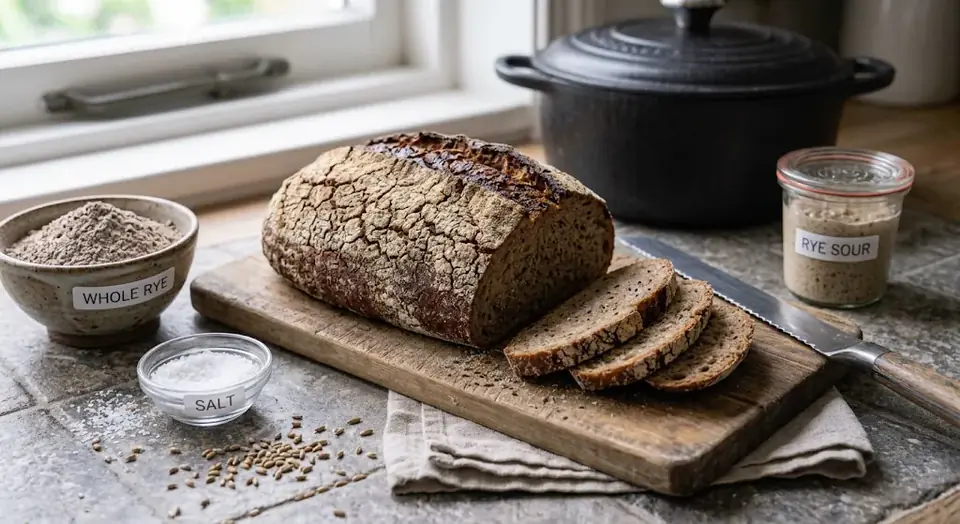
Rye Sourdough
Sticky rather than elastic, and held together by acid, not gluten.
At a glance.
Rye Sourdough comes from Northern Europe · The Rye Sour and appears in The Bread Atlas, in the chapter Artisan & Sourdough. It makes 1 tin loaf, takes about 26 hours, and uses 11 ingredients and 11 steps.
- Yield
- Makes 1 tin loaf
- Method
- Oven 230°C / 450°F
- Time
- 26 hours
Ingredients
Tap an ingredient to tick it off.
- Rye Sour — First Build
- Rye Sour — Second Build
- The Dough
- For the Tin
Method
-
Refresh your starter twice on whole rye flour over two days before you begin; a culture kept on white flour will work here but takes a build or two to hit its stride on rye, which is a different food source.
-
First build: mix the ripe starter with 75 g rye flour and 75 g water at 30°C to a thick paste. Cover and hold 14–16 hours at 22–24°C. It should double, crack across the surface and smell strongly of yogurt and apple skins.
-
Second build: stir in the remaining 75 g rye flour and 75 g water at 30°C and hold 3–4 hours at 28°C. The short warm stage multiplies the yeast population after the long cool stage has built the acid, which is the whole logic of a staged sour.
-
The sour is ready when it has domed and just begun to sink in the middle, and tastes sharply sour but not bitter. If you measure, look for pH 3.8–4.2. Under-soured rye is the direct cause of the sticky, gluey crumb that rye is blamed for.
-
Mix everything: the sour, both flours, the water at 45°C, the salt and the caraway. Beat it with a wooden spoon or a paddle for 3 minutes to a thick, tacky batter-dough. There is nothing to knead — no amount of work will produce a gluten network here. Aim for a final temperature of 29–30°C.
-
Bulk ferment only 30–45 minutes, covered, in the warm. A rye dough carries most of its fermentation in the sour, and a long bulk gains nothing while giving the enzymes more time to work on the starch.
-
Wet your hands and scrape the dough into a greased and rye-dusted 900 g tin, pressing it into the corners and smoothing the top into a dome with a wet spoon. Dust the top generously with rye flour.
-
Prove 60–80 minutes at 28°C. There is no poke test for rye. Watch the flour on top: when the dome has risen and the dusting has split into a network of fine cracks, the loaf is ready. Wait for wide cracks and it will fall in the oven.
-
Bake at 230°C / 450°F for 15 minutes with a tray of boiling water beneath, then drop to 190°C / 375°F, remove the water, and bake 45–50 minutes more. Take it to 98°C inside; a dense wet loaf needs the full internal reading, not a hollow sound.
-
Turn out and cool on a rack, then wrap the cooled loaf in a cloth or in paper and leave it 24 hours before cutting. This is not a nicety. The starch is still setting, the crumb is still equalizing its moisture, and a rye cut warm will be gummy on the knife and stale by evening.
-
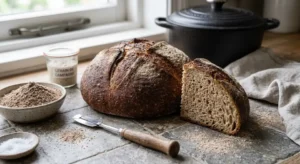
Cut with a long serrated knife in thin slices, 5–8 mm. The loaf improves for three days and keeps for a week; the acidity that gave it structure also holds mold off far longer than a wheat loaf manages.
Cook’s notes
- To serve and keep
- Cut thin and buttered, under herring, pickles, cured meat or a hard cheese; it is far too assertive for jam and far too good for toast. Store it cut side down in a linen bag or a bread crock, never in plastic, which softens the crust and encourages mold.

Where it comes from
In a German bakery the rye sour is not a recipe but a fixture. A portion of ripe sour, the Anstellgut, is held back from every batch and refreshed on a fixed schedule, and the loaf is built out of it in stages rather than mixed in one go. That practice was studied and standardized in the mid-twentieth century by the cereal research institute at Detmold, whose one-, two- and three-stage methods gave bakeries a way to hit a consistent acidity by controlling the temperature, hydration and duration of each build rather than by instinct. German food law then codified what the results could be called: under the Leitsätze für Brot und Kleingebäck, a Roggenmischbrot must carry between 50 and 89% rye, a Roggenbrot at least 90%, and a baker who writes one on a label has committed to the proportion. This loaf sits at the lower end of the mixed range, which is the practical place for a domestic oven, and everything about handling it follows from a single fact: rye brings no workable gluten to the party.
All 3 recipes from Northern Europe
All 14 recipes from Europe
Rye Sourdough: quick answers
How long does Rye Sourdough take?
About 26 hours.
How many does this Rye Sourdough recipe make?
This recipe makes 1 tin loaf.
Where does Rye Sourdough come from?
In a German bakery the rye sour is not a recipe but a fixture. A portion of ripe sour, the Anstellgut, is held back from every batch and refreshed on a fixed schedule, and the loaf is built out of it in stages rather than mixed in one go. That practice was studied and standardized in the mid-twentieth century by the cereal research institute at Detmold, whose one-, two- and three-stage methods gave bakeries a way to hit a consistent acidity by controlling the temperature, hydration and duration of each build rather than by instinct. German food law then codified what the results could be called: under the Leitsätze für Brot und Kleingebäck, a Roggenmischbrot must carry between 50 and 89% rye, a Roggenbrot at least 90%, and a baker who writes one on a label has committed to the proportion. This loaf sits at the lower end of the mixed range, which is the practical place for a domestic oven, and everything about handling it follows from a single fact: rye brings no workable gluten to the party.
More from Northern Europe

More in Artisan & Sourdough

https://www.atlasserie.com/recipes/bread/rye-sourdough/