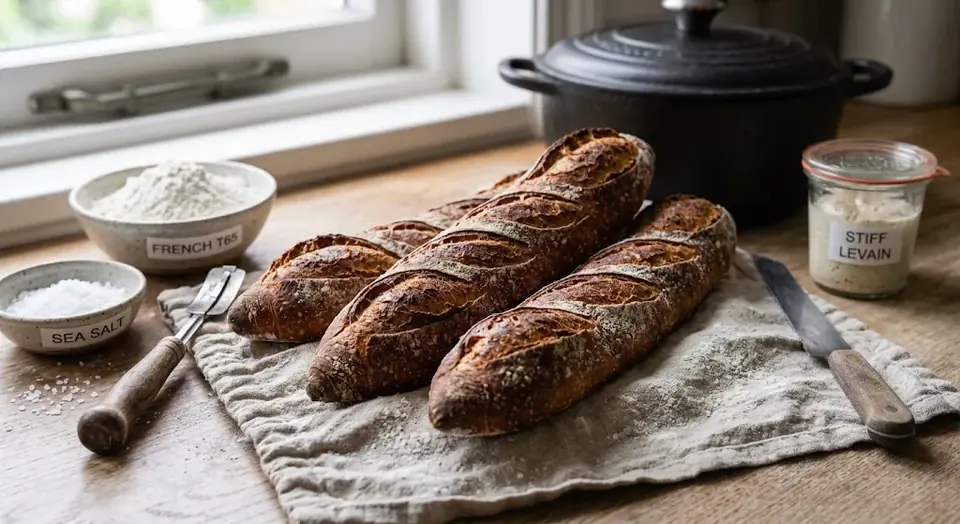
France · The Décret Pain of 1993 · 46.56° N, 2.35° E
Baguette Tradition
Flour, water, salt, leaven — and, by law, nothing else at all.
At a glance.
Baguette Tradition comes from France · The Décret Pain of 1993 and appears in The Bread Atlas, in the chapter Artisan & Sourdough. It makes 3 baguettes, takes about 30 hours, and uses 9 ingredients and 11 steps.
- Yield
- Makes 3 baguettes
- Method
- Oven 245°C / 475°F
- Time
- 30 hours
Ingredients
Tap an ingredient to tick it off.
- Stiff Levain
- The Dough
- For Shaping and Baking
Method
-
Twelve hours ahead, build a stiff levain: dissolve the starter in the 55 g of water at 24°C, then knead in the flour to a firm, smooth ball. Leave covered at 20°C. Kept this dry, it ferments slowly and evenly and holds its strength rather than slackening into a batter.
-
Mix the dough flour with the water at 22°C until no dry patches remain, and autolyse a full hour. This is the longest rest in the chapter and it is doing legal work as well as culinary: no additive is going to compensate for a lazy mix, so hydration and enzyme action must do all of it.
-
The levain is ready when it has doubled, domed and cracked across the top. Tear it into small pieces, press them into the autolysed dough and squeeze until fully dispersed. Add the salt and the fraction of yeast. Mix 5 minutes to a smooth, medium-firm dough at 23°C.
-
Bulk ferment 1 hour at 23°C, with one fold at 30 minutes, then cover the tub and refrigerate 16–18 hours at 5°C. The cold bulk is where the taste comes from: yeast activity nearly stops, bacterial acid production continues, and the flour's own enzymes break starch down into sugars that will color the crust.
-
Take the dough out and let it stand 1 hour at room temperature. It should have risen by about half, feel cool and firm, and smell of hazelnut and wheat rather than of sourness. A tradition dough is aromatic rather than tangy; if it is sharp, the levain went in over-ripe.
-
Divide into three pieces of 280 g. Preshape each into a loose oblong and rest 30 minutes under a cloth. A colder, stiffer dough than the one in recipe 17 needs the longer rest — press a corner, and if it holds the mark it is ready to shape.
-
Shape by the three-fold roll of recipe 17: press to a rectangle, fold and seal the top third, turn and repeat, then fold in half and seal the spine hard along its whole length. Roll out to 45 cm from the center, tapering the points.
-
Lay seam up on a heavily floured couche with a pleat between each loaf. Prove 60–75 minutes at 22°C — noticeably longer than a yeasted baguette, because a levain-raised dough carrying a fifth of the usual yeast lifts more slowly and less far.
-
Heat the oven to 245°C / 475°F for 45 minutes with a stone in the middle and a heavy tray on the floor. Flip the loaves seam down onto a peel and give each a light dust of flour, which makes the score visible and the crust matte rather than glassy.
-
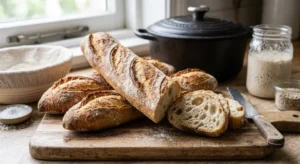
Score seven overlapping cuts, blade at 25°, each running almost parallel to the length and starting beside the previous one. Load, pour boiling water into the tray, and bake 22 minutes, venting after 14, to a dark red-gold crust and 99°C inside.
-
Cool on a rack 30 minutes. The crust should crackle audibly as it contracts. Eat within the day: the absence of additives that the law insists upon is also the reason this loaf stales faster than a supermarket stick, and that trade-off is the entire point of the legislation.
Cook’s notes
- To serve and keep
- Bought in the morning and again at six, carried home unwrapped, torn at the table for the meal, and used at the end of it to clear the plate. It wants butter and salt, ripe cheese, or nothing at all. Store in linen, never plastic, and expect one day of glory.

Where it comes from
By the 1980s French bread was in poor condition, and the French said so. Intensified mixing had bleached the crumb white and blown the flavor out of it, ascorbic acid and other additives propped up doughs that had barely fermented, and frozen part-baked sticks were being finished in shop terminals and sold as fresh. The state answered with the décret n° 93-1074 of 13 September 1993, the décret pain. It reserves the name pain de tradition française for bread made from wheat flour, drinking water, salt and leavening alone — baker's yeast or levain — with no additives whatever, and it forbids freezing at any stage of production, from dough to finished loaf. A short list of processing aids survives in the accompanying order, chiefly bean flour up to 2% and wheat malt flour up to 0.3%. A law of 1998 went further, reserving the title boulanger for those who mix, ferment and bake on the premises. The bread has since been celebrated as well as regulated: Paris has run its Grand Prix de la Baguette since 1994, and UNESCO inscribed the artisanal know-how of the baguette in December 2022.
Baguette Tradition: quick answers
How long does Baguette Tradition take?
About 30 hours.
How many does this Baguette Tradition recipe make?
This recipe makes 3 baguettes.
Where does Baguette Tradition come from?
By the 1980s French bread was in poor condition, and the French said so. Intensified mixing had bleached the crumb white and blown the flavor out of it, ascorbic acid and other additives propped up doughs that had barely fermented, and frozen part-baked sticks were being finished in shop terminals and sold as fresh. The state answered with the décret n° 93-1074 of 13 September 1993, the décret pain. It reserves the name pain de tradition française for bread made from wheat flour, drinking water, salt and leavening alone — baker's yeast or levain — with no additives whatever, and it forbids freezing at any stage of production, from dough to finished loaf. A short list of processing aids survives in the accompanying order, chiefly bean flour up to 2% and wheat malt flour up to 0.3%. A law of 1998 went further, reserving the title boulanger for those who mix, ferment and bake on the premises. The bread has since been celebrated as well as regulated: Paris has run its Grand Prix de la Baguette since 1994, and UNESCO inscribed the artisanal know-how of the baguette in December 2022.
More from France



More in Artisan & Sourdough

https://www.atlasserie.com/recipes/bread/baguette-tradition/