United States · Sullivan Street, New York · 39.87° N, 98.73° W
No-Knead Artisan Loaf
Time doing the work of kneading, and a covered pot doing the rest.
At a glance.
No-Knead Artisan Loaf comes from United States · Sullivan Street, New York and appears in The Bread Atlas, in the chapter Artisan & Sourdough. It makes 1 boule, takes about 20 hr 15 min, and uses 6 ingredients and 11 steps.
- Yield
- Makes 1 boule
- Method
- Oven 230°C / 450°F
- Time
- 20 hr 15 min
Ingredients
Tap an ingredient to tick it off.
- The Dough
- For Shaping and Baking
Method
-
Whisk the flour, salt and yeast together in a large bowl. Add the water at 20°C and stir with a spoon for 45 seconds, until there is no dry flour left and you have a shaggy, sticky mass. That is the entire mixing. Do not be tempted to improve it.
-
Cover the bowl and leave it at 20–21°C for 16–18 hours. Kitchen temperature is the one variable that matters: at 24°C the dough will be finished in 12 hours and collapsing by 16, and at 17°C it will still be sluggish the next morning.
-
It is ready when the surface is domed and blistered with bubbles, the dough smells yeasty and faintly of beer, and it pulls away from the side of the bowl in long strands when you tug it. It should have more than doubled.
-
Scrape it onto a well-floured bench. Fold it over on itself twice — top to middle, bottom to middle, then the sides in — and let it rest 15 minutes, seam down, uncovered. These two folds are the only structural work the dough will get, and they are worth doing carefully.
-
Shape a loose round: cup floured hands around the dough and drag it toward you a few times to pull the skin taut. It will not hold the tension a kneaded dough would, and pushing for it only tears the surface. Aim for tidy, not tight.
-
Lay a cotton cloth in a bowl, dust it heavily with flour and semolina, and set the dough on it seam side down. Cover with the ends of the cloth and prove 1½–2 hours at 21°C, until a floured fingertip leaves a dent that fills back slowly and not completely.
-
Half an hour before the end of the prove, put a 24 cm cast-iron pot and its lid in the oven and heat to 230°C / 450°F. The pot is doing what a bakery's steam injection does — trapping the loaf's own evaporating water against its surface so the crust stays soft through the rise.
-
Take the pot out, uncover it, and tip the dough in seam side up so it lands roughly centerd. It will look untidy and slump to the shape of the base; this is normal and self-correcting. Shake the pot once to settle it.
-
Cover and bake 30 minutes. The loaf makes its full spring in the sealed pot and splits open along whatever line its seam offers, which is why this method needs no scoring — and cannot really take one, the dough being too slack to hold a clean cut.
-
Uncover and bake 15–20 minutes more, to a deep brown crust and an internal 99°C. If the base is browning faster than the top, slide a second tray onto the shelf beneath for the last ten minutes.
-
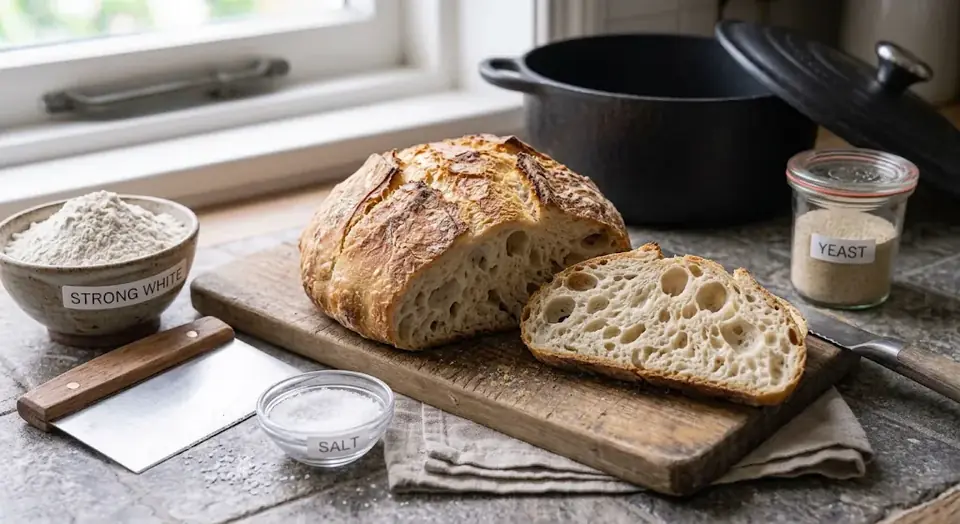
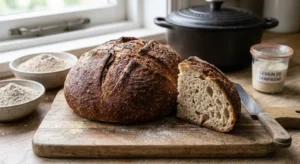
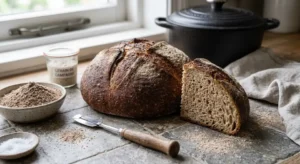
Turn out onto a rack and cool at least 2 hours. The crust crackles for several minutes as it contracts; the crumb finishes setting in that time, and cutting into it early gives the dense, damp streak that gets blamed on the flour.
Cook’s notes
- To serve and keep
- A general-purpose loaf: sliced for toast, torn for soup, cut in wedges for cheese. Be honest about what it is not — the crumb is randomly holed rather than evenly open, the crust is thick rather than fine, and the flavor is clean rather than complex. For an eighteen-hour wait and fifteen minutes of work, it remains a very good bargain.

Where it comes from
Almost no home baking method has an origin as precisely datable as this one. Jim Lahey had been running the Sullivan Street Bakery in New York since 1994 when Mark Bittman published his method in the New York Times on 8 November 2006, under a headline promising that time could do the work. The recipe asked for four ingredients, no kneading, an eighteen-hour rest on the counter and a preheated covered pot, and it spread faster than any bread recipe before it: reprinted, blogged, filmed and argued over within weeks, and credited with putting a cast-iron casserole in kitchens that had never owned a loaf tin. The individual elements were not new — very wet doughs, long slow fermentation and baking under a cover are all old practice, and the covered pot has ancestors in the clay cloche and further back still. What was new was the assembly and the audience. It demonstrated to several million people that structure in bread comes from time and water at least as much as from muscle.
No-Knead Artisan Loaf: quick answers
How long does No-Knead Artisan Loaf take?
About 20 hr 15 min.
How many does this No-Knead Artisan Loaf recipe make?
This recipe makes 1 boule.
Where does No-Knead Artisan Loaf come from?
Almost no home baking method has an origin as precisely datable as this one. Jim Lahey had been running the Sullivan Street Bakery in New York since 1994 when Mark Bittman published his method in the New York Times on 8 November 2006, under a headline promising that time could do the work. The recipe asked for four ingredients, no kneading, an eighteen-hour rest on the counter and a preheated covered pot, and it spread faster than any bread recipe before it: reprinted, blogged, filmed and argued over within weeks, and credited with putting a cast-iron casserole in kitchens that had never owned a loaf tin. The individual elements were not new — very wet doughs, long slow fermentation and baking under a cover are all old practice, and the covered pot has ancestors in the clay cloche and further back still. What was new was the assembly and the audience. It demonstrated to several million people that structure in bread comes from time and water at least as much as from muscle.
More from United States





More in Artisan & Sourdough

https://www.atlasserie.com/recipes/bread/no-knead-artisan-loaf/