France · Mushroom Cookery · 46.56° N, 2.35° E
Mushroom Omelette
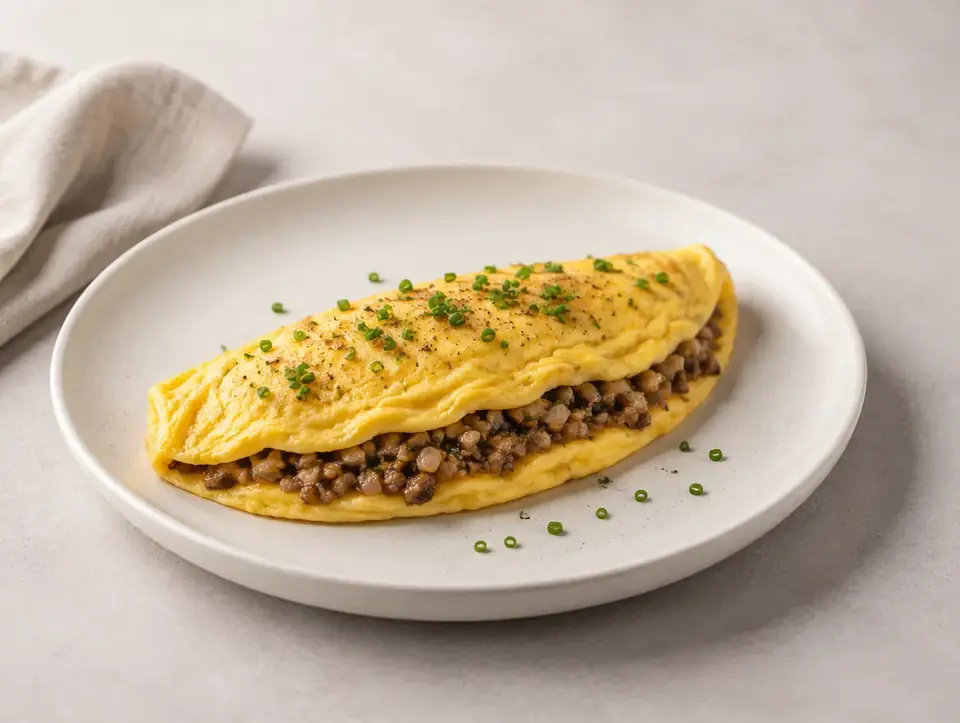
Duxelles of chestnut mushroom and shallot folded into a soft omelette.
At a glance.
Mushroom Omelette comes from France · Mushroom Cookery and appears in The Breakfast Atlas, in the chapter Eggs. It serves 1, takes about 25 minutes, and uses 14 ingredients and 10 steps.
- Yield
- Serves 1
- Method
- Stovetop
- Time
- 25 minutes
Ingredients
Tap an ingredient to tick it off.
- For the duxelles
- For the omelette
Method
-
Chop the mushrooms by hand to an even 3 mm dice, or pulse them in a food processor in short bursts. Stop before they turn to paste; a wet purée will never brown properly.
-
Heat the oil and butter in a wide 26 cm (10 in) skillet over medium-high. Use the widest pan you have — surface area is what lets moisture escape rather than pool.
-
Add the mushrooms in a single layer without salt and leave them undisturbed for 2 minutes. They will release a surprising amount of gray liquid; let it come.
-
Cook 8–10 minutes, stirring occasionally, until that liquid has completely evaporated and the pan sizzles rather than bubbles. The mushrooms shrink to about a third of their volume and smell nutty.
-
Now add the shallot and the salt and cook 3 minutes more, until the shallot softens and the mushrooms take on a deep, even brown with crisp fragments at the pan's edge.
-
Stir in the garlic and thyme for 30 seconds, then pour in the sherry and scrape the base clean as it hisses away. Add pepper and the crème fraîche if using, and keep the duxelles warm.
-
Beat the eggs with the salt for 20 seconds, until uniform but not frothy. Wipe out a 22 cm (9 in) nonstick pan, set over medium heat and melt the butter until it foams and settles.
-
Pour in the eggs and stir in slow figure-eights for about 40 seconds, drawing the setting egg through the liquid. Then let the pan sit 15 seconds so the base knits into a single sheet.
-
Spoon two-thirds of the warm duxelles across the half of the omelette nearest you, while the surface is still glossy and slightly wet.
-
Fold the far half over into a half-moon, slide onto a warmed plate, and top with the remaining duxelles and the parsley. Cut across it: the filling should be dark and dense, with no water running out.
Cook’s notes
- The technique
- Salt late and crowd never. Salt added at the start draws water out of the mushrooms by osmosis, and they then stew in it, staying pale and slippery however long you cook them. Leave it until the pan is dry and browning is under way and you get concentration instead: the Maillard reaction needs a surface above 140°C, impossible while water is still boiling off at 100°C. A wide pan and a patient ten minutes matter more than any ingredient here.
- Make ahead
- Duxelles is designed to be made ahead. It keeps five days in a sealed jar under a film of melted butter, and freezes for three months in tablespoon portions. Warm it in a dry pan before it meets the eggs — cold filling in a hot omelette forces you to overcook the surface.
- Troubleshooting
- Gray, watery filling — the mushrooms were salted early or the pan was too small. Omelette weeps on the plate — the duxelles went in wet. Filling tastes of raw alcohol — the sherry was not cooked off; wait until the pan is dry again. Burnt shallot — it went in with the mushrooms rather than after them.
- Variations
- Use a mix of wild mushrooms — girolle, trompette, pied de mouton — for a duxelles with more depth. Add a tablespoon of grated Comté with the filling for a fuller plate. A Japanese slant seasons the mushrooms with soy, mirin and butter, and serves the omelette over rice.
- Serve with
- A green salad with walnut oil and mustard vinaigrette, and a piece of baguette. Sautéed potatoes if it stands in for a main meal. A glass of light red — Beaujolais or a village Burgundy — is the classic match for mushrooms and egg. Made in full within this recipe — Mushroom Duxelles. Also listed in the Component Index at the back.

Where it comes from
The filling here has a name and a technique of its own. Duxelles — mushrooms, shallot and butter chopped fine and cooked until every trace of water has gone — is traditionally credited to François Pierre de La Varenne, the seventeenth-century cook whose Le Cuisinier François reshaped French cooking, and named for his employer the Marquis d'Uxelles; the attribution is repeated everywhere though the documentary chain is loose. What is certain is that the preparation became a foundation of classical cookery, the stuffing inside beef Wellington and the base of countless sauces. France's relationship with the cultivated mushroom is equally particular: the champignon de Paris was grown at scale in abandoned gypsum quarries beneath and around Paris through the nineteenth century, their steady cool damp making commercial production possible. An omelette aux champignons is where those two threads meet — a restaurant technique applied to a domestic dish. The rule that governs it is unglamorous and absolute: mushrooms are roughly nine-tenths water, and that water must be driven off in the pan before it reaches the eggs.
Mushroom Omelette: quick answers
How long does Mushroom Omelette take?
About 25 minutes.
How many does this Mushroom Omelette recipe make?
This recipe serves 1.
Where does Mushroom Omelette come from?
The filling here has a name and a technique of its own. Duxelles — mushrooms, shallot and butter chopped fine and cooked until every trace of water has gone — is traditionally credited to François Pierre de La Varenne, the seventeenth-century cook whose Le Cuisinier François reshaped French cooking, and named for his employer the Marquis d'Uxelles; the attribution is repeated everywhere though the documentary chain is loose. What is certain is that the preparation became a foundation of classical cookery, the stuffing inside beef Wellington and the base of countless sauces. France's relationship with the cultivated mushroom is equally particular: the champignon de Paris was grown at scale in abandoned gypsum quarries beneath and around Paris through the nineteenth century, their steady cool damp making commercial production possible. An omelette aux champignons is where those two threads meet — a restaurant technique applied to a domestic dish. The rule that governs it is unglamorous and absolute: mushrooms are roughly nine-tenths water, and that water must be driven off in the pan before it reaches the eggs.
More from France




More in Eggs

https://www.atlasserie.com/recipes/breakfast/mushroom-omelette/