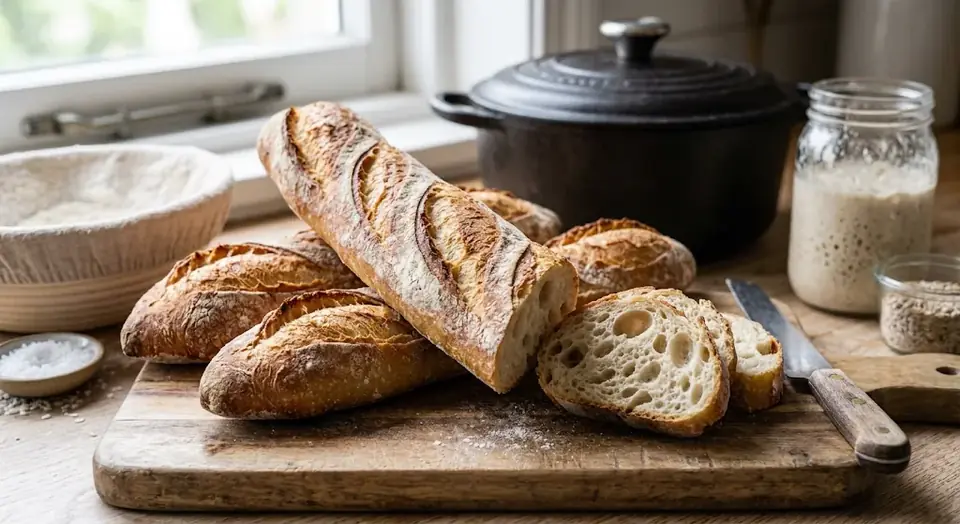
France · The Baguette Ordinaire · 46.56° N, 2.35° E
French Baguette
The everyday long loaf, poolish-raised and shaped in three folds.
At a glance.
French Baguette comes from France · The Baguette Ordinaire and appears in The Bread Atlas, in the chapter Artisan & Sourdough. It makes 3 baguettes, takes about 16 hours, and uses 9 ingredients and 12 steps.
- Yield
- Makes 3 baguettes
- Method
- Oven 245°C / 475°F
- Time
- 16 hours
Ingredients
Tap an ingredient to tick it off.
- Poolish
- The Dough
- For Shaping and Baking
Method
-
Twelve to fourteen hours ahead, whisk the poolish flour, water at 20°C and the speck of yeast to a loose batter. Cover and leave at 20°C. It is ripe when domed across the whole surface, honeycombed underneath and beginning to dip in the center.
-
Scrape the poolish into the dough water at 22°C and break it up, then add the flour and mix to a shaggy mass. Rest 30 minutes. Add the salt and yeast and mix 4 minutes to a smooth, slack dough at 24°C.
-
Bulk ferment 2 hours at 24°C with a fold at 40 and 80 minutes. Aim for a dough that has risen by half and feels alive but still slightly under-fermented — the baguette gets its remaining lift from shaping and the oven, not from a long bulk.
-
Divide into three pieces of about 235 g. Preshape each into a loose rectangle: press flat, fold the top down to the middle, the bottom up to meet it, and roll it lightly into a stubby cylinder. Do not tighten it — this is organization, not shaping.
-
Rest the cylinders 25–30 minutes under a cloth, seam down. The gluten relaxes and the dough will lengthen without tearing. A piece that fights back when you press it has not rested long enough; give it another ten minutes rather than forcing it.
-
Shape. Set a cylinder in front of you, flour up, and press it into a rectangle about 20 × 12 cm, knocking out the largest bubbles only. Fold the top third down and seal the edge with the heel of your hand, pressing along the whole length.
-
Rotate the piece 180° and repeat: fold the new top third down and seal it. Then fold the dough in half away from you and seal that final seam hard with the heel of the hand, running the length twice. That sealed seam is the spine of the loaf and the reason it holds a straight line in the oven.
-
Roll out to length. Hands flat, fingers together, start at the center and roll outward with light even pressure, lifting slightly at the ends so they taper. Take it to 45 cm in two or three passes rather than one, or the skin tears and the crumb goes coarse at the tips.
-
Lay the baguettes seam side up on a heavily floured linen couche, pleating the cloth into a ridge between each. Cover and prove 45–60 minutes at 22°C, until a floured fingertip leaves a dent that fills back about two-thirds.
-
Heat the oven to 245°C / 475°F with a baking stone in the middle and a heavy tray on the floor for the last 45 minutes. Roll the loaves seam side down onto a floured board, then onto parchment or a peel.
-
Score each loaf with five overlapping cuts, the blade at 25° and almost parallel to the long axis, each cut starting alongside the last rather than behind it. Load, pour boiling water into the tray, and bake 20 minutes, venting the oven after 12.
-
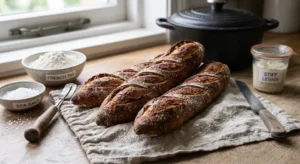
The crust should be red-brown with a matte bloom and the loaf light in the hand at 98°C inside. Cool on a rack for 20 minutes, no longer. A baguette is at its best within two hours, and it is the only bread in this chapter you are allowed to eat warm.
Cook’s notes
- To serve and keep
- Bought or baked twice a day in France and eaten within hours: torn at the table, split for a jambon-beurre, or cut into rounds under pâté. Store it in paper, cut end down, and accept that by tomorrow it is an ingredient rather than a loaf.

Where it comes from
Long loaves were sold in Paris well before the word baguette settled on them: eighteenth-century price lists name pain long, and by the 1830s the city's bakers had ovens capable of baking them well. The equipment mattered. August Zang, a Viennese entrepreneur, opened the Boulangerie Viennoise on the rue de Richelieu in 1839 with steam-injected ovens, and the glossy, thin-crusted loaves that came out of them were widely imitated. The name itself is a twentieth-century Parisian usage, fixed by municipal weight and price rules in the 1920s at roughly 250–300 g and something over half a meter. The story usually attached to it — that a 1919 law barring bakers from working between ten at night and four in the morning forced a shape that could be mixed and baked in a single short morning — fits the chronology and is repeated in the trade, but the documentary line from statute to shape is thinner than the telling suggests. What is certain is that the baguette became a bread bought twice a day and eaten the day it is baked.
French Baguette: quick answers
How long does French Baguette take?
About 16 hours.
How many does this French Baguette recipe make?
This recipe makes 3 baguettes.
Where does French Baguette come from?
Long loaves were sold in Paris well before the word baguette settled on them: eighteenth-century price lists name pain long, and by the 1830s the city's bakers had ovens capable of baking them well. The equipment mattered. August Zang, a Viennese entrepreneur, opened the Boulangerie Viennoise on the rue de Richelieu in 1839 with steam-injected ovens, and the glossy, thin-crusted loaves that came out of them were widely imitated. The name itself is a twentieth-century Parisian usage, fixed by municipal weight and price rules in the 1920s at roughly 250–300 g and something over half a meter. The story usually attached to it — that a 1919 law barring bakers from working between ten at night and four in the morning forced a shape that could be mixed and baked in a single short morning — fits the chronology and is repeated in the trade, but the documentary line from statute to shape is thinner than the telling suggests. What is certain is that the baguette became a bread bought twice a day and eaten the day it is baked.
More from France

More in Artisan & Sourdough

https://www.atlasserie.com/recipes/bread/french-baguette/