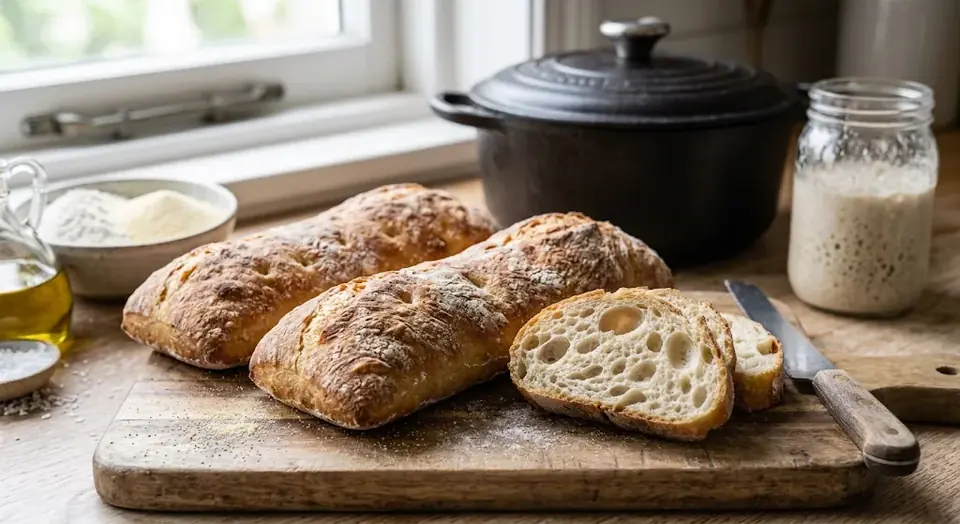
Italy · Adria, Veneto · 43.43° N, 12.37° E
Ciabatta
A slipper of a loaf: wet, folded, never truly shaped, full of holes.
At a glance.
Ciabatta comes from Italy · Adria, Veneto and appears in The Bread Atlas, in the chapter Artisan & Sourdough. It makes 2 loaves, takes about 20 hours, and uses 9 ingredients and 11 steps.
- Yield
- Makes 2 loaves
- Method
- Oven 230°C / 450°F
- Time
- 20 hours
Ingredients
Tap an ingredient to tick it off.
- Biga
- The Dough
- For Handling
Method
-
Sixteen to eighteen hours ahead, rub the yeast into the biga flour and add the cold water. Work it to a rough, stiff dough with no dry flour left — it will look unpromising and should. Cover and leave at 17–19°C.
-
The biga is ready when it has trebled, smells of cream and alcohol, and pulls apart in long webbed strands. A biga is kept stiff and cool precisely so that it ferments slowly and builds flavor without turning acid, which a wetter preferment at the same age would do.
-
Tear the biga into the 275 g of water at 20°C and let it soften for 10 minutes, then squeeze it to a rough slurry. Add the remaining flour and mix to a thick batter. Rest 20 minutes.
-
Add the salt, yeast and olive oil, then work the dough with a wet hand for 3 minutes, lifting and slapping it against the side of the bowl. Add the held-back 50 g of water in two additions once it has come together. Target 23–24°C.
-
Bulk ferment 2½–3 hours at 24°C in a rectangular tub, with four sets of coil folds every 30 minutes: lift the dough from the middle with wet hands, let it hang and fold under itself, then turn the tub and repeat.
-
The dough is ready when it has doubled, holds a domed edge against the tub and is covered in bubbles the size of coins. It should still be slack enough to flow when tipped, but it should flow slowly, in one piece, like a thick quilt.
-
Flour the bench heavily with the flour and semolina. Tip the dough out in one movement, without stretching or degassing it, and let it settle into a rough rectangle. Dust the top. From here on you cut, you do not shape.
-
Cut the rectangle in two with a dough scraper, one firm stroke each, never a sawing motion. Lift each piece with both hands under its length, stretch it very slightly toward a slipper, and lay it on floured parchment. Fingerprints and dents are correct.
-
Prove 45 minutes at 24°C, uncovered for the last 15 so the surface dries a little and takes the heat. Meanwhile heat the oven to 230°C / 450°F with a stone in the middle and a tray on the floor.
-
Slide the loaves and parchment onto the stone, pour 250 ml boiling water into the tray, and bake 15 minutes. Vent the steam and bake 10 minutes more, until deep gold, hollow-sounding and 99°C inside — a very wet dough needs to be taken further than it looks.
-
Cool on a rack for at least 45 minutes. The interior of a ciabatta finishes cooking as it cools, and cut too soon the walls of those large holes collapse and go leathery. Not scoring it at all is deliberate: the loaf tears open where its own gas decides.
Cook’s notes
- To serve and keep
- Split and filled while still crisp, with mozzarella, prosciutto or grilled vegetables; or torn and used to mop oil and juices. Never sliced thin — the structure is the point. Keep it uncovered on a board and toast whatever is left the next morning.

Where it comes from
Ciabatta has something almost no bread has: a documented inventor and a date. Arnaldo Cavallari, a miller and baker in Adria in the Polesine, south of Venice, developed it in 1982 and called it ciabatta polesana, after the district and after the flat-heeled slipper it resembles. His motive was commercial and openly stated — the baguette had taken over the Italian sandwich, and Italian bakers wanted a loaf of their own to sell against it. Cavallari registered the name, licensed the method to bakers abroad, and the loaf reached Britain in 1985 through Marks and Spencer, then spread through Europe and North America with unusual speed for something so new. Regional variants appeared almost at once: the ciabatta of Como is wetter and more open, the Tuscan version firmer and saltless in keeping with local bread, and the Roman ciabatta flatter. That a bread invented in the 1980s now reads as timeless Italian tradition says something useful about how quickly bread traditions can form.
Ciabatta: quick answers
How long does Ciabatta take?
About 20 hours.
How many does this Ciabatta recipe make?
This recipe makes 2 loaves.
Where does Ciabatta come from?
Ciabatta has something almost no bread has: a documented inventor and a date. Arnaldo Cavallari, a miller and baker in Adria in the Polesine, south of Venice, developed it in 1982 and called it ciabatta polesana, after the district and after the flat-heeled slipper it resembles. His motive was commercial and openly stated — the baguette had taken over the Italian sandwich, and Italian bakers wanted a loaf of their own to sell against it. Cavallari registered the name, licensed the method to bakers abroad, and the loaf reached Britain in 1985 through Marks and Spencer, then spread through Europe and North America with unusual speed for something so new. Regional variants appeared almost at once: the ciabatta of Como is wetter and more open, the Tuscan version firmer and saltless in keeping with local bread, and the Roman ciabatta flatter. That a bread invented in the 1980s now reads as timeless Italian tradition says something useful about how quickly bread traditions can form.
More from Italy





More in Artisan & Sourdough
https://www.atlasserie.com/recipes/bread/ciabatta/