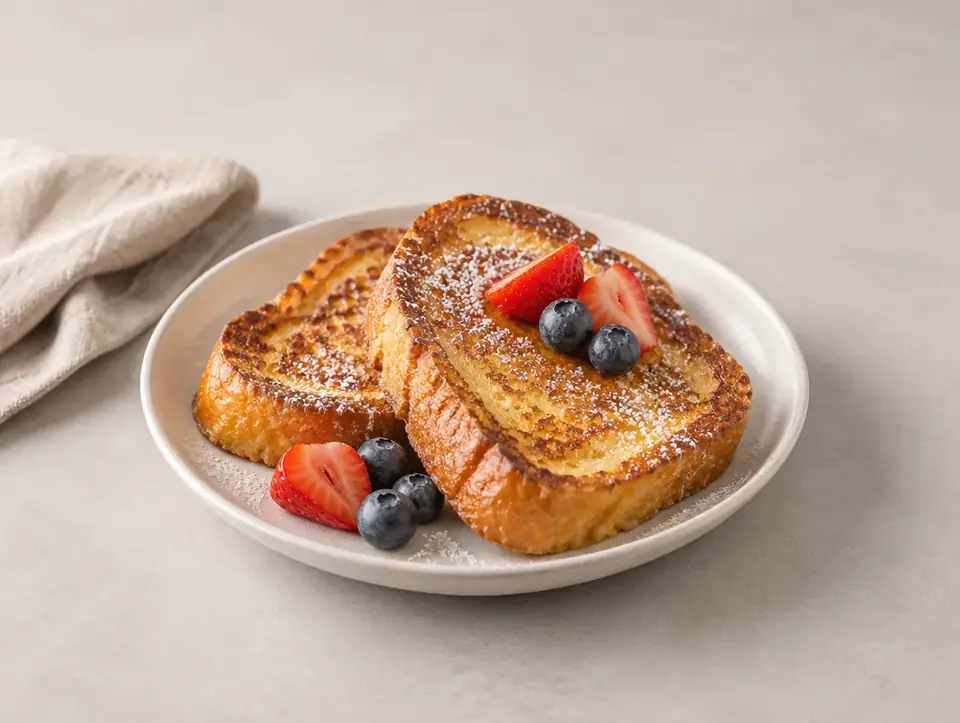
France · Pain Perdu · 46.56° N, 2.35° E
French Toast
Day-old bread rescued in vanilla custard and fried in foaming butter.
At a glance.
French Toast comes from France · Pain Perdu and appears in The Breakfast Atlas, in the chapter Toast & Breakfast Breads. It serves 2, takes about 25 minutes, and uses 12 ingredients and 10 steps.
- Yield
- Serves 2
- Method
- Stovetop
- Time
- 25 minutes
Ingredients
Tap an ingredient to tick it off.
Method
-
Dry the bread if it is fresh: lay the slices on a rack in a 150°C (300°F) oven for 8–10 minutes, until the surfaces feel leathery but the centers stay soft. Cool completely before soaking.
-
Whisk the eggs with the sugar and salt first, until the sugar dissolves and the mixture briefly ribbons. Pouring dairy onto unbroken yolks leaves ropes of white that fry into rubbery lace.
-
Whisk in the milk, cream, vanilla, cinnamon and nutmeg. The ratio decides the result: roughly one egg to 80 ml of dairy sets soft and custardy, while more egg pushes the middle toward omelette.
-
Pour the custard into a wide dish. Lay in two slices and soak 45 seconds a side for ordinary bread, up to 2 minutes a side for dense, well-staled brioche. Press the center gently to feel for a saturated core.
-
Lift each slice on a fish slice and let it drain for a few seconds over the dish. Sodden bread that drips will steam in the pan rather than brown.
-
Heat half the butter with half the oil in a heavy skillet over medium heat. The oil dilutes the milk solids so a scorched patch cannot flavor the whole pan — it does not raise butter’s smoke point, which only clarifying does.
-
When the foam subsides, lay the slices in without crowding. Fry 2½–3 minutes, until the underside is a deep even bronze and the edges look set rather than glossy.
-
Turn once and give the second side 2–2½ minutes. Press the center with a finger: it should feel springy and slightly resistant, not liquid, which means the custard has set at around 82°C (180°F).
-
Move finished slices to a rack in a low oven while you wipe the pan, add the rest of the butter and oil, and cook the remainder. A rack keeps the undersides crisp; a plate steams them soft.
-
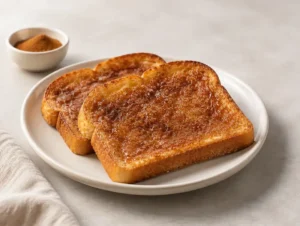
Dust with icing sugar through a fine sieve, held high so the fall is even, stack the slices on warmed plates and pour the maple syrup at the table rather than in the kitchen.
Cook’s notes
- The technique
- Stale bread is not a compromise, it is the requirement. As bread ages its starch retrogrades and releases water, leaving a firmer, more absorbent network that drinks custard and still holds together under a spatula. Fresh bread is already saturated with its own moisture, so it takes on little custard and disintegrates when lifted. Two days on the counter, or ten minutes in a low oven, does the work.
- Make ahead
- Mix the custard the night before and refrigerate it, whisking again before use. Slices can be soaked, drained and held on a tray for 30 minutes. Cooked French toast reheats acceptably on a rack at 180°C (350°F) for 6 minutes and freezes for a month.
- Troubleshooting
- Wet, eggy middle — soaked too long, or the pan too hot so the outside set before the center; drop the heat and give it another minute. Pale and greasy — the pan was not hot enough at the start. Scrambled patches on the surface — the eggs were not whisked smooth before the milk went in.
- Variations
- Torrijas soak in milk infused with cinnamon and lemon peel, fry in olive oil and finish under honey syrup. Hong Kong's version sandwiches two slices around peanut butter, deep-fries them, and tops them with condensed milk. A savory take skips the sugar entirely and serves the slices with bacon and hot sauce.
- Serve with
- Warmed maple syrup, and something sharp against the richness: macerated berries, poached rhubarb or grapefruit segments. Black coffee. In France the slices more often appear as a goûter, the after-school snack, than at breakfast.

Where it comes from
The dish is older than France. The Roman recipe collection attributed to Apicius, compiled around the fourth century, includes a sweet made by soaking bread in milk, frying it and pouring honey over — no name attached, but unmistakably this. Medieval Europe kept the idea because it solved a problem: bread went hard within days and nobody threw bread away. The French called it pain perdu, lost bread, and the phrase describes the economics precisely. Every bread-eating culture holds a version. Spain fries torrijas in olive oil during Holy Week and steeps them in wine or honeyed syrup; Portugal makes rabanadas at Christmas; Germany and Austria say arme Ritter, poor knights, and England once said poor knights of Windsor. The American name is a puzzle with no settled answer — several claims circulate and none is well supported — but by the nineteenth century French toast was firmly established as a griddle breakfast in the United States, sweetened, spiced and served under syrup.
French Toast: quick answers
How long does French Toast take?
About 25 minutes.
How many does this French Toast recipe make?
This recipe serves 2.
Where does French Toast come from?
The dish is older than France. The Roman recipe collection attributed to Apicius, compiled around the fourth century, includes a sweet made by soaking bread in milk, frying it and pouring honey over — no name attached, but unmistakably this. Medieval Europe kept the idea because it solved a problem: bread went hard within days and nobody threw bread away. The French called it pain perdu, lost bread, and the phrase describes the economics precisely. Every bread-eating culture holds a version. Spain fries torrijas in olive oil during Holy Week and steeps them in wine or honeyed syrup; Portugal makes rabanadas at Christmas; Germany and Austria say arme Ritter, poor knights, and England once said poor knights of Windsor. The American name is a puzzle with no settled answer — several claims circulate and none is well supported — but by the nineteenth century French toast was firmly established as a griddle breakfast in the United States, sweetened, spiced and served under syrup.
The same dish in another volume
More from France



More in Toast & Breakfast Breads

https://www.atlasserie.com/recipes/breakfast/french-toast/