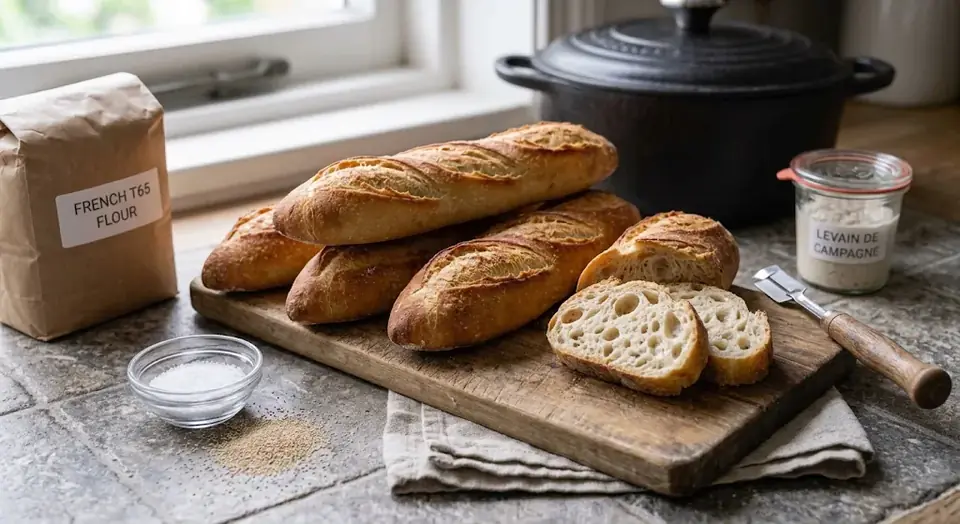
France · The Half Loaf and the Home Oven · 46.56° N, 2.35° E
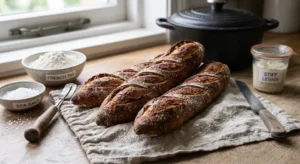
Demi-Baguette
Half the length, all of the crust, and it fits a domestic oven.
At a glance.
Demi-Baguette comes from France · The Half Loaf and the Home Oven and appears in The Bread Atlas, in the chapter Artisan & Sourdough. It makes 4 demi-baguettes, takes about 20 hours, and uses 8 ingredients and 11 steps.
- Yield
- Makes 4 demi-baguettes
- Method
- Oven 245°C / 475°F
- Time
- 20 hours
Ingredients
Tap an ingredient to tick it off.
- The Dough
- For Shaping and Baking
Method
-
Mix the flour with the water at 18°C and rest 30 minutes. Add the salt and yeast and work the dough 5 minutes to a firm, smooth mass at 22°C. A cool, relatively dry dough is chosen here because it will hold a clean shape after a long night in the cold.
-
Bulk ferment 45 minutes at room temperature with one fold, then cover the tub and refrigerate 16–18 hours. The whole flavor of a loaf with no preferment in it comes from this cold night, and the schedule is deliberate: mix after dinner, bake the following afternoon.
-
Take the dough out and rest it 45 minutes at room temperature. It should have risen by about half and feel cool, firm and smooth. Divide into four pieces of 185 g, preshape each into a loose oblong, and rest 25 minutes under a cloth.
-
Shape by the three-fold roll of recipe 17, but stop rolling at 28–30 cm — a length chosen so that four loaves fit a domestic sheet with room between them, and so that a roasting tin will sit over them. Seal the spine firmly along the whole length.
-
Lay the loaves seam up on a floured couche with a pleat of cloth between each. Prove 50–60 minutes at 22°C, to the point where a fingertip dent fills back about two-thirds. Short loaves prove faster than long ones; check at 45 minutes.
-
Heat the oven for 45 minutes at 245°C / 475°F with a heavy baking sheet inverted on the middle shelf and a cast-iron skillet on the floor. Turning the sheet upside down removes the lip, so the loaves can be slid on and off, and gives a flat mass of hot metal that behaves something like a stone.
-
Be honest about home steam. A domestic oven leaks, has little thermal mass and cannot hold a steam-filled chamber the way a deck oven can. The reliable answer at this length is a cover: an inverted deep roasting tin over the loaves traps their own moisture completely, which no amount of spraying will match.
-
Flip the loaves onto floured parchment, score three overlapping cuts on each at 25°, and slide parchment and all onto the hot sheet. Pour the boiling water into the skillet, invert the roasting tin over the loaves, and shut the door.
-
Bake covered 10 minutes. The confined steam keeps the crust soft while the loaves make their full spring, and dissolves surface starch that later bakes to a gloss. Lift the tin away with dry oven gloves — the escaping steam is scalding — and remove the skillet.
-
Bake a further 8–10 minutes uncovered until the crust is red-gold and the loaves are light in the hand, reading 99°C. If your oven browns unevenly, turn the sheet once at this stage rather than during the covered phase.
-
Cool on a rack for 15 minutes and eat within the hour. The crust of a small loaf is a larger fraction of it, which is the compensation for what a home oven cannot do: you will get slightly less blistering than a bakery, and slightly more crust per mouthful.
Cook’s notes
- To serve and keep
- Split lengthwise and filled with ham and butter, or cut into sections for the table alongside soup. A demi is sized for one or two people and should be finished the day it is baked. Store in paper and never in a sealed bag, which softens the crust within twenty minutes.

Where it comes from
The demie is an ordinary transaction in France rather than a special loaf: half a baguette, asked for at the counter and cut on the spot, or baked as a short stick of about 125 g for a household that will not finish a full one before it goes stale. Its rise tracks a demographic fact. As French households shrank across the twentieth century and daily bread shopping survived alongside them, the bakery's range of small formats — the demie, the ficelle, the petit pain — carried more of the trade. There is a second reason it belongs in a home baking book, and it is worth stating plainly: the French did not, on the whole, bake baguettes at home. Bread was bought fresh twice a day from a shop three streets away, and the domestic oven was designed for gratins and roasts. Baking baguettes in a house is largely an English-speaking enthusiasm of the last thirty years, and it runs into a physical limit at once. A standard 65 cm baguette does not fit a 46 cm oven. The demi does.
Demi-Baguette: quick answers
How long does Demi-Baguette take?
About 20 hours.
How many does this Demi-Baguette recipe make?
This recipe makes 4 demi-baguettes.
Where does Demi-Baguette come from?
The demie is an ordinary transaction in France rather than a special loaf: half a baguette, asked for at the counter and cut on the spot, or baked as a short stick of about 125 g for a household that will not finish a full one before it goes stale. Its rise tracks a demographic fact. As French households shrank across the twentieth century and daily bread shopping survived alongside them, the bakery's range of small formats — the demie, the ficelle, the petit pain — carried more of the trade. There is a second reason it belongs in a home baking book, and it is worth stating plainly: the French did not, on the whole, bake baguettes at home. Bread was bought fresh twice a day from a shop three streets away, and the domestic oven was designed for gratins and roasts. Baking baguettes in a house is largely an English-speaking enthusiasm of the last thirty years, and it runs into a physical limit at once. A standard 65 cm baguette does not fit a 46 cm oven. The demi does.
More from France





More in Artisan & Sourdough

https://www.atlasserie.com/recipes/bread/demi-baguette/