Chaoshan & Singapore · Teochew Muay · 1.35° N, 103.82° E
Rice Congee with Toppings
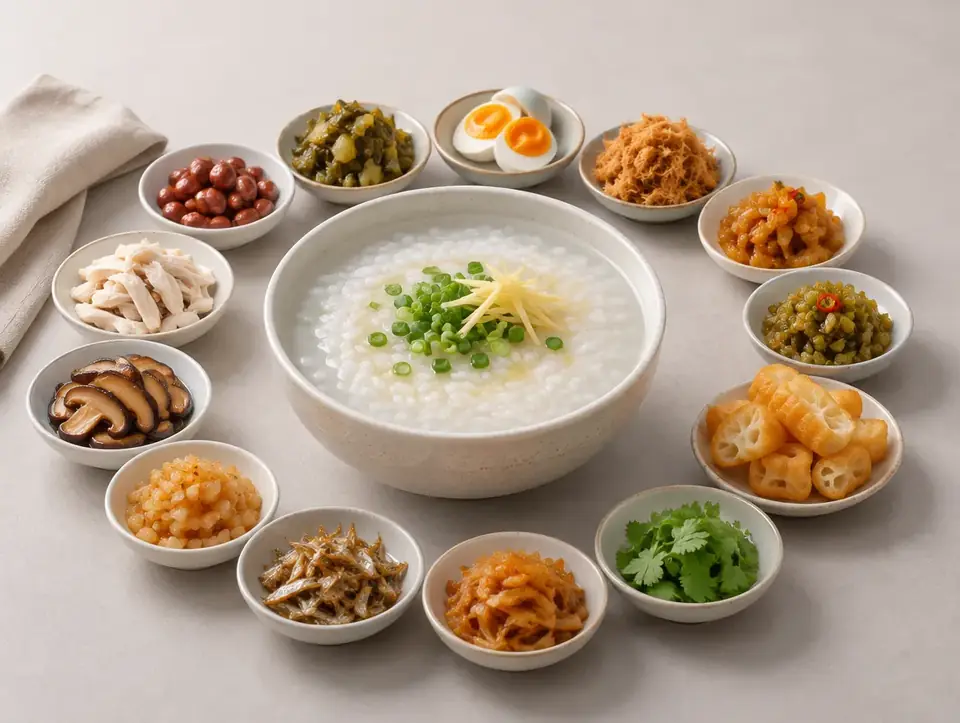
Loose, short-cooked rice porridge surrounded by a dozen small salty plates.
At a glance.
Rice Congee with Toppings comes from Chaoshan & Singapore · Teochew Muay and appears in The Breakfast Atlas, in the chapter Breakfast Around the World. It serves 4, takes about 1 hr 45 min, and uses 21 ingredients and 10 steps.
- Yield
- Serves 4
- Method
- Stovetop
- Time
- 1 hr 45 min
Ingredients
Tap an ingredient to tick it off.
- For the muay
- For the braised peanuts
- For the chai poh omelette
- For the steamed fish and the za xian table
Method
-
Start the peanuts a day ahead: soak them overnight, then simmer in the liter of water with the star anise, ginger, salt and soy for 60–75 minutes until they give completely between finger and thumb but keep their shape. Cool them in the liquid.
-
For the muay, bring the water to a hard boil in a wide pot, add the rinsed rice and the small measure of salt, and stir once to stop the grains settling and catching.
-
Boil, uncovered and at a genuine rolling boil, for 20–25 minutes. This is not the low, patient simmer used for Cantonese jook; the agitation is what abrades the grains and clouds the water while leaving them intact.
-
Watch for the moment the grains split lengthwise like flower buds and swell to twice their size while still being countable in the pot. Stop there. Five minutes more and you have a different dish entirely.
-
Take it off the heat and let it stand 10 minutes. It thickens as it rests and should end up pourable — loose enough to slosh in the ladle, with a distinct layer of cloudy liquid above the settled rice.
-
For the omelette, chop the rinsed chai poh finely and fry it with the garlic in the oil over medium heat for 3 minutes until it smells sweet and toasty. Rinsing first is essential; unrinsed preserved radish is punishingly salty.
-
Pour in the beaten eggs with the white pepper, leave 60 seconds to set at the base, then fold it over in thirds and slide it out. Cut into strips and set on a small plate.
-
Score the fish twice on each side and lay it on a heatproof plate over the kiam chai, sour plum, tomato and half the ginger. Steam over rapidly boiling water for 10–12 minutes, until the flesh at the thickest point parts from the bone.
-
Heat the oil until it shimmers, pour it over the scallions and remaining ginger heaped on the fish, then add the soy sauce around the edge of the plate rather than over the top.
-
Ladle the muay into bowls and let it cool to warm rather than scalding — the Teochew way is to eat it barely hot. Set every side dish on the table in its own small plate and let people spoon a little of each against a mouthful of plain rice.
Cook’s notes
- The technique
- The ratio and the clock do everything. At one part rice to eight parts water, boiled hard for twenty-odd minutes, the grains hydrate and burst but never release enough amylose to bind the liquid into a gel, so the bowl stays in two phases — this is the defining character of Teochew muay. A lid, a lower flame or an extra fifteen minutes will thicken it into something else. Boil openly, stir rarely, and stop early.
- Make ahead
- Braised peanuts keep five days in their liquid and improve after one. Chai poh can be rinsed, chopped and refrigerated a week ahead. Salted duck eggs and fermented bean curd are shelf-stable by design. The porridge itself takes 25 minutes and should be made fresh; reheated, it sets solid and needs boiling water whisked in.
- Troubleshooting
- Thick and gluey — cooked too long, or the pot was covered. Rice sunk into a solid raft — it was left standing more than 20 minutes; stir in boiling water. Everything tasting of salt — the preserved sides went on the plate unrinsed. Watery and thin with hard grains — the boil was too gentle to break the rice open.
- Variations
- Singapore and Malaysian stalls serve the same porridge with braised duck, hei bee hiam or steamed pork ribs. Thai Teochew households add a raw egg dropped into the hot bowl. In Chaoshan itself, seafood muay cooked with prawns, squid and fish bones is a separate and much richer tradition. Malay bubur runs sweeter and often carries coconut milk.
- Serve with
- Chinese tea, usually a strong Phoenix oolong from the Chaoshan hills, poured in tiny cups between mouthfuls. Everything is shared: one bowl of porridge each, all the side dishes in the middle, and a spoon rather than chopsticks for the muay itself. Made in full within this recipe — Braised Peanuts, Chai Poh Omelette, Teochew Steamed Fish. Also listed in the Component Index at the back.

Where it comes from
The Teochew of the Chaoshan region — Chaozhou, Shantou and Jieyang, in eastern Guangdong — treat rice porridge as a plain vehicle rather than a finished dish, and their muay is deliberately different from the Cantonese jook described in Chapter Four. The rice is boiled hard in a great deal of water for twenty-odd minutes and stopped while the grains are still whole and split, so the bowl separates into cloudy liquid and visible rice rather than dissolving into a single suspension. Its purpose is to be bland. The flavor sits in the za xian, the array of small salty sides set around it: preserved radish, braised peanuts, salted duck egg, fermented bean curd, salted mustard greens, and a steamed fish for the table to pick at. The pattern travelled with nineteenth- and twentieth-century Teochew migration out of Shantou to Singapore, Malaysia, Thailand and Vietnam, where late-night porridge stalls with a counter of covered dishes remain one of the most recognizable forms of Chinese food in Southeast Asia, sitting alongside the broader Malay and Indonesian bubur.
Rice Congee with Toppings: quick answers
How long does Rice Congee with Toppings take?
About 1 hr 45 min.
How many does this Rice Congee with Toppings recipe make?
This recipe serves 4.
Where does Rice Congee with Toppings come from?
The Teochew of the Chaoshan region — Chaozhou, Shantou and Jieyang, in eastern Guangdong — treat rice porridge as a plain vehicle rather than a finished dish, and their muay is deliberately different from the Cantonese jook described in Chapter Four. The rice is boiled hard in a great deal of water for twenty-odd minutes and stopped while the grains are still whole and split, so the bowl separates into cloudy liquid and visible rice rather than dissolving into a single suspension. Its purpose is to be bland. The flavor sits in the za xian, the array of small salty sides set around it: preserved radish, braised peanuts, salted duck egg, fermented bean curd, salted mustard greens, and a steamed fish for the table to pick at. The pattern travelled with nineteenth- and twentieth-century Teochew migration out of Shantou to Singapore, Malaysia, Thailand and Vietnam, where late-night porridge stalls with a counter of covered dishes remain one of the most recognizable forms of Chinese food in Southeast Asia, sitting alongside the broader Malay and Indonesian bubur.
More from Singapore
More in Breakfast Around the World

https://www.atlasserie.com/recipes/breakfast/rice-congee-with-toppings/