Türkiye · İzmir Province · 39.06° N, 35.37° E
Menemen
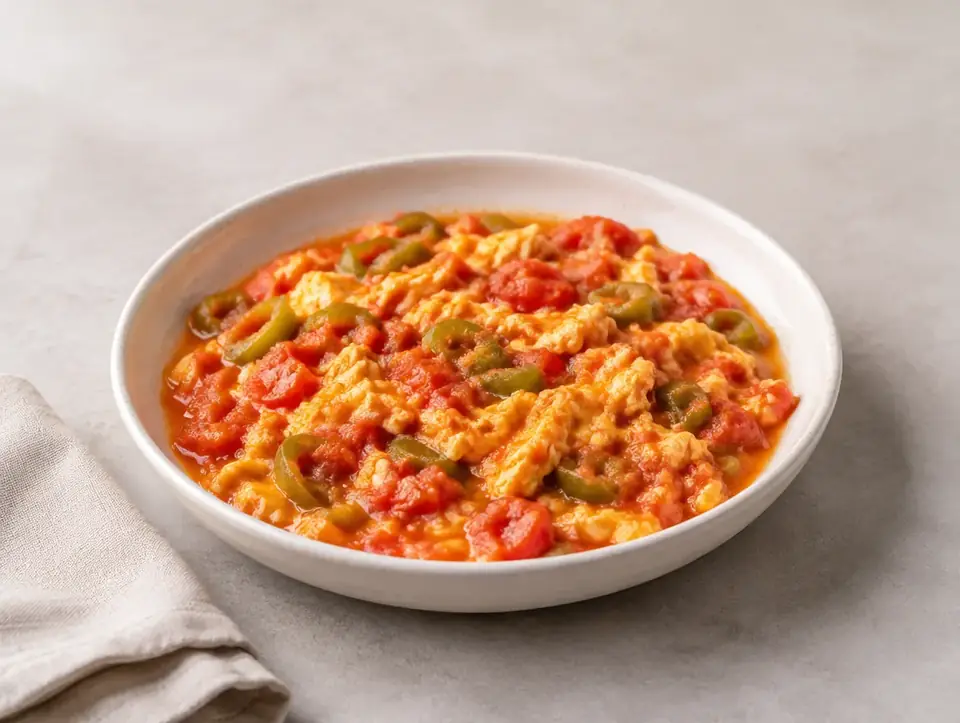
Green peppers cooked soft, tomatoes reduced, eggs stirred to loose curds.
At a glance.
Menemen comes from Türkiye · İzmir Province and appears in The Breakfast Atlas, in the chapter Breakfast Around the World. It serves 2, takes about 30 minutes, and uses 11 ingredients and 10 steps.
- Yield
- Serves 2
- Method
- Stovetop
- Time
- 30 minutes
Ingredients
Tap an ingredient to tick it off.
Method
-
Skin the tomatoes if you want the classic texture: score a cross in the base, cover with boiling water for 30 seconds, then slip the skins off. Grate the flesh on the coarse side of a box grater and discard the shreds of skin.
-
Warm the oil, or the oil and butter, in a 22 cm heavy pan over medium heat. If you are in the soğanlı camp, soften the onion first for 5 minutes until translucent and sweet, without letting it brown.
-
Add the sliced peppers and cook 8–10 minutes over medium-low heat, stirring occasionally. They must go completely limp and begin to blister and sweeten; this is the longest step and the one that defines the dish.
-
Under-cooked peppers stay grassy and squeaky and dominate everything that follows. Wait until they collapse against the side of the pan when pressed with a spoon.
-
Tip in the tomatoes with the salt and black pepper. Raise the heat slightly and cook 8–10 minutes until the mixture has reduced from watery to jammy and the oil begins to separate and pool at the edges.
-
That separation is your signal. Adding eggs to a wet tomato base gives you soup; adding them to a reduced one gives you menemen.
-
Turn the heat to low. Pour the beaten eggs across the whole surface and count to twenty before touching them, letting the underside begin to set against the sauce.
-
Now stir slowly with a wooden spoon, drawing it through in wide arcs rather than beating. You want ribbons of egg suspended in the sauce — neither a homogeneous orange mass nor a uniform scramble.
-
Take the pan off the heat while the eggs still look slightly underdone and glossy, after 2–3 minutes of stirring in total. Residual heat in the metal will carry them the rest of the way in under a minute.
-
Scatter the crumbled cheese, pul biber and parsley over the top and bring the pan to the table on a board, with torn bread and nothing else on the plate.
Cook’s notes
- The technique
- Two temperatures make this dish. The peppers need eight to ten unhurried minutes at medium-low so their cell walls break down and their sugars come forward, and the eggs need the lowest heat you can manage, because egg proteins coagulate between 62 and 70°C and anything hotter squeezes water out into the sauce and leaves rubbery grains behind. Stir in arcs, pull the pan early, and let carryover finish it.
- Make ahead
- The pepper and tomato base can be made up to three days ahead and refrigerated; it is arguably better on day two, and this is the standard way to have menemen on a weekday. Reheat it until it sizzles, then add eggs to order. A finished menemen cannot be reheated at all.
- Troubleshooting
- Watery, split pan — the tomatoes were not reduced far enough before the eggs went in. Grainy, tight egg — the heat was too high or the stirring too vigorous. Harsh, vegetal flavor — the peppers were rushed. Gray tinge — cheap tinned tomatoes; use fresh in season and good passata otherwise.
- Variations
- Sucuklu menemen adds 80 g of sliced garlic-and-cumin sausage, rendered before the peppers go in. A version around Bursa stirs in white cheese early so it melts into strands. Some Aegean cooks put a spoonful of thick yogurt on the side. In eastern provinces, butter replaces oil entirely.
- Serve with
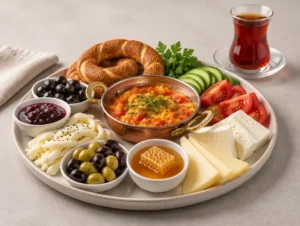
- Bread is the only utensil that matters — a fresh loaf torn into pieces, or a split simit. Drink çay from a tulip glass, poured from the double teapot. Olives, cucumber and a wedge of white cheese alongside turn it into a full breakfast.

Where it comes from
Menemen takes its name from a town on the Gediz plain north of İzmir, in a stretch of the Aegean known for its peppers and its tomatoes; the connection is asserted more often than it is documented, but the dish is unmistakably Aegean in construction, and pepper does the work that tomato does elsewhere. It belongs to the kahvaltı salonu and the esnaf lokantası, cooked to order in a small copper sahan and carried to the table in the pan it was made in, and it doubles as student food and as late-night food. Its resemblance to the shakshuka of Chapter One is superficial and worth setting straight. Shakshuka is Maghrebi, built on a tomato base spiced with cumin, caraway and paprika, with whole eggs cracked into wells and left until the whites firm. Menemen uses no cumin and no paprika, leans on long, slow, sweet green peppers rather than tomatoes for its character, and has its eggs beaten first and stirred into the sauce as a soft, loose curd. The one live argument concerns onion: soğanlı or soğansız, with or without, and İzmir tends to say without.
Menemen: quick answers
How long does Menemen take?
About 30 minutes.
How many does this Menemen recipe make?
This recipe serves 2.
Where does Menemen come from?
Menemen takes its name from a town on the Gediz plain north of İzmir, in a stretch of the Aegean known for its peppers and its tomatoes; the connection is asserted more often than it is documented, but the dish is unmistakably Aegean in construction, and pepper does the work that tomato does elsewhere. It belongs to the kahvaltı salonu and the esnaf lokantası, cooked to order in a small copper sahan and carried to the table in the pan it was made in, and it doubles as student food and as late-night food. Its resemblance to the shakshuka of Chapter One is superficial and worth setting straight. Shakshuka is Maghrebi, built on a tomato base spiced with cumin, caraway and paprika, with whole eggs cracked into wells and left until the whites firm. Menemen uses no cumin and no paprika, leans on long, slow, sweet green peppers rather than tomatoes for its character, and has its eggs beaten first and stirred into the sauce as a soft, loose curd. The one live argument concerns onion: soğanlı or soğansız, with or without, and İzmir tends to say without.
More from Turkey



More in Breakfast Around the World



https://www.atlasserie.com/recipes/breakfast/menemen/