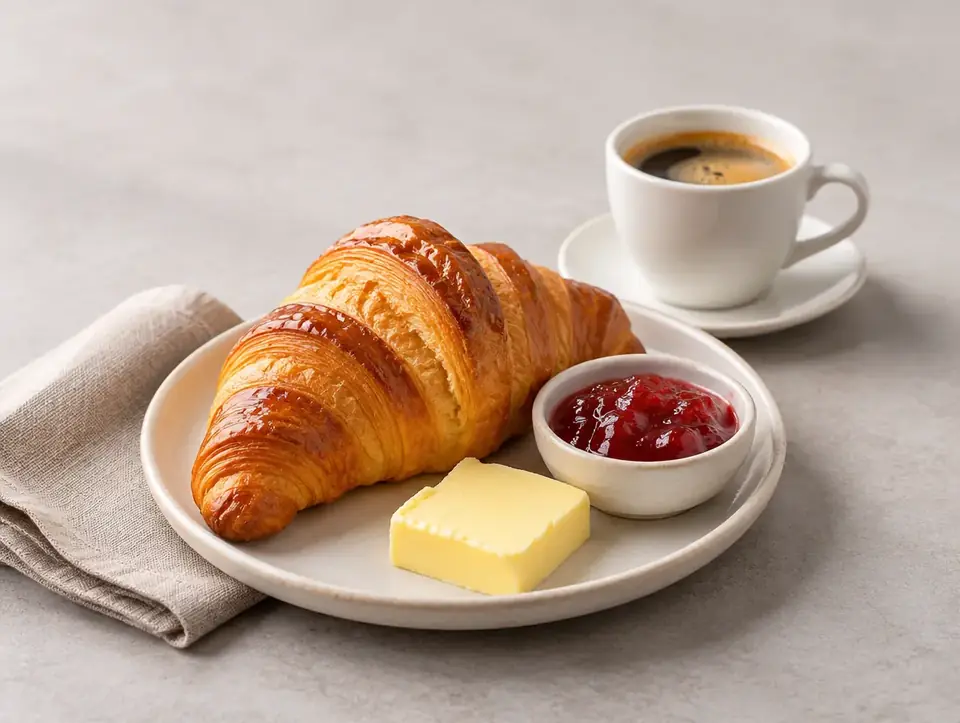
Europe · The Hotel Term · 50.00° N, 10.00° E
Continental Breakfast
Warm pastry, good butter, sharp jam and coffee — the light European morning.
At a glance.
Continental Breakfast comes from Europe · The Hotel Term and appears in The Breakfast Atlas, in the chapter Breakfast Around the World. It serves 4, takes about 1 hr 10 min, and uses 15 ingredients and 10 steps.
- Yield
- Serves 4
- Method
- Oven
- Time
- 1 hr 10 min
Ingredients
Tap an ingredient to tick it off.
- For the rough-puff pains au chocolat
- For the table
- For the coffee
Method
-
Make the pastry first. Rub the salt and sugar into the flour, then add the cold butter cubes and toss them through with your fingertips until coated but still recognizably cubes. Do not rub the butter in.
-
Pour in the ice water and bring the mixture together with a knife into a rough, shaggy, marbled dough. It will look wrong. Wrap it and chill 20 minutes.
-
Roll the dough on a floured surface into a rectangle roughly 20 × 45 cm, fold it in three like a letter, turn it 90°, and roll again. Repeat four times in all, chilling 15 minutes after the second turn.
-
Those folds are the entire method. Each one triples the sheets of butter trapped between layers of dough, and in the oven the water in that butter flashes to steam and forces the layers apart.
-
Roll the rested dough to 3 mm thick and cut eight rectangles about 8 × 12 cm. Lay two chocolate batons across the short end of each, roll up snugly, and set seam-side down on a lined tray.
-
Chill the shaped pastries 20 minutes — cold pastry meeting a hot oven is the difference between lift and a puddle of butter. Heat the oven to 200°C (390°F) meanwhile.
-
Glaze with the yolk and milk and bake 20–22 minutes until deeply bronzed, visibly flaky at the cut ends and light in the hand. Cool 10 minutes; the chocolate inside is molten and will burn a mouth.
-
If you are buying pastry instead, revive it properly: spritz croissants lightly with water and give them 4 minutes at 180°C (355°F) so the crust re-crisps and the crumb steams back to life.
-
Brew the coffee — grounds and hot water in a jug, stirred once, left 4 minutes, then plunged or decanted. Scald the milk to 70°C and pour the two together in equal measure for café au lait.
-
Set out the pastries in a napkin-lined basket, butter and preserves in small dishes with their own knives, yogurt and fruit in bowls, and coffee in a warmed pot. Nothing here should be plated for anyone.
Cook’s notes
- The technique
- Keep the butter in pieces and keep everything cold. Rough puff works because visible lumps of butter survive the mixing and are smeared into sheets by the rolling pin rather than dispersed into the flour; those sheets become steam, and steam becomes layers. The moment the butter warms past about 16°C it merges with the dough and you have shortcrust instead. Chill at any sign of softening.
- Make ahead
- The dough keeps three days refrigerated and freezes two months, either as a block or shaped and unglazed. Bake shaped pastries from frozen, adding four minutes. Preserves, fruit and yogurt are all night-before jobs; only the coffee and the oven need you in the morning.
- Troubleshooting
- Butter leaking onto the tray — the dough was too warm going in, or the oven under temperature. Flat, dense pastries — the butter was rubbed in rather than left in sheets. Pale, floppy croissants after reheating — the oven was too cool; 180°C is the floor. Bitter coffee — the water boiled.
- Variations
- A Swiss or French café complet is bread, butter, jam and a hot drink, with nothing baked at all. A German Frühstück adds rye, cold cuts, cheese and a boiled egg in a cup. Northern Italy reduces the whole thing to a cappuccino and a cornetto, taken standing. Scandinavian tables put out crispbread, cheese and cucumber.
- Serve with
- Coffee first and continuously — café au lait in a wide bowl for dipping is the French habit, and dipping is not bad manners. Fresh orange juice, and hot chocolate for children. The one rule is that everything sits out at once and people help themselves. Made in full within this recipe — Rough-Puff Pains au Chocolat. Also listed in the Component Index at the back.

Where it comes from
The phrase comes from the hotel trade, not from any kitchen. Nineteenth-century British and American hotels distinguished between the cooked breakfast served at home and the lighter one taken on the Continent — bread, butter, preserve and coffee — and the term hardened into a tariff line, sitting alongside the older commercial split between the European plan, where a room bought only a bed, and the American plan, where it bought meals as well. What the Continent actually eats varies: a French petit déjeuner of tartine and café au lait, the Swiss and French café complet of bread, butter, jam and a hot drink, a German Frühstück with cold cuts and rye, an Italian cappuccino taken standing at a bar. The croissant's own migration fits the pattern. It descends from the Viennese kipferl, brought to Paris when August Zang opened his Boulangerie Viennoise on the rue de Richelieu in 1839; the laminated butter-dough version we now recognize is a French refinement documented only in the early twentieth century. The tale about the 1683 siege of Vienna is charming and unsupported.
Continental Breakfast: quick answers
How long does Continental Breakfast take?
About 1 hr 10 min.
How many does this Continental Breakfast recipe make?
This recipe serves 4.
Where does Continental Breakfast come from?
The phrase comes from the hotel trade, not from any kitchen. Nineteenth-century British and American hotels distinguished between the cooked breakfast served at home and the lighter one taken on the Continent — bread, butter, preserve and coffee — and the term hardened into a tariff line, sitting alongside the older commercial split between the European plan, where a room bought only a bed, and the American plan, where it bought meals as well. What the Continent actually eats varies: a French petit déjeuner of tartine and café au lait, the Swiss and French café complet of bread, butter, jam and a hot drink, a German Frühstück with cold cuts and rye, an Italian cappuccino taken standing at a bar. The croissant's own migration fits the pattern. It descends from the Viennese kipferl, brought to Paris when August Zang opened his Boulangerie Viennoise on the rue de Richelieu in 1839; the laminated butter-dough version we now recognize is a French refinement documented only in the early twentieth century. The tale about the 1683 siege of Vienna is charming and unsupported.
More from Europe

More in Breakfast Around the World




https://www.atlasserie.com/recipes/breakfast/continental-breakfast/