England · The Fry-Up · 51.51° N, 0.13° W
Full English Breakfast
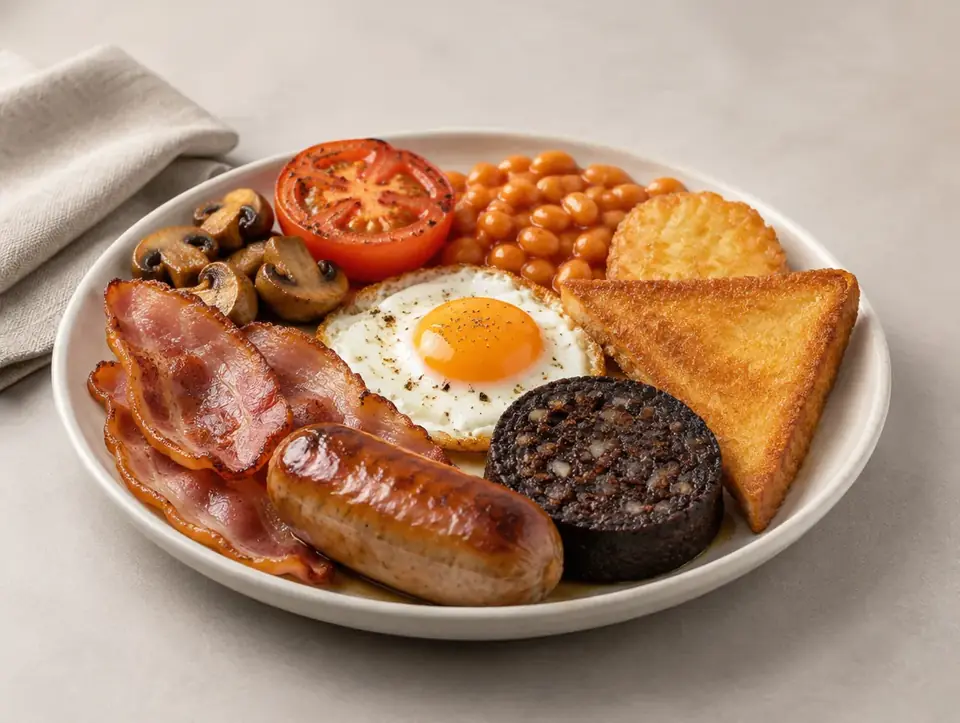
Bacon, banger, black pudding and fried bread, every item landing hot together.
At a glance.
Full English Breakfast comes from England · The Fry-Up and appears in The Breakfast Atlas, in the chapter Breakfast Around the World. It serves 2, takes about 45 minutes, and uses 13 ingredients and 10 steps.
- Yield
- Serves 2
- Method
- Stovetop & Oven
- Time
- 45 minutes
Ingredients
Tap an ingredient to tick it off.
- For the plate
- For the fried bread and toast
Method
-
Heat the oven to 90°C (195°F) and slide in two dinner plates and a baking tray lined with kitchen paper. A cold plate is what actually ruins a fry-up; everything you cook now goes onto that tray to wait.
-
Set a large heavy frying pan over medium-low heat with 15 g of the dripping. Lay in the sausages and cook them 14–16 minutes, turning every three or four minutes so they color evenly on all four sides.
-
Sausages need the longest and the gentlest heat. They are ready when the skin is mahogany and taut and the center reads 75°C (165°F); rushing them splits the casing and leaves the middle pink.
-
Move the sausages to the warm tray. Add the bacon to the same pan, laying the rashers flat, and cook 4–5 minutes a side until the fat has gone glassy and the lean has caught at the edges. Move it to the tray.
-
Put the mushrooms in gill-side up, season them, and drop a knob of butter into each cup. Cook 3 minutes, turn, and give them 3 minutes more until they are floppy, dark and beaded with their own liquor.
-
Season the cut faces of the tomato and lay them cut-side down in the bacon fat. Leave them alone for 4 minutes until the surface is deeply caramelized, then turn and give them 2 minutes more so they slump without collapsing.
-
Fry the black pudding last of the meats, 2 minutes a side over medium heat. It should crust and crack slightly at the edge while the middle stays soft; overcooked, it turns to dry crumb.
-
Tip the beans into a small pan and warm them over low heat, stirring, until they steam but do not boil — around 5 minutes. Toast the bread and butter it right to the edges.
-
Add the last of the dripping to the frying pan and raise the heat to medium-high. Fry the bread 90 seconds a side until it is golden, crisp at the rim and still faintly chewy at the center, then blot it briefly.
-
Crack the eggs into the same fat and fry 2–3 minutes, spooning fat over the whites until they are opaque with no clear jelly. Bring out the hot plates, assemble everything at once, and carry it straight to the table.
Cook’s notes
- The technique
- This is a scheduling problem dressed as a recipe. One pan, one order: sausages, bacon, mushrooms, tomato, black pudding, fried bread, eggs — longest cook first, each item leaving behind fat that seasons the next. A 90°C oven holds the finished components without cooking them further, since nothing dries out below 100°C in a short window. The eggs and the fried bread are made last because both die within two minutes of leaving the pan.
- Make ahead
- Very little, and that is the point. What you can do the night before is halve the tomato, trim the mushrooms, take the eggs out of the fridge in the morning, and set the plates in the oven before you light the hob. Cooked components hold 20 minutes at 90°C and no longer.
- Troubleshooting
- Gray, wrinkled bacon — the pan was too crowded and it steamed in its own water; work in two batches. Split sausages — heat too high from the start. Greasy fried bread — the fat was not hot enough, so the bread absorbed instead of sealing. Watery tomato — it was moved too early and never took color.
- Variations
- A full Cornish substitutes hog's pudding, the pork-and-groat sausage of Devon and Cornwall, for the black pudding. In Yorkshire and Lancashire the pudding is more likely to come from Bury, in thicker slices. A Welsh breakfast adds laverbread patted into oatmeal and fried, with cockles. Vegetarian versions lean on grilled halloumi, extra mushrooms and a vegetable-suet pudding rather than pretending.
- Serve with
- Strong builder's tea with milk, brewed until it stains the mug. Brown sauce on the sausage and ketchup on the egg is the usual division, and arguing about it is part of the meal. Keep a rack of dry toast on the table for the yolk and the bean juice.

Where it comes from
The cooked breakfast began as a display of surplus. In the country houses of Georgian and early Victorian England a sideboard of covered chafing dishes held kidneys, chops, bacon, eggs and fish for guests who came down when they pleased, and Isabella Beeton's Book of Household Management of 1861 sets out exactly that kind of spread. What turned it into a national plate was a growing middle class with a coal range, a cook and an appetite for imitating the gentry — followed by the railway hotel and the seaside boarding house, which sold the same plate to anyone with the fare. By the Edwardian period it was standard hotel provision. After 1945 it moved downmarket and became better for it, anchoring the transport café and the urban caff, where builders and lorry drivers ate at six in the morning in a haze of frying fat. Regional loyalty settled on the sausage — the coiled Cumberland ring, the sage-heavy Lincolnshire, hog's pudding in Devon — and on the perennial argument over whether mushrooms or black pudding may be dropped.
Full English Breakfast: quick answers
How long does Full English Breakfast take?
About 45 minutes.
How many does this Full English Breakfast recipe make?
This recipe serves 2.
Where does Full English Breakfast come from?
The cooked breakfast began as a display of surplus. In the country houses of Georgian and early Victorian England a sideboard of covered chafing dishes held kidneys, chops, bacon, eggs and fish for guests who came down when they pleased, and Isabella Beeton's Book of Household Management of 1861 sets out exactly that kind of spread. What turned it into a national plate was a growing middle class with a coal range, a cook and an appetite for imitating the gentry — followed by the railway hotel and the seaside boarding house, which sold the same plate to anyone with the fare. By the Edwardian period it was standard hotel provision. After 1945 it moved downmarket and became better for it, anchoring the transport café and the urban caff, where builders and lorry drivers ate at six in the morning in a haze of frying fat. Regional loyalty settled on the sausage — the coiled Cumberland ring, the sage-heavy Lincolnshire, hog's pudding in Devon — and on the perennial argument over whether mushrooms or black pudding may be dropped.
More from United Kingdom



More in Breakfast Around the World



https://www.atlasserie.com/recipes/breakfast/full-english-breakfast/