Jamaica · Ackee and Saltfish · 18.14° N, 77.32° W
Scrambled Ackee
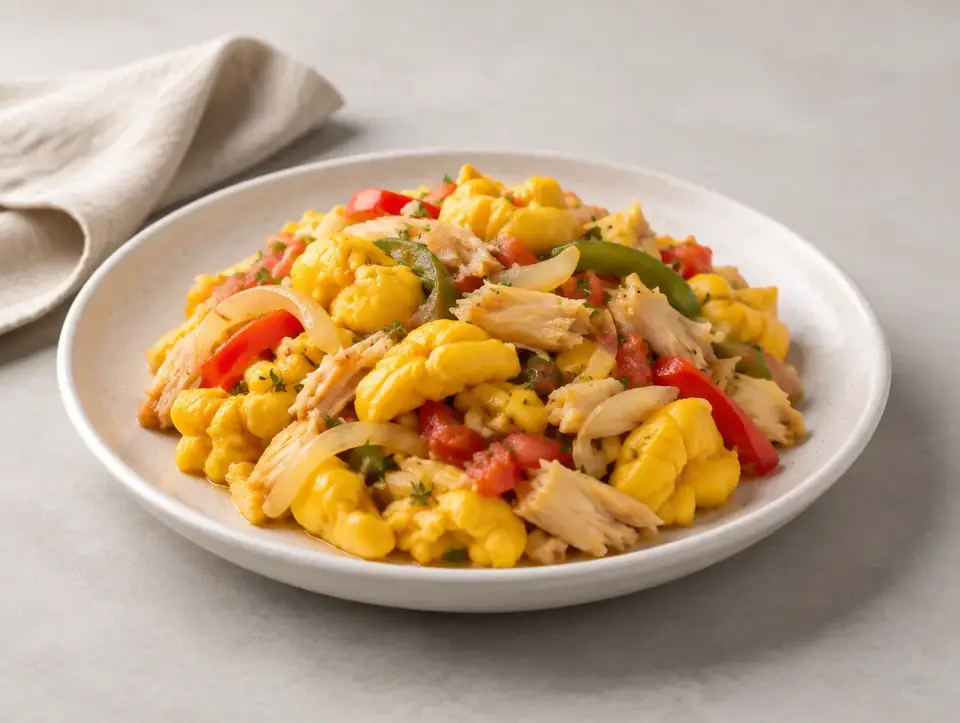
Jamaica's national dish: golden ackee folded through flaked salt cod.
At a glance.
Scrambled Ackee comes from Jamaica · Ackee and Saltfish and appears in The Breakfast Atlas, in the chapter Breakfast Around the World. It serves 4, takes about 40 minutes, and uses 14 ingredients and 10 steps.
- Yield
- Serves 4
- Method
- Stovetop
- Time
- 40 minutes
Ingredients
Tap an ingredient to tick it off.
- For the saltfish
- For the pan
- To serve
Method
-
Read this step before anything else. Unripe ackee contains hypoglycin A, a toxin that causes severe hypoglycemia and the illness known as Jamaican vomiting sickness. The fruit is safe only after it has ripened and split open naturally on the tree.
-
Never force a closed pod. Only the soft yellow arils are eaten; the black seed and the pink membrane between the lobes must be removed and discarded, and fresh ackee is boiled in water that is then thrown away.
-
Outside Jamaica, use ackee tinned in brine from a licensed processor. It has been picked, cleaned and canned under supervision, and it is what nearly every cook in the diaspora uses. If you cannot find it, do not improvise with fresh fruit of unknown provenance.
-
Soak the saltfish in a large bowl of cold water for 12–24 hours, changing the water three or four times. Drain, cover with fresh water, bring to a boil and simmer 15 minutes; taste a flake, and if it is still harsh, boil again in clean water for 10 minutes more.
-
Drain, cool, and pick the fish over carefully, discarding skin and any bones, then flake it into pieces about 2 cm across. It should taste seasoned rather than salty — you will add no further salt until the very end.
-
Warm the oil in a large frying pan over medium heat. If using bacon, render it first for 4 minutes, then add the onion, bell pepper and scallion whites and cook 6–7 minutes until soft and translucent but not colored.
-
Add the thyme, Scotch bonnet and black pepper and cook 1 minute until fragrant, then stir in the tomatoes and cook 3 minutes more until they slump and their liquid has largely gone.
-
Fold the flaked saltfish through and let it warm for 2 minutes, coating in the oil and aromatics. Everything in the pan should be seasoned and finished before the ackee goes anywhere near it.
-
Tip the drained ackee in and fold — do not stir. Use a spatula, lift from the bottom and turn it over three or four times across 3–4 minutes until heated through. Tinned ackee is already cooked and structurally fragile.
-
Scatter the scallion greens over the top and take the pan off the heat. Taste for salt, which it may not need, and serve straight away with fried dumplings, avocado and lime.
Cook’s notes
- The technique
- Fold, never stir, and add the ackee last. The arils are soft, waxy and held together by very little; a spoon worked through them for even thirty seconds turns a golden, egg-like scramble into yellow paste. Build every layer of flavor first — aromatics, chile, thyme, tomato, fish — so the ackee needs only to be warmed and lifted through at the end.
- Make ahead
- Desalting is by definition a day-ahead job, and cooked flaked saltfish keeps three days refrigerated. The vegetable and fish base can be made the night before and reheated gently. Add the ackee only when serving; reheated ackee disintegrates entirely.
- Troubleshooting
- Mushy, formless pan — the ackee was stirred or overheated. Aggressively salty — the fish was under-soaked, and there is no fix once cooked, so taste a flake before you commit. Watery — the tomatoes were not cooked down. Bland — thyme and Scotch bonnet went in too late to bloom in the oil.
- Variations
- Ackee cooked without saltfish, seasoned only with onion, thyme and pepper, is common in vegetarian and Ital Rastafari cooking. Some kitchens add curry powder or a spoonful of coconut milk. In Trinidad and Barbados, salt cod turns up instead in buljol, cured raw with tomato and onion rather than cooked with ackee.
- Serve with
- Fried dumplings — Jamaican johnny cakes — are the standard, with boiled green banana, yam or roasted breadfruit. Sliced avocado, called pear locally, goes on the side. Drink strong Blue Mountain coffee, mint tea, or a glass of sorrel if any is left from Christmas.

Where it comes from
Ackee is not native to Jamaica. Blighia sapida is a West African tree — akye fufo in Twi, from the forest belt of present-day Ghana and Côte d'Ivoire — carried across on slave ships in the eighteenth century and established on the island well before Captain William Bligh took specimens to Kew in 1793, the event that gave the genus his name. Salt cod arrived by a different route: dried and salted in Newfoundland and New England, shipped south as cheap, imperishable protein to feed enslaved people on sugar estates, and retained in the cooking long after the trade that brought it ended. The pairing of the two is about as clear a statement of Jamaican history as a plate can make, and it is the national dish, with ackee the national fruit. It is Sunday morning food and hotel-breakfast food alike, served with fried dumplings, boiled green banana or roasted breadfruit, and it is one of the dishes for which Jamaicans abroad will pay almost anything to get a tin of the real thing.
Scrambled Ackee: quick answers
How long does Scrambled Ackee take?
About 40 minutes.
How many does this Scrambled Ackee recipe make?
This recipe serves 4.
Where does Scrambled Ackee come from?
Ackee is not native to Jamaica. Blighia sapida is a West African tree — akye fufo in Twi, from the forest belt of present-day Ghana and Côte d'Ivoire — carried across on slave ships in the eighteenth century and established on the island well before Captain William Bligh took specimens to Kew in 1793, the event that gave the genus his name. Salt cod arrived by a different route: dried and salted in Newfoundland and New England, shipped south as cheap, imperishable protein to feed enslaved people on sugar estates, and retained in the cooking long after the trade that brought it ended. The pairing of the two is about as clear a statement of Jamaican history as a plate can make, and it is the national dish, with ackee the national fruit. It is Sunday morning food and hotel-breakfast food alike, served with fried dumplings, boiled green banana or roasted breadfruit, and it is one of the dishes for which Jamaicans abroad will pay almost anything to get a tin of the real thing.
More from Jamaica
More in Breakfast Around the World

https://www.atlasserie.com/recipes/breakfast/scrambled-ackee/