Central Europe & the Levant · Fresh Curds · 50.00° N, 10.00° E
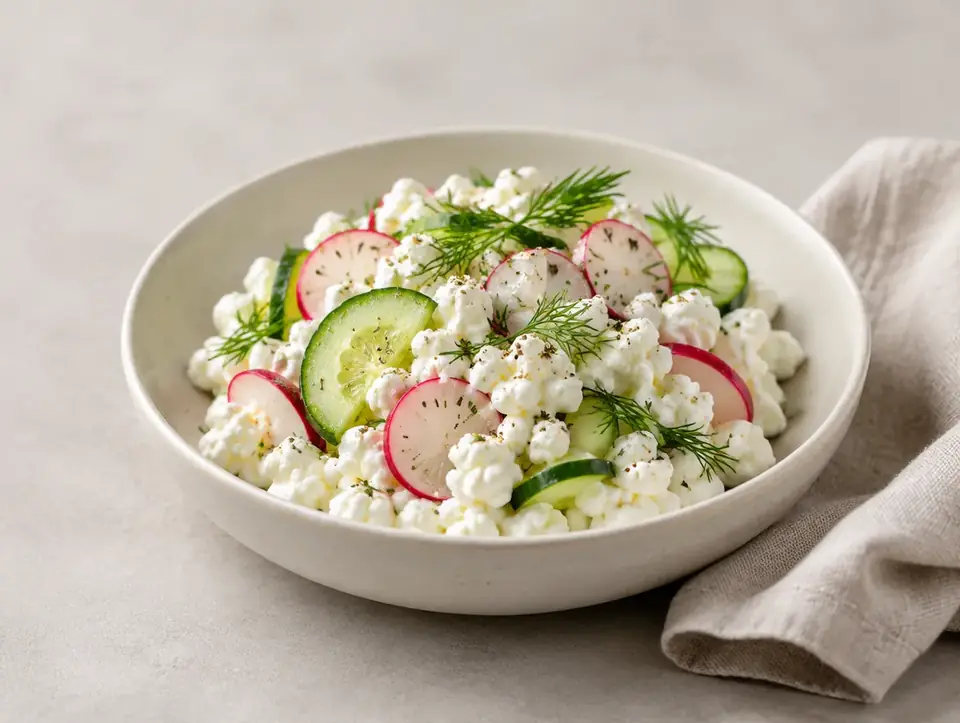
Cottage Cheese Bowl
Cool curds with cucumber, radish and dill under coarse black pepper.
At a glance.
Cottage Cheese Bowl comes from Central Europe & the Levant · Fresh Curds and appears in The Breakfast Atlas, in the chapter Yogurt, Fruit & Cold Bowls. It serves 4, takes about 15 hr 15 min, and uses 12 ingredients and 10 steps.
- Yield
- Serves 4
- Method
- Stovetop
- Time
- 15 hr 15 min
Ingredients
Tap an ingredient to tick it off.
- For the home-made cottage cheese (makes about 450 g)
- For the bowl
Method
-
Warm the milk to 22–24°C — barely more than a cool room — stir in the buttermilk, and the rennet solution if using, then cover and leave 12–16 hours somewhere draught-free.
-
It is ready when the surface has set to a soft, glossy custard that pulls cleanly from the side of the pot when you tilt it, with a shallow film of whey on top and a lactic smell like fresh cream.
-
Cut the curd into 1.5 cm cubes with a long knife, first in one direction, then across, then at an angle to reach the base. Even cubes cook evenly; ragged ones give you both rubber and mush.
-
Rest the cut curd 10 minutes undisturbed. The faces knit and firm slightly, which stops them shattering when you start to stir.
-
Set the pot over the lowest heat and bring it from 24°C to 49°C over a full 40 minutes, stirring gently every few minutes with a slotted spoon. Rushing this is the only serious mistake available.
-
Hold at 49°C for 20 minutes, still stirring occasionally. The cubes shrink to about half their size, firm up, and stop tasting of raw milk when you fish one out and squeeze it.
-
Drain through a colander lined with muslin, then rinse the curds under cold running water for a minute — this stops the acidity developing further and separates the grains so they stay distinct.
-
Drain 10 minutes, tip into a bowl, fold through the salt and the cream, and chill. The cream is what turns dry curd into cottage cheese; without it the bowl reads chalky.
-
Salt the diced cucumber lightly and leave it in a sieve for 10 minutes, then pat dry. Watery cucumber thins the whole bowl within minutes of hitting it.
-
Spoon the curds into shallow bowls, scatter cucumber, radish, spring onion and dill over, pour the oil across in a thin stream, and finish with cracked pepper and flaky salt. Serve with dark rye.
Cook’s notes
- The technique
- Cook the curd slowly. The ramp from 24°C to 49°C must take forty minutes, because heat shrinks the outside of each curd first; go fast and the surface seals while whey is still trapped inside, giving grains that are rubbery outside and wet within. Gentle, occasional stirring keeps the curds moving so they cook evenly and stay separate. The cold rinse afterwards halts acidification and is why cottage cheese tastes mild where quark tastes sharp.
- Make ahead
- The curds keep five days refrigerated in a lidded box, though they tighten, so hold back a spoon of cream to loosen them on the day. Culture the milk overnight and cook the curd in the morning. Cut the vegetables no more than two hours ahead and dress the bowl at the table.
- Troubleshooting
- Rubbery grains — the pot heated too fast; hold to the forty-minute ramp. Mushy curd that breaks up in the pan — the milk was under-cultured or cut too soon, so wait for a clean break. A watery bowl — the cucumber was not salted and drained, or the curds went in without their final rinse and drain.
- Variations
- The Levantine version swaps the dill for 2 tsp za'atar, a squeeze of lemon, chopped tomato and a heavy pour of olive oil. Hungarian körözött beats the curds with paprika, butter, caraway and onion. Czech and Polish kitchens keep it simplest: twaróg, sour cream, radish and a great deal of chive.
- Serve with
- Dark rye or a sour wheat bread is not optional here — the bowl needs something to be eaten on. Serve with strong tea, or with a cold beer if this is standing in for lunch, and a boiled egg if it needs to carry the morning. Made in full within this recipe — Home-Made Cottage Cheese. Also listed in the Component Index at the back.

Where it comes from
Fresh acid-set curd is the oldest cheese there is, and every dairying culture keeps a version: Polish twaróg, Czech tvaroh, Russian tvorog eaten with sour cream and herbs, German quark, the Egyptian areesh, and the drier relatives of Levantine labneh. The English name is nineteenth-century and completely literal — cheese made in the cottage from the skimmed milk left after the cream went for butter, using no equipment beyond a warm corner and a cloth. In America it became a health food during the sanitarium era, then, from the 1950s through the 1970s, the emblem of the diet plate: a scoop beside a canned peach half on a lettuce leaf, a fixture of coffee shops, reducing regimens and Hollywood. Sales collapsed in the 1980s as flavored yogurt took the same shelf. Interest returned sharply from around 2023, driven by protein counting, and largely in the savory direction that Central and Eastern Europe never abandoned.
Cottage Cheese Bowl: quick answers
How long does Cottage Cheese Bowl take?
About 15 hr 15 min.
How many does this Cottage Cheese Bowl recipe make?
This recipe serves 4.
Where does Cottage Cheese Bowl come from?
Fresh acid-set curd is the oldest cheese there is, and every dairying culture keeps a version: Polish twaróg, Czech tvaroh, Russian tvorog eaten with sour cream and herbs, German quark, the Egyptian areesh, and the drier relatives of Levantine labneh. The English name is nineteenth-century and completely literal — cheese made in the cottage from the skimmed milk left after the cream went for butter, using no equipment beyond a warm corner and a cloth. In America it became a health food during the sanitarium era, then, from the 1950s through the 1970s, the emblem of the diet plate: a scoop beside a canned peach half on a lettuce leaf, a fixture of coffee shops, reducing regimens and Hollywood. Sales collapsed in the 1980s as flavored yogurt took the same shelf. Interest returned sharply from around 2023, driven by protein counting, and largely in the savory direction that Central and Eastern Europe never abandoned.
More from Europe
More in Yogurt, Fruit & Cold Bowls

https://www.atlasserie.com/recipes/breakfast/cottage-cheese-bowl/