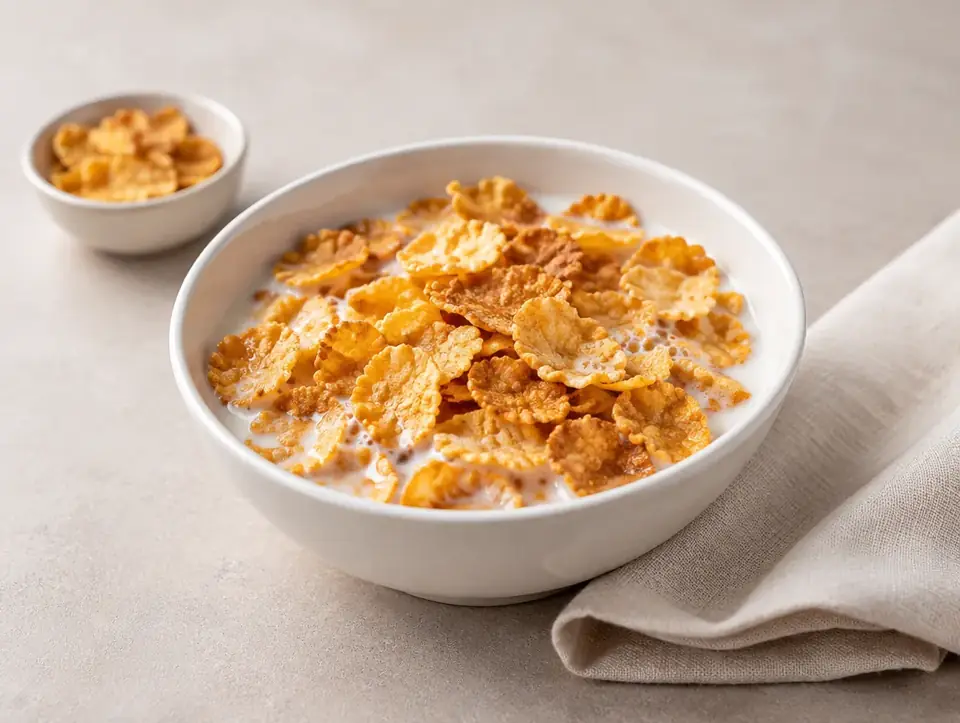
Battle Creek, Michigan · Flaked Cereal · 39.87° N, 98.73° W
Cereal and Milk
The Battle Creek bowl, rebuilt with flakes toasted in your own oven.
At a glance.
Cereal and Milk comes from Battle Creek, Michigan · Flaked Cereal and appears in The Breakfast Atlas, in the chapter Yogurt, Fruit & Cold Bowls. It serves 6, takes about 1 hr 15 min, and uses 11 ingredients and 10 steps.
- Yield
- Serves 6
- Method
- Oven
- Time
- 1 hr 15 min
Ingredients
Tap an ingredient to tick it off.
- For the toasted corn flakes (makes about 300 g)
- For each bowl
Method
-
Bring the water to a boil with the salt, rain in the polenta while whisking, and cook on the lowest heat for 20 minutes, stirring often, until it is thick enough to hold the trail of a spoon.
-
Beat in the malt syrup, sugar and butter. Malt is not decoration: its reducing sugars are what drive the browning and give commercial flakes their particular toasted note.
-
Spread the paste onto a tray and cool for 10 minutes, until it is warm rather than hot and stiff enough to handle. Heat the oven to 150°C (300°F), 130°C fan.
-
Take walnut-sized pieces and press each between two sheets of parchment, rolling out to the thinness of a postcard — 1 mm or less. Thickness decides everything; anything thicker bakes to a biscuit rather than a flake.
-
Peel off the top sheet, transfer the parchment to a baking tray, and bake 25 minutes until dry to the touch and pale. Rotate the trays halfway.
-
Raise the heat to 180°C (350°F) and give them 5–8 minutes more, watching closely, until the sheets blister and turn a light gold. They scorch in seconds at this stage.
-
Cool completely on the tray, then snap the sheets into flakes about 2 cm across. They will not be uniform, which is the honest sign of the domestic version.
-
Now build the bowl properly. Chill the bowl and the milk; milk at 3°C is more viscous and diffuses into the flake more slowly than milk at 8°C, which buys real minutes.
-
Measure 50 g of flakes into the cold bowl, add fruit and flaky salt, then pour 150 ml milk down the inside wall rather than over the top, so the surface layer stays dry.
-
Eat within four minutes, spooning from the edge inward. Keep a second handful of flakes to hand and scatter it over halfway through, which is the only real defense against a soft finish.
Cook’s notes
- The technique
- Sogginess is plasticization. A flake is a glassy starch matrix, brittle while its moisture stays below about 8 percent; milk pushes water in and the matrix softens into leather. Two levers matter. Thinner flakes brown faster and take on less structural water, and colder milk is more viscous, so it wicks more slowly. A ratio of 50 g cereal to 150 ml milk keeps the top layer above the waterline rather than drowning it.
- Make ahead
- Homemade flakes keep two weeks in an airtight jar and refresh with 6 minutes at 150°C if they soften. The cooked polenta base can be made a day ahead and rolled cold, though it needs a little more pressure. Never store flakes in the refrigerator, where condensation ruins them overnight.
- Troubleshooting
- Chewy rather than crisp — the sheets were rolled too thick or pulled before the high-heat stage. Bitter and dark — the final 180°C stage ran long; it needs watching, not timing. A soggy bowl in 90 seconds — warm milk, a warm bowl, or the milk poured straight over the top.
- Variations
- For clusters instead of flakes, mix 200 g rolled oats with 60 g malt syrup and 30 g oil, press into a slab and bake as above. Bran flakes take a third of the polenta replaced with wheat bran. In Britain the same bowl is often built on shredded wheat with hot milk, which is a different dish altogether and meant to soften.
- Serve with
- Cold milk in a jug so nobody is served a drowned bowl, and a second bowl of fruit alongside. Coffee or tea after, not during — hot drinks and cold cereal fight each other. Made in full within this recipe — Home-Toasted Corn Flakes. Also listed in the Component Index at the back.

Where it comes from
The whole industry traces to one Michigan institution. John Harvey Kellogg ran the Battle Creek Sanitarium, a Seventh-day Adventist health resort where patients ate a vegetarian, low-stimulant diet descended from Sylvester Graham's teaching and James Caleb Jackson's baked Granula. In 1894 Kellogg and his younger brother Will Keith left a batch of boiled wheat standing while other business intervened; when they finally ran it through the rollers, each tempered berry flattened into a separate flake instead of a sheet. They patented flaked cereal, and the brothers then diverged. Will Keith added sugar, which John Harvey opposed on principle, founded the Battle Creek Toasted Corn Flake Company in 1906, and the two litigated bitterly for years over who could use the family name. Charles William Post, a former patient at the sanitarium, launched Postum in 1895 and Grape-Nuts in 1897. By the 1950s the business had found television: cereal was sold directly to children on Saturday mornings, and the sugar the elder Kellogg objected to became the point.
Cereal and Milk: quick answers
How long does Cereal and Milk take?
About 1 hr 15 min.
How many does this Cereal and Milk recipe make?
This recipe serves 6.
Where does Cereal and Milk come from?
The whole industry traces to one Michigan institution. John Harvey Kellogg ran the Battle Creek Sanitarium, a Seventh-day Adventist health resort where patients ate a vegetarian, low-stimulant diet descended from Sylvester Graham's teaching and James Caleb Jackson's baked Granula. In 1894 Kellogg and his younger brother Will Keith left a batch of boiled wheat standing while other business intervened; when they finally ran it through the rollers, each tempered berry flattened into a separate flake instead of a sheet. They patented flaked cereal, and the brothers then diverged. Will Keith added sugar, which John Harvey opposed on principle, founded the Battle Creek Toasted Corn Flake Company in 1906, and the two litigated bitterly for years over who could use the family name. Charles William Post, a former patient at the sanitarium, launched Postum in 1895 and Grape-Nuts in 1897. By the 1950s the business had found television: cereal was sold directly to children on Saturday mornings, and the sugar the elder Kellogg objected to became the point.
More from United States




More in Yogurt, Fruit & Cold Bowls




https://www.atlasserie.com/recipes/breakfast/cereal-and-milk/