Eastern Europe · The Jewish Bakery · 50.00° N, 25.00° E
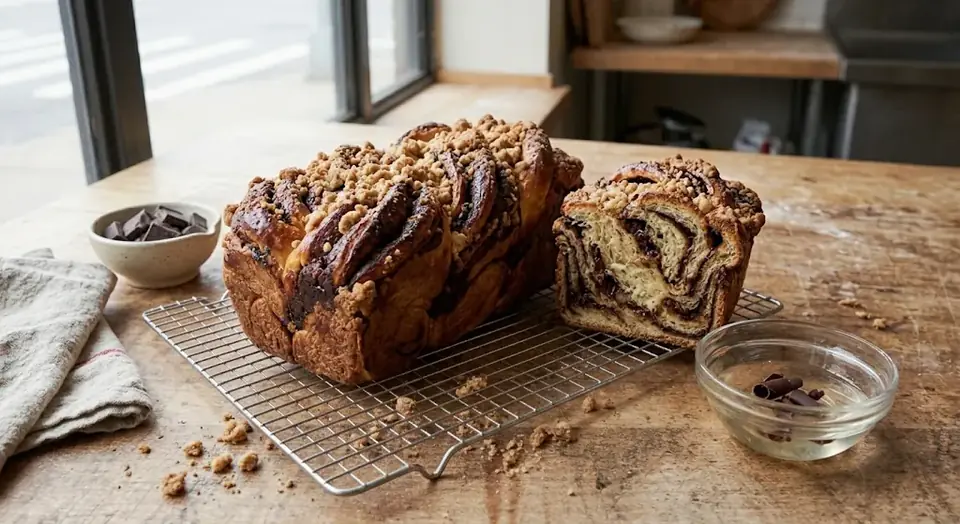
Chocolate Babka
A twisted loaf, dark with chocolate, soaked in syrup and crumbed.
At a glance.
Chocolate Babka comes from Eastern Europe · The Jewish Bakery and appears in The Bread Atlas, in the chapter Sweet & Enriched Breads. It makes 1 loaf, takes about 16 hours, and uses 18 ingredients and 11 steps.
- Yield
- Makes 1 loaf
- Method
- Oven 180°C / 350°F
- Time
- 16 hours
Ingredients
Tap an ingredient to tick it off.
- The Dough
- Chocolate Filling
- Streusel
- Sugar Syrup Soak
Method
-
Mix the flour, sugar, salt and yeast with the milk and eggs on low speed to a firm dough, then knead 8 minutes on second speed until smooth. Add the cool butter in four additions, mixing each in completely, and continue to a full windowpane. Target 24°C.
-
Cover and refrigerate at least 8 hours, or overnight. Babka dough is rolled thin and must not fight back; cold dough sheets to 3 mm without shrinking, and cold dough holds the filling where you put it instead of absorbing it.
-
Make the filling: melt the chocolate and butter together over barely simmering water, take it off the heat, and beat in the icing sugar, cocoa and salt to a glossy paste. Cool to room temperature until it is spreadable but no longer runny.
-
Rub the streusel ingredients between your fingers to coarse, uneven crumbs, some the size of a pea, and chill. Boil the syrup sugar and water for 1 minute, stir in the rum, and set aside — it is used hot on a hot loaf.
-
Roll the cold dough to a rectangle 45 × 35 cm on a lightly floured bench, a long side toward you. Spread the filling over it, leaving a clean 2 cm strip along the far edge for the seam to stick to.
-
Roll up tightly from the near edge, keeping the log even and pressing out air as you go. Pinch the seam closed, then chill the log 20 minutes — a firm log cuts cleanly, and a warm one smears chocolate across the bench.
-
Cut the log in half lengthwise with a sharp knife, straight down the middle, so the layers are laid open. Turn both halves cut-side up: every twist from here on keeps those exposed strata facing outward, which is the whole visual point.
-
Cross the two halves over each other at the middle, then twist the ends around one another two or three times in each direction, keeping the cut faces upward. Lift the twist into a buttered and lined 25 × 11 cm loaf tin, folding the ends under to fit.
-
Prove 2–2½ hours at 24°C, until the dough has risen by three-quarters and fills the tin to within 2 cm of the rim. Set the oven to 180°C / 350°F. Scatter the chilled streusel thickly over the top immediately before baking.
-
Bake 40–45 minutes, tenting with foil once the streusel is golden, to an internal 92°C — a little higher than most enriched loaves, because the filling holds heat back at the center and an underbaked babka is raw in its coils.
-
Brush or spoon the whole of the hot syrup over the loaf the moment it comes out, letting it soak in over 10 minutes. Cool in the tin 20 minutes, then lift out onto a rack and cool completely before slicing.
Cook’s notes
- To serve and keep
- Cut thick, at room temperature, with strong coffee — babka belongs to the mid-morning and the late evening rather than to a meal. Day-three slices are excellent toasted briefly under a grill. Store wrapped in foil at room temperature, cut face pressed against the wrapping.

Where it comes from
Babka means little grandmother in Polish and Ukrainian, a diminutive of baba, and the name was attached first to tall fluted yeast cakes of the kind still baked across Eastern Europe at Easter. The Jewish version is a different object and the account bakers give of it is domestic: on Fridays, the trimmings of challah dough were rolled out, spread with cinnamon, jam or poppy seed, coiled and baked alongside the loaves. It is a plausible story, repeated in most of the literature, and it has no single document behind it — treat it as trade memory rather than record. What is certain is that chocolate is a later and largely American addition, that the twisted, filled babka travelled with Ashkenazi emigration to New York, and that Israeli bakers reworked it as the krantz cake. Breads Bakery, opened in Manhattan in 2013 by the Israeli baker Uri Scheft, is widely credited with the modern revival, though the bread had been sold in Brooklyn without interruption for a century.
Chocolate Babka: quick answers
How long does Chocolate Babka take?
About 16 hours.
How many does this Chocolate Babka recipe make?
This recipe makes 1 loaf.
Where does Chocolate Babka come from?
Babka means little grandmother in Polish and Ukrainian, a diminutive of baba, and the name was attached first to tall fluted yeast cakes of the kind still baked across Eastern Europe at Easter. The Jewish version is a different object and the account bakers give of it is domestic: on Fridays, the trimmings of challah dough were rolled out, spread with cinnamon, jam or poppy seed, coiled and baked alongside the loaves. It is a plausible story, repeated in most of the literature, and it has no single document behind it — treat it as trade memory rather than record. What is certain is that chocolate is a later and largely American addition, that the twisted, filled babka travelled with Ashkenazi emigration to New York, and that Israeli bakers reworked it as the krantz cake. Breads Bakery, opened in Manhattan in 2013 by the Israeli baker Uri Scheft, is widely credited with the modern revival, though the bread had been sold in Brooklyn without interruption for a century.
More from Eastern Europe
More in Sweet & Enriched Breads
https://www.atlasserie.com/recipes/bread/chocolate-babka/