United States · Granula, Granola and the Health Reformers · 39.87° N, 98.73° W
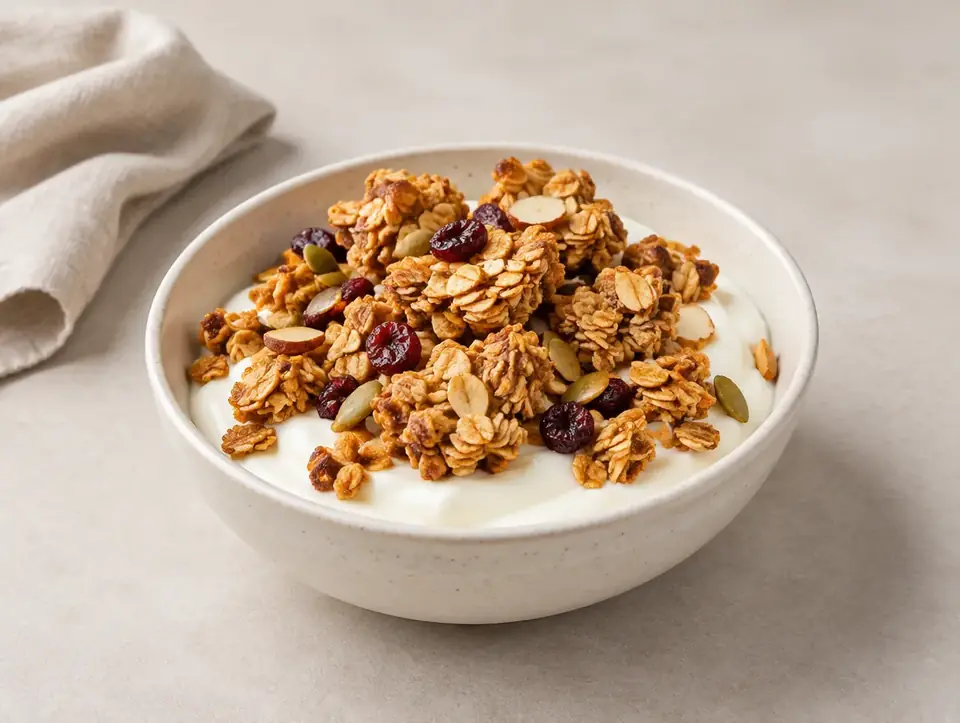
Granola Bowl
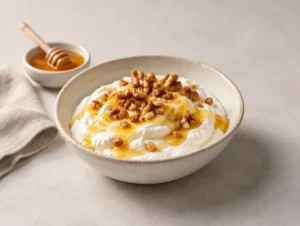
Cluster granola baked, pressed and cooled hard over cold yogurt.
At a glance.
Granola Bowl comes from United States · Granula, Granola and the Health Reformers and appears in The Breakfast Atlas, in the chapter Yogurt, Fruit & Cold Bowls. It serves 8, takes about 1 hr 20 min, and uses 16 ingredients and 10 steps.
- Yield
- Serves 8
- Method
- Oven
- Time
- 1 hr 20 min
Ingredients
Tap an ingredient to tick it off.
- For the house granola (makes about 750 g)
- For each bowl
Method
-
Heat the oven to 150°C (300°F), or 130°C in a fan oven, and line a large rimmed baking sheet with parchment. Low and slow is the rule: granola dries before it browns, and a hot oven scorches the sugars while the oats are still damp.
-
Whisk the maple syrup, oil, brown sugar, vanilla and salt in a large bowl until the sugar dissolves, then whisk in the frothed egg white. The white is the cluster-maker — its proteins set into a brittle scaffold that glues flakes together.
-
Add the oats, nuts, seeds and cinnamon and fold for a full minute, scraping from the bottom, until no dry oats remain. Hold the ratio in mind: roughly a quarter of the oat weight in syrup and a fifth in fat is the line between clusters and gravel.
-
Tip onto the tray and press the mixture into an even slab about 1.5 cm thick with the back of a spatula or a second sheet of parchment. Compression is what turns loose flakes into clusters; leave it loose and you get toasted oats.
-
Bake 25 minutes without opening the door, then rotate the tray front to back and bake 15 minutes more. Resist stirring at any point — every stir breaks the slab you have spent effort building.
-
Scatter the coconut flakes over the surface for the last 8 minutes only. Coconut has a high fat content and burns bitterly long before oats are done.
-
The granola is ready when the edges are a deep amber, the center is the color of light toast and the whole tray smells nutty rather than sweet. It will still feel soft. That is expected.
-
Set the tray on a rack and leave it strictly alone for 30 minutes. As the sugar syrup cools past about 60°C it passes into a glassy solid, and that transition — not the oven — is what makes the crunch.
-
Break the cooled slab into pieces the size of a thumbnail and larger, fold through the dried fruit, and store in an airtight jar.
-
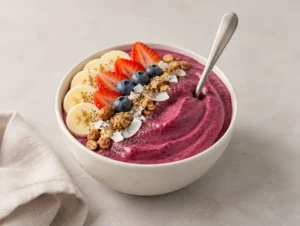
To build the bowl, spoon the cold yogurt into a wide shallow dish and drag a spoon through it to make a shallow trough. Pile 60 g granola along one side, the fruit along the other, and thread honey and a squeeze of lemon over the yogurt. Serve at once.
Cook’s notes
- The technique
- Do not stir, and do not eat it warm. Two things create a cluster: mechanical compression while the mix is wet, and the sugar syrup cooling into an amorphous glass. Stirring mid-bake shears the wet matrix apart; scooping while warm crushes it before the glass forms. Egg white reinforces the structure at almost no flavor cost, and the whole tray must cool untouched to room temperature for the texture to set hard.
- Make ahead
- This is a make-ahead recipe by design. Granola keeps three weeks airtight at room temperature and three months frozen; it comes back from the freezer crisp with no refreshing. If humidity softens it, spread it out and dry it 10 minutes at 150°C, then cool completely again.
- Troubleshooting
- No clusters — the mix was spread loose rather than pressed, or stirred during baking. Burnt edges, raw middle — the tray was crowded, so use two. Chewy after cooling — underbaked; return it for 8 minutes and judge only once cold, never straight from the oven.
- Variations
- A savory batch drops the sugar to 25 g, adds 2 tsp fennel seed, black pepper and rosemary, and finishes with olive oil for scattering over soups. A Nordic version uses rye flakes for a third of the oats and cardamom instead of cinnamon. A tahini granola replaces half the oil with tahini and half the maple with date syrup.
- Serve with
- Serve with plain full-fat yogurt so the granola supplies all the sweetness, and cold milk in a jug for anyone who wants it as cereal. Coffee, and a wedge of sharp apple to cut the richness. Made in full within this recipe — House Granola. Also listed in the Component Index at the back.

Where it comes from
Three American health reformers stand behind the jar. Sylvester Graham, a Presbyterian minister who died in 1851, preached coarse unbolted wheat flour as a moral as much as a dietary matter, and gave his name to graham flour. James Caleb Jackson, running the water-cure establishment Our Home on the Hillside at Dansville, New York, baked graham dough into sheets around 1863, broke it up, baked it again and called the result Granula — so adamantly hard that it needed soaking overnight before anyone could chew it. John Harvey Kellogg produced a comparable oat, wheat and cornmeal version at the Battle Creek Sanitarium under the same name; Jackson sued, and Kellogg renamed his Granola around 1881. The food then vanished behind the flake, and the word floated free. It came back through the American counterculture of the late 1960s, when homemade granola became shorthand for a whole set of convictions about food and self-sufficiency, and the commercial brands followed in the early 1970s, sweeter than anything the reformers would have recognized.
Granola Bowl: quick answers
How long does Granola Bowl take?
About 1 hr 20 min.
How many does this Granola Bowl recipe make?
This recipe serves 8.
Where does Granola Bowl come from?
Three American health reformers stand behind the jar. Sylvester Graham, a Presbyterian minister who died in 1851, preached coarse unbolted wheat flour as a moral as much as a dietary matter, and gave his name to graham flour. James Caleb Jackson, running the water-cure establishment Our Home on the Hillside at Dansville, New York, baked graham dough into sheets around 1863, broke it up, baked it again and called the result Granula — so adamantly hard that it needed soaking overnight before anyone could chew it. John Harvey Kellogg produced a comparable oat, wheat and cornmeal version at the Battle Creek Sanitarium under the same name; Jackson sued, and Kellogg renamed his Granola around 1881. The food then vanished behind the flake, and the word floated free. It came back through the American counterculture of the late 1960s, when homemade granola became shorthand for a whole set of convictions about food and self-sufficiency, and the commercial brands followed in the early 1970s, sweeter than anything the reformers would have recognized.
More from United States
More in Yogurt, Fruit & Cold Bowls
https://www.atlasserie.com/recipes/breakfast/granola-bowl/