Britain & Ireland · Blood Sausage · 53.17° N, 8.02° W
Black Pudding
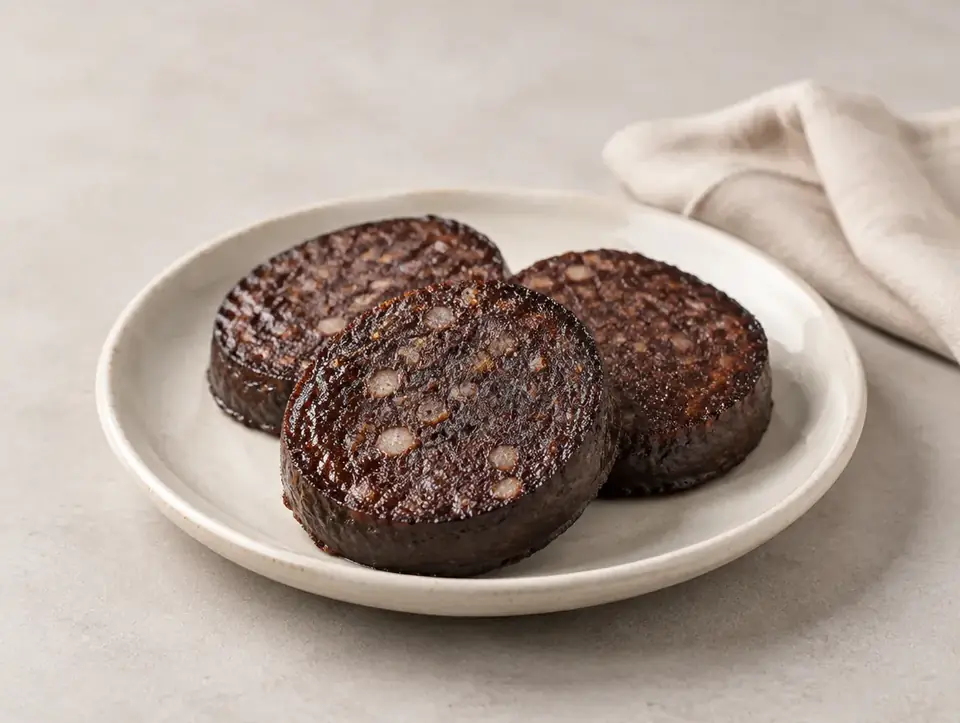
Thick slices, crisp-edged, the interior still yielding rather than crumbling.
At a glance.
Black Pudding comes from Britain & Ireland · Blood Sausage and appears in The Breakfast Atlas, in the chapter Bacon, Sausage & Hash. It serves 4, takes about 15 minutes, and uses 5 ingredients and 8 steps.
- Yield
- Serves 4
- Method
- Stovetop
- Time
- 15 minutes
Ingredients
Tap an ingredient to tick it off.
Method
-
Chill the pudding thoroughly, an hour in the fridge if it has been on the counter. Cold fat holds the crumb together while you cut and while it first meets heat.
-
If the pudding is wrapped in plastic casing, peel it off completely. Natural casings can be left on; they crisp into an edible ring around each slice.
-
Cut slices a full 1.5 cm (½ in) thick with a thin, sharp knife, wiping the blade between cuts. Thin slices have no interior to protect and disintegrate as soon as they are turned.
-
Warm the dripping in a heavy skillet over medium heat, no higher — high heat melts the binding fat faster than the surface can crust. Lay the slices in with space between them and leave them 3 minutes without touching.
-
Turn once only, using a palette knife slid fully under each slice to keep it whole, and cook 2–3 minutes on the second side until it firms.
-
Press the top of a slice very gently with the back of a spoon. It should feel springy and dry; if it weeps dark liquid or slumps, it has had too long.
-
For larger numbers, lay the slices on a rack over a tray and bake at 200°C (400°F, fan 180°C) for 10 minutes, turning once. There is no pan contact to break.
-
Drain for 30 seconds on a rack, grind over black pepper and add a drop of cider vinegar or a spoon of apple sauce. Serve at once, while the crust is still distinct from the soft center.
Cook’s notes
- The technique
- Black pudding is already cooked. It is held together by set blood protein and solid fat, so you are only warming it and building a crust — and if the interior climbs much past 70°C the fat melts, the binder loses its grip and the slice slumps into crumbs. Start cold, use medium heat, commit to one turn only, and stop when the middle is warm rather than hot.
- Make ahead
- A whole pudding keeps a week refrigerated and freezes for three months, best sliced first and frozen in a single layer. Slices can be fried, cooled and refreshed in a hot oven for 4 minutes, though they never regain quite the same edge.
- Troubleshooting
- Collapsed into crumbs — sliced too thin, cooked too hot, or turned more than once. Greasy and soft — the pan was not hot enough at the start, so the fat leached before a crust formed. Dry and dusty — an oatmeal pudding overcooked; drop a minute from each side.
- Variations
- Stornoway pudding, oat-based and coarse, is best sliced thicker still at 2 cm. White pudding uses the same cereal and fat without the blood. Morcilla de Burgos, sweet with onion and rice, is fried the same way and served with piquillo peppers. Boudin noir aux pommes pairs the French version with fried apple.
- Serve with
- A full breakfast — bacon, fried egg, grilled tomato, buttered toast — or on its own with apple sauce and a mustard dab. Scallops and black pudding is the standard restaurant pairing. Tea, or a dark ale for a late breakfast.

Where it comes from
Blood sausage is very old and nearly universal across pork-eating Europe: Homer describes a stomach filled with fat and blood being roasted at the fire, which is recognizably the same idea. France has boudin noir, Spain has morcilla — the Burgos version bound with rice, the León version with onion — Germany has blutwurst, Poland has kaszanka with buckwheat, and southern Italy has sanguinaccio, in places made sweet with chocolate. Britain's two centers are Bury in Lancashire, whose market stalls have sold pudding boiled and eaten from the hand with mustard since the nineteenth century, and Stornoway on the Isle of Lewis, whose pudding was granted Protected Geographical Indication status in 2013. The cereal is the tell: Bury uses pearl barley, giving a dense, moist pudding, while Stornoway uses oatmeal, which drinks up the fat and cooks drier and more crumbly. All of it was autumn food, made at the pig killing because blood spoils within hours of collection and could not wait.
All 12 recipes from Ireland
All 69 recipes from United Kingdom
Black Pudding: quick answers
How long does Black Pudding take?
About 15 minutes.
How many does this Black Pudding recipe make?
This recipe serves 4.
Where does Black Pudding come from?
Blood sausage is very old and nearly universal across pork-eating Europe: Homer describes a stomach filled with fat and blood being roasted at the fire, which is recognizably the same idea. France has boudin noir, Spain has morcilla — the Burgos version bound with rice, the León version with onion — Germany has blutwurst, Poland has kaszanka with buckwheat, and southern Italy has sanguinaccio, in places made sweet with chocolate. Britain's two centers are Bury in Lancashire, whose market stalls have sold pudding boiled and eaten from the hand with mustard since the nineteenth century, and Stornoway on the Isle of Lewis, whose pudding was granted Protected Geographical Indication status in 2013. The cereal is the tell: Bury uses pearl barley, giving a dense, moist pudding, while Stornoway uses oatmeal, which drinks up the fat and cooks drier and more crumbly. All of it was autumn food, made at the pig killing because blood spoils within hours of collection and could not wait.
More from Ireland





More in Bacon, Sausage & Hash
 Crispy BaconBritain & United States · Cured Pork
 Breakfast Sausage LinksUnited States · Fresh Cased Sausage
 Sausage PattiesAmerican South & Midwest · Country Sausage
 Turkey Sausage PattiesUnited States · Lean Breakfast Meats
 Hash BrownsUnited States · Diner Cooking
 Home FriesUnited States · Diner Griddle
https://www.atlasserie.com/recipes/breakfast/black-pudding/